

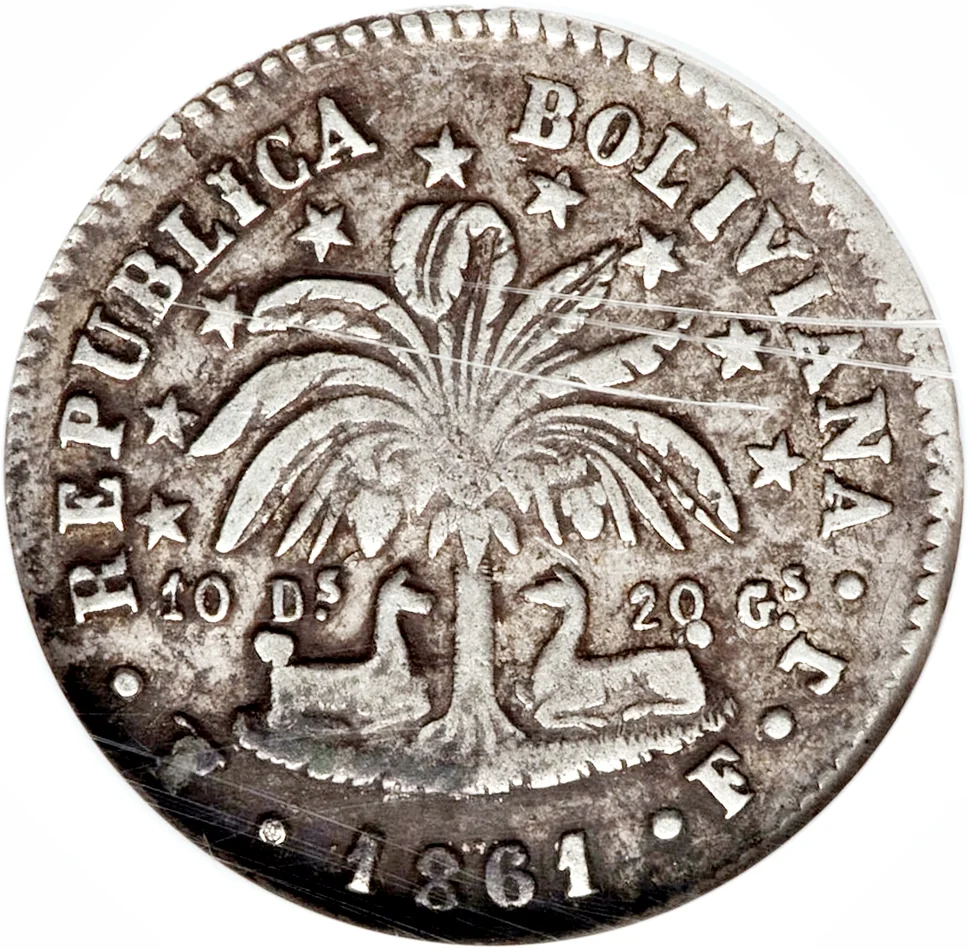
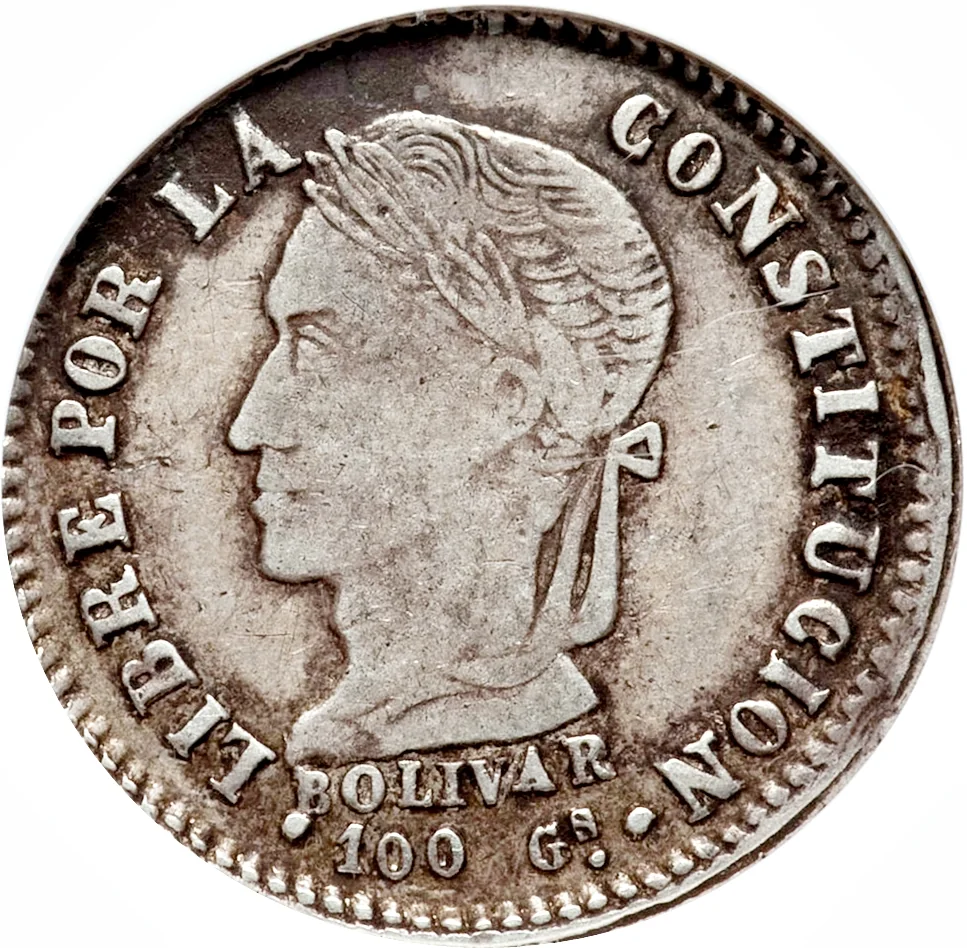

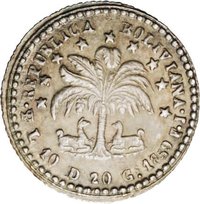
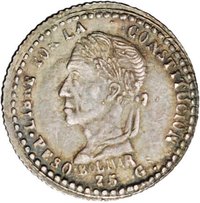
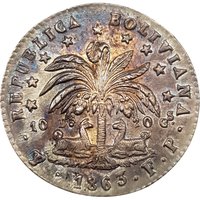
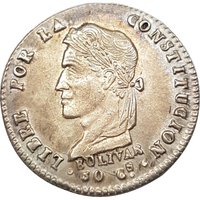
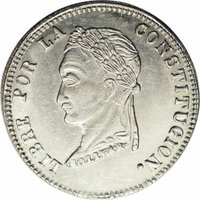
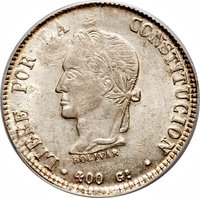
Obverse
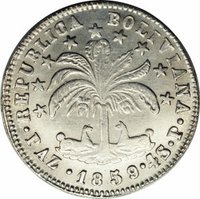
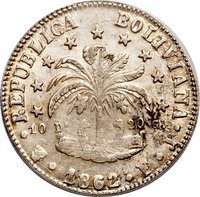
Reverse
Edge
Categories
| Symbol> Wreath |
| Animal> Camel |
| Person> Military leader |
| Person> Politician |
| Plant> Tree |
Mints
| Name | Mark |
|---|---|
| Potosi | — |
Mintings
| Year | Mint Mark | Mintage | Quality | Collection |
|---|---|---|---|---|
| 1859 | PTS | — | ||
| 1860 | PTS | — | ||
| 1861 | PTS | — | ||
| 1862 | PTS | — | ||
| 1863 | PTS | — |
Historical background
In 1859, Bolivia’s currency situation was characterized by profound instability and scarcity, a direct legacy of the economic devastation following the War of the Confederation (1836-39) and the ongoing political turbulence of the mid-19th century. The national treasury was chronically empty, and the country lacked a unified, trusted monetary system. While the Bolivian peso was the official unit of account, its value and physical availability were highly erratic. The economy relied heavily on a chaotic mix of foreign coins—primarily Peruvian and Chilean silver pesos, and even older Spanish colonial coins—that circulated alongside limited and often debased domestic issues, leading to confusion in commerce and hindering economic development.
This monetary fragmentation was exacerbated by the government's fiscal desperation. Facing immense debt and minimal revenue from its primary export, silver mining, which was still recovering from earlier decline, successive administrations resorted to short-term solutions. These included issuing low-quality subsidiary coinage (moneda feble) and experimenting with paper money, which the public deeply distrusted due to a history of depreciation. The lack of a strong central bank or minting authority meant there was no institution to guarantee value or regulate supply, leaving the monetary landscape at the mercy of market forces and regional variations.
Consequently, the currency situation of 1859 reflected a young republic struggling with foundational state-building. The inability to provide a stable medium of exchange was both a symptom and a cause of broader economic weakness, constraining internal trade and complicating fiscal policy. This instability would persist until later in the century, when increased silver mining revenue and more centralized political control eventually allowed for a more standardized and reliable monetary system to take hold.
This monetary fragmentation was exacerbated by the government's fiscal desperation. Facing immense debt and minimal revenue from its primary export, silver mining, which was still recovering from earlier decline, successive administrations resorted to short-term solutions. These included issuing low-quality subsidiary coinage (moneda feble) and experimenting with paper money, which the public deeply distrusted due to a history of depreciation. The lack of a strong central bank or minting authority meant there was no institution to guarantee value or regulate supply, leaving the monetary landscape at the mercy of market forces and regional variations.
Consequently, the currency situation of 1859 reflected a young republic struggling with foundational state-building. The inability to provide a stable medium of exchange was both a symptom and a cause of broader economic weakness, constraining internal trade and complicating fiscal policy. This instability would persist until later in the century, when increased silver mining revenue and more centralized political control eventually allowed for a more standardized and reliable monetary system to take hold.
Series: 1859 Bolivia circulation coins

⭐ Rare