

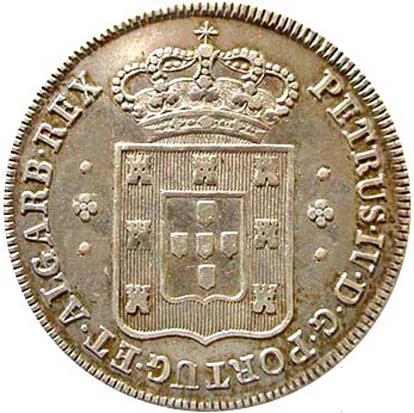
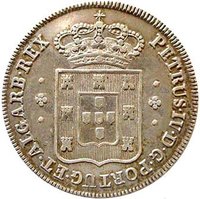
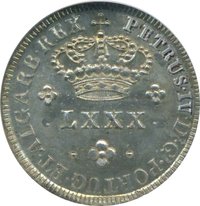
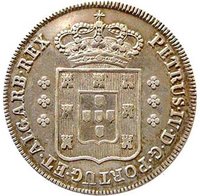
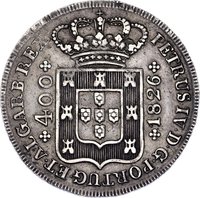
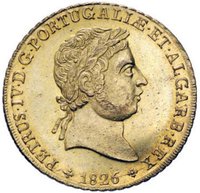
Obverse
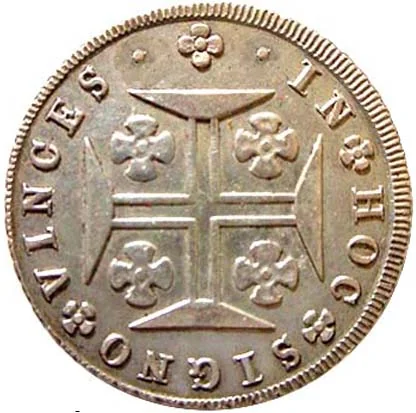
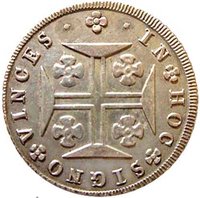
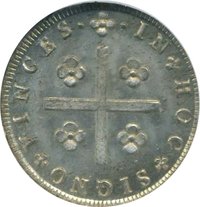
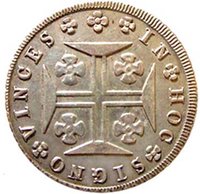
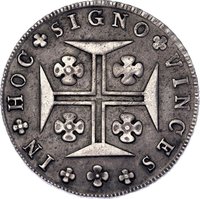
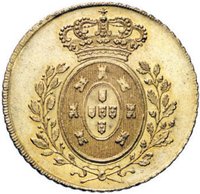
Reverse
Edge
Rope shaped
Mints
| Name | Mark |
|---|---|
| Imprensa Nacional - Casa da Moeda | — |
Mintings
| Year | Mint Mark | Mintage | Quality | Collection |
|---|---|---|---|---|
| 1826 | — | 9,953 |
Historical background
In 1826, Portugal's currency situation was deeply unstable and reflected the nation's profound political and economic turmoil. The country was embroiled in the Liberal Wars (1828-1834), a civil war between the liberal constitutionalists, led by Pedro IV (Emperor Pedro I of Brazil), and the absolutist forces of his brother, Miguel. This conflict followed the death of King João VI earlier in the year, which triggered a succession crisis. The political chaos disrupted trade, crippled tax collection, and led to massive war expenditures, placing immense strain on the state treasury and the monetary system.
The circulating medium was a chaotic mix of officially minted coinage and a proliferation of privately issued tokens. The standard unit was the Portuguese real (plural: réis), but the state's ability to mint sufficient high-quality coinage was severely hampered. Consequently, a wide variety of low-quality copper and bronze coins, along with emergency private tokens issued by merchants, municipalities, and even military authorities, filled the void to facilitate everyday transactions. Furthermore, foreign coins, particularly British gold and Spanish silver, circulated widely, their value fluctuating based on metallic content and market confidence, leading to a complex and unreliable system of exchange.
This monetary fragmentation exacerbated severe inflation and a loss of public confidence. The government, desperate for funds, resorted to debasing coinage and printing paper money without sufficient backing, which further devalued the currency. The result was a period of significant economic hardship for the populace, with prices rising sharply and the value of savings eroding. The currency situation in 1826 was therefore not merely a financial issue but a direct symptom of a fractured state, with monetary stability impossible to achieve until the political conflict was resolved.
The circulating medium was a chaotic mix of officially minted coinage and a proliferation of privately issued tokens. The standard unit was the Portuguese real (plural: réis), but the state's ability to mint sufficient high-quality coinage was severely hampered. Consequently, a wide variety of low-quality copper and bronze coins, along with emergency private tokens issued by merchants, municipalities, and even military authorities, filled the void to facilitate everyday transactions. Furthermore, foreign coins, particularly British gold and Spanish silver, circulated widely, their value fluctuating based on metallic content and market confidence, leading to a complex and unreliable system of exchange.
This monetary fragmentation exacerbated severe inflation and a loss of public confidence. The government, desperate for funds, resorted to debasing coinage and printing paper money without sufficient backing, which further devalued the currency. The result was a period of significant economic hardship for the populace, with prices rising sharply and the value of savings eroding. The currency situation in 1826 was therefore not merely a financial issue but a direct symptom of a fractured state, with monetary stability impossible to achieve until the political conflict was resolved.
Series: 1826 Portugal circulation coins
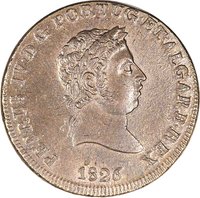
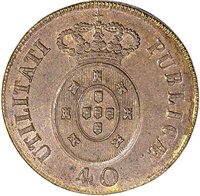
✨ Legendary