

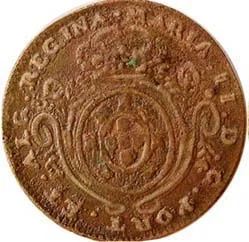
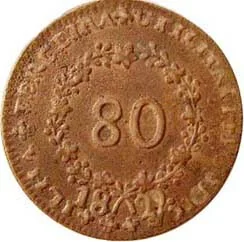
80 réis – Azores
Add to wishlist
Portugal
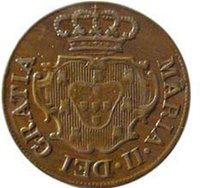
Obverse
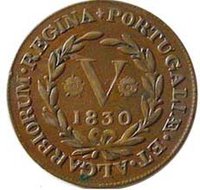
Reverse
Edge
Plain
Categories
| Symbols> Coat of Arms |
Mints
| Name | Mark |
|---|---|
| Angra | — |
Mintings
| Year | Mint Mark | Mintage | Quality | Collection |
|---|---|---|---|---|
| 1829 | — | — |
Historical background
In 1829, the Azores found itself in a complex monetary situation, caught between the legacy of the Portuguese Empire and the turmoil of the Liberal Wars (1828-1834). The archipelago was a stronghold for the Liberal forces supporting Queen Maria II and the constitutional monarchy, in opposition to the absolutist rule of Dom Miguel, who controlled the mainland. This political divide had direct economic consequences, as the Miguelist regime in Lisbon sought to blockade and isolate the Azores, disrupting normal trade and the flow of official currency from the mainland.
The scarcity of official Portuguese coinage led to a severe shortage of circulating medium on the islands. To facilitate daily commerce, local authorities and merchants resorted to the widespread use of foreign coins, primarily Spanish and Brazilian, which entered through trade. More notably, there was an increased reliance on moeda de conto—a system of accounting based on the old Portuguese real where transactions were often recorded as credit in ledgers due to the physical absence of coins. This created a fragile economy dependent on trust and local networks, with barter also playing a significant role in internal trade.
Ultimately, the currency chaos of 1829 was a symptom of the Azores' precarious position as a Liberal enclave. The situation would only begin to stabilize after 1831, with the arrival of a major Liberal expeditionary force that used the islands as a base. This military presence injected some liquidity, but a definitive solution to the monetary disorder had to await the eventual Liberal victory in the civil war and the subsequent centralization efforts of the Portuguese state in the 1830s, which aimed to standardize currency circulation across the reunited kingdom.
The scarcity of official Portuguese coinage led to a severe shortage of circulating medium on the islands. To facilitate daily commerce, local authorities and merchants resorted to the widespread use of foreign coins, primarily Spanish and Brazilian, which entered through trade. More notably, there was an increased reliance on moeda de conto—a system of accounting based on the old Portuguese real where transactions were often recorded as credit in ledgers due to the physical absence of coins. This created a fragile economy dependent on trust and local networks, with barter also playing a significant role in internal trade.
Ultimately, the currency chaos of 1829 was a symptom of the Azores' precarious position as a Liberal enclave. The situation would only begin to stabilize after 1831, with the arrival of a major Liberal expeditionary force that used the islands as a base. This military presence injected some liquidity, but a definitive solution to the monetary disorder had to await the eventual Liberal victory in the civil war and the subsequent centralization efforts of the Portuguese state in the 1830s, which aimed to standardize currency circulation across the reunited kingdom.
💎 Very Rare