

2 Shillings – Ireland
Ireland
Context
Material
Diameter: 28.6 mm
Weight: 11.3 g
Thickness: 2.28 mm
Shape: Round
Composition: Copper-nickel
Technique: Milled
Alignment: Medal alignment
flip
References
KM: #Click to copy to clipboard15a
Numista: #1401
Obverse
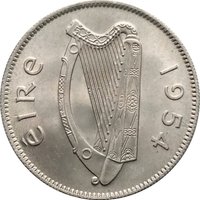
Description:
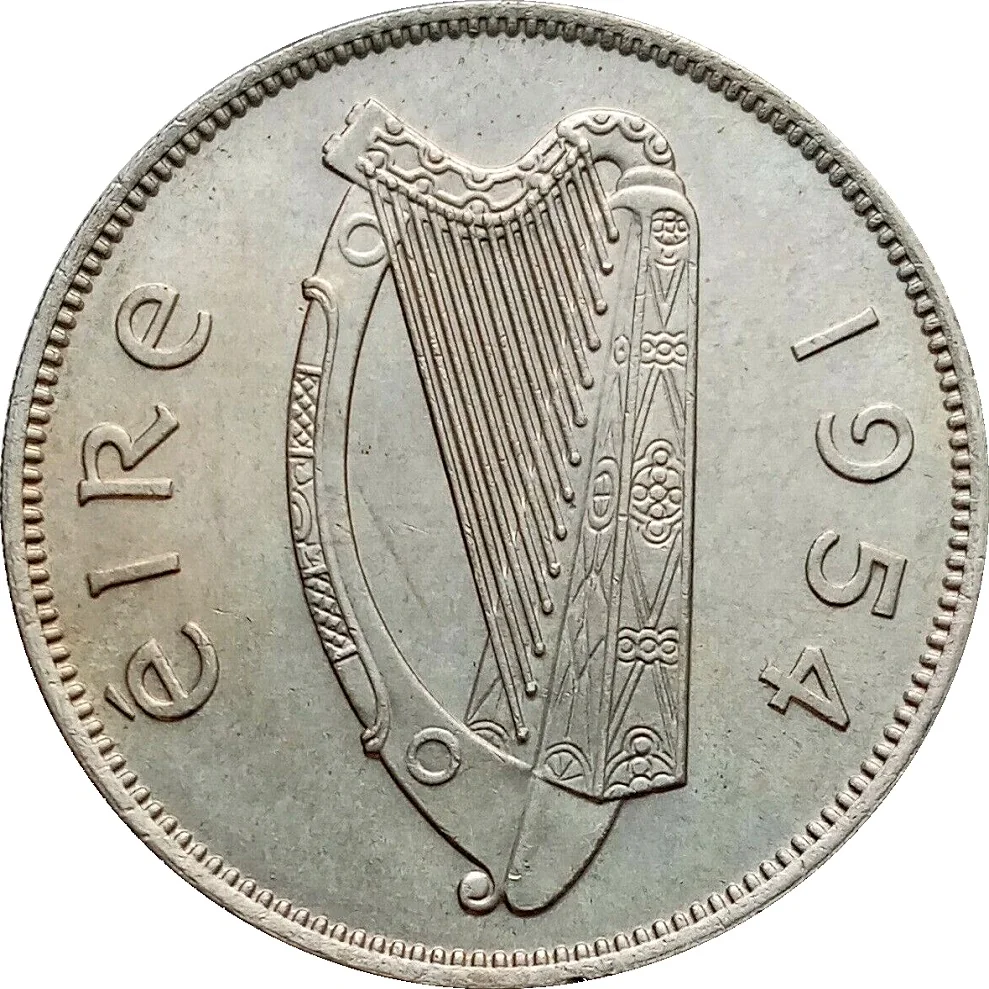
Irish harp, country name left, date right.
Inscription:
éIRe 1955
Translation:
Ireland 1955
Script: Latin (Gaelic)
Reverse
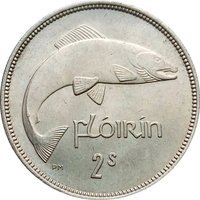
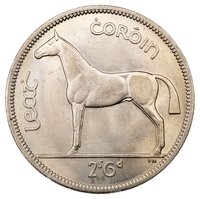
Description:
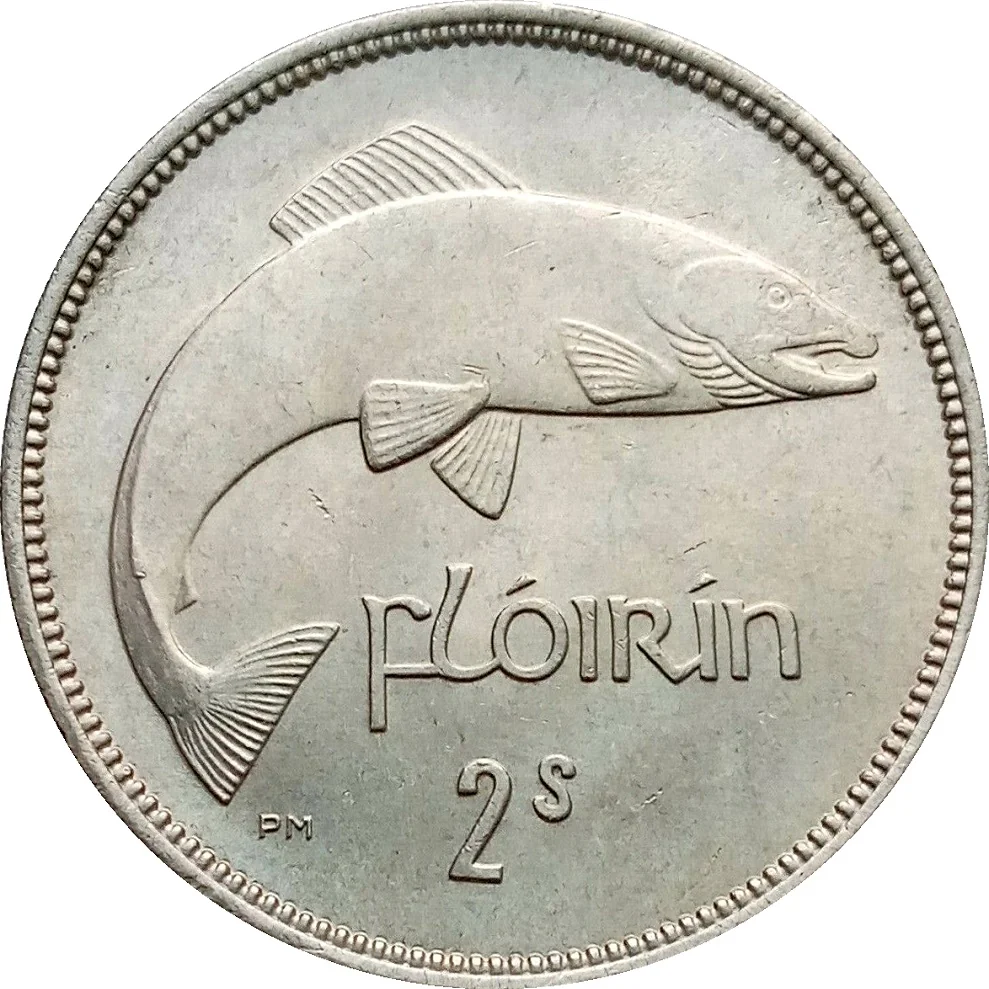
Salmon value (right).
Inscription:
flóirín
2s
PM
2s
PM
Translation:
flóirín
2 shilling
P.M.
2 shilling
P.M.
Script: Latin (Gaelic)
Engraver: Percy Metcalfe
Edge
Reeded
Mints
| Name | Mark |
|---|---|
| Royal Mint (Tower Hill) | — |
Mintings
| Year | Mint Mark | Mintage | Quality | Collection |
|---|---|---|---|---|
| 1951 | — | — | Proof | |
| 1951 | — | 1,000,000 | ||
| 1954 | — | 1,000,000 | ||
| 1954 | — | — | Proof | |
| 1955 | — | 1,000,000 | ||
| 1955 | — | — | Proof | |
| 1959 | — | 2,000,000 | ||
| 1959 | — | — | Proof | |
| 1961 | — | 2,000,000 | ||
| 1961 | — | — | Proof | |
| 1962 | — | — | Proof | |
| 1962 | — | 2,400,000 | ||
| 1963 | — | 3,000,000 | ||
| 1963 | — | — | Proof | |
| 1964 | — | 4,000,000 | ||
| 1965 | — | 2,000,000 | ||
| 1966 | — | 3,625,000 | ||
| 1968 | — | 1,000,000 |
Historical background
In 1951, Ireland's currency situation was defined by its continued membership in the Sterling Area, a legacy of its economic ties to the United Kingdom. The Irish pound (or punt) was not an independent floating currency but was pegged at par with the British pound sterling. This meant the Central Bank of Ireland held its external reserves predominantly in sterling, and there was free convertibility and movement of capital between the two jurisdictions. This arrangement provided stability for trade, as Britain remained Ireland's dominant export market, but it also meant Irish monetary policy was largely dictated by the needs of the British economy.
The year fell within a period of significant economic difficulty, marked by the aftermath of the 1949 devaluation of sterling. While that devaluation had provided a short-term boost to Irish exports, by 1951 the global inflationary pressures of the Korean War boom were causing severe strain. The cost of imported goods, particularly essential items like food and fuel, rose sharply, leading to a substantial trade deficit and a drain on the country's sterling reserves. This external imbalance was a primary concern for the government, highlighting the vulnerability of being tied to sterling during a time of international economic volatility.
Domestically, the Fianna Fáil government, returned to power in 1951, faced the challenge of managing this crisis without the tools of an independent exchange rate. Policy responses were therefore constrained to fiscal measures and direct controls. The budget of that year introduced austerity, including increased taxes and cuts to subsidies, in an attempt to curb domestic consumption and reduce the import bill. Thus, the currency regime of 1951 placed Ireland in a complex position: it enjoyed the stability of a strong anchor currency but was forced to absorb imported inflation and address balance-of-payments problems through politically difficult internal adjustments rather than monetary instruments.
The year fell within a period of significant economic difficulty, marked by the aftermath of the 1949 devaluation of sterling. While that devaluation had provided a short-term boost to Irish exports, by 1951 the global inflationary pressures of the Korean War boom were causing severe strain. The cost of imported goods, particularly essential items like food and fuel, rose sharply, leading to a substantial trade deficit and a drain on the country's sterling reserves. This external imbalance was a primary concern for the government, highlighting the vulnerability of being tied to sterling during a time of international economic volatility.
Domestically, the Fianna Fáil government, returned to power in 1951, faced the challenge of managing this crisis without the tools of an independent exchange rate. Policy responses were therefore constrained to fiscal measures and direct controls. The budget of that year introduced austerity, including increased taxes and cuts to subsidies, in an attempt to curb domestic consumption and reduce the import bill. Thus, the currency regime of 1951 placed Ireland in a complex position: it enjoyed the stability of a strong anchor currency but was forced to absorb imported inflation and address balance-of-payments problems through politically difficult internal adjustments rather than monetary instruments.
🌱 Very Common