

Obverse
Description:
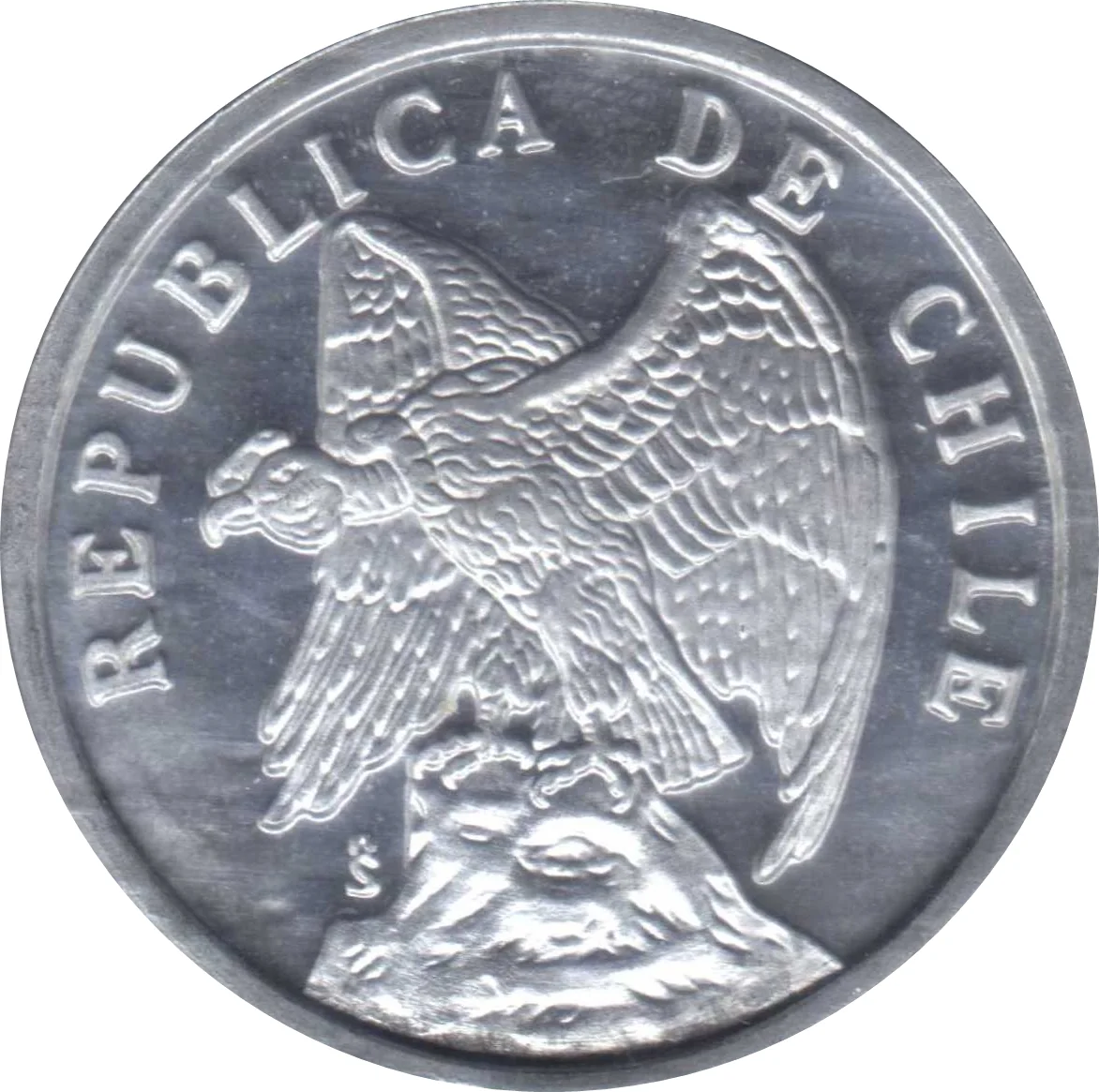
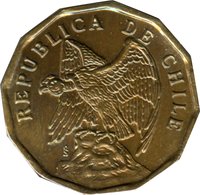
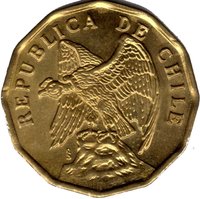
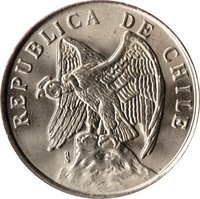
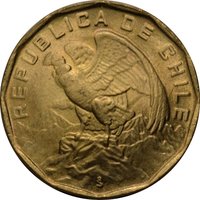
Andean Condor perched.
Inscription:
REPUBLICA DE CHILE
So
So
Translation:
REPUBLIC OF CHILE
Script: Latin
Language: Spanish
Engraver: Louis-Oscar Roty
Reverse
Edge
Plain
Mints
| Name | Mark |
|---|---|
| Casa de Moneda de Chile | (So) |
Mintings
| Year | Mint Mark | Mintage | Quality | Collection |
|---|---|---|---|---|
| 1975 | So | 2,000,000 | ||
| 1975 | So | — | Proof |
Historical background
In 1975, Chile was in the midst of a profound economic transformation under the military dictatorship of General Augusto Pinochet. The country was reeling from the economic chaos of the early 1970s, characterized by hyperinflation, price controls, and a collapsing production sector under the previous socialist government of Salvador Allende. Upon taking power in 1973, the junta initially continued interventionist policies but by 1975, under the guidance of a group of economists known as the "Chicago Boys," it embarked on a radical shift toward free-market neoliberalism. This period, often called "The Shock," involved severe austerity, deregulation, and the opening of the economy to global markets.
The currency situation was central to this crisis and reform. The Chilean peso was severely overvalued and subject to a complex system of multiple exchange rates, a legacy of the Allende years designed to control imports but which fueled a black market and drained reserves. In 1975, as part of the shock treatment, the government unified the exchange rate and implemented a massive devaluation, slashing the peso's value by over 40% against the US dollar. This painful measure aimed to correct the balance of payments deficit, boost non-traditional exports by making them cheaper abroad, and eliminate the distortions of the previous system, though it also dramatically increased the cost of imported goods and contributed to a deep recession.
The results were severe and immediate. The 1975 devaluation, combined with drastic cuts to public spending and the removal of subsidies, plunged the economy into its worst recession of the 20th century, with GDP contracting by nearly 13% and unemployment soaring. However, this harsh medicine laid the groundwork for the fixed "tablita" exchange rate system introduced later in the decade and the broader neoliberal model that would define Chile's economy. Thus, the currency situation of 1975 represents a pivotal, traumatic moment of transition from a state-controlled to a market-oriented economic system.
The currency situation was central to this crisis and reform. The Chilean peso was severely overvalued and subject to a complex system of multiple exchange rates, a legacy of the Allende years designed to control imports but which fueled a black market and drained reserves. In 1975, as part of the shock treatment, the government unified the exchange rate and implemented a massive devaluation, slashing the peso's value by over 40% against the US dollar. This painful measure aimed to correct the balance of payments deficit, boost non-traditional exports by making them cheaper abroad, and eliminate the distortions of the previous system, though it also dramatically increased the cost of imported goods and contributed to a deep recession.
The results were severe and immediate. The 1975 devaluation, combined with drastic cuts to public spending and the removal of subsidies, plunged the economy into its worst recession of the 20th century, with GDP contracting by nearly 13% and unemployment soaring. However, this harsh medicine laid the groundwork for the fixed "tablita" exchange rate system introduced later in the decade and the broader neoliberal model that would define Chile's economy. Thus, the currency situation of 1975 represents a pivotal, traumatic moment of transition from a state-controlled to a market-oriented economic system.
Series: 1975 Chile circulation coins
🌱 Common