

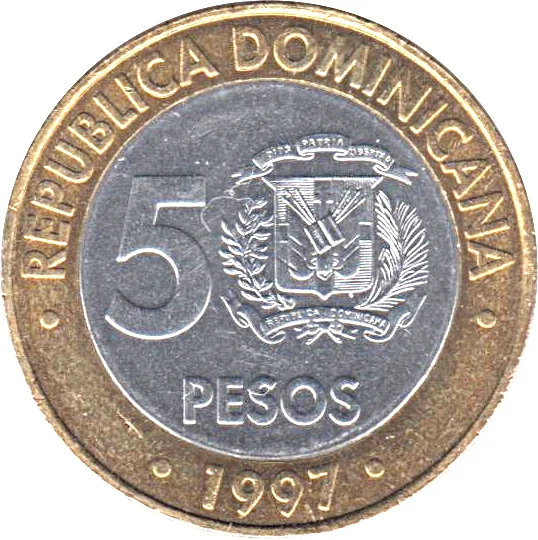
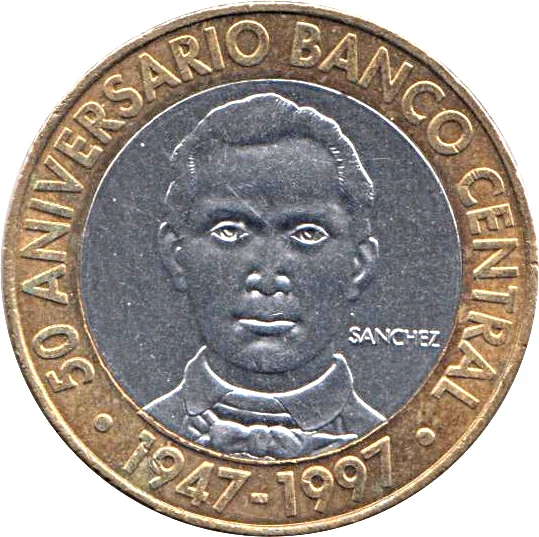
5 pesos (Central Bank) – Dominican Republic
Add to wishlist
Circulating commemorative coins
Commemoration: 50th Anniversary of the Central Bank
Dominican Republic
Context
Material
References
KM: #
Numista: #1400
Value
Exchange value: 5 DOP
Obverse
Reverse
Edge
Segmented (5 milled, 5 smooth)
Categories
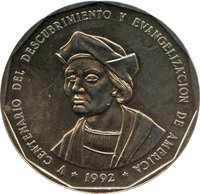
| Person> Politician |
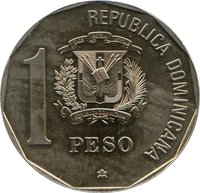
| Symbols> Coat of Arms |
Mintings
| Year | Mint Mark | Mintage | Quality | Collection |
|---|---|---|---|---|
| 1997 | — | — |
Historical background
In 1997, the Dominican Republic was operating under a managed floating exchange rate regime, a system it had adopted in the early 1990s following a period of economic instability and high inflation. The central bank, the Banco Central de la República Dominicana (BCRD), actively intervened in the foreign exchange market to smooth out excessive volatility and maintain broad stability for the Dominican peso (DOP) against the US dollar. This period was characterized by relative macroeconomic calm compared to the turbulent 1980s, with the peso experiencing a controlled and gradual depreciation. Inflation, while still a concern, had been brought down to more manageable levels, hovering around 8% annually, which helped foster a degree of confidence in the local currency.
The economy was experiencing robust growth, driven by sectors like tourism, telecommunications, and free trade zones, which generated vital foreign exchange earnings. This influx of US dollars from exports and remittances provided crucial support for the peso and allowed the BCRD to build its international reserves. The monetary policy of the time focused on maintaining this stability, using tools like open market operations to manage liquidity and influence interest rates. The exchange rate was not a primary source of economic tension in 1997, as the country was not facing a balance of payments crisis.
However, underlying vulnerabilities persisted. The financial system was relatively fragile, and the fiscal position of the government remained a point of watchfulness for economists. The managed float, while successful in providing short-term stability, required consistent and prudent intervention. The calm of 1997 stood in contrast to the more severe economic challenges that would emerge just a few years later, culminating in a major banking crisis in 2003-2004 that forced a shift to a pure floating exchange rate regime. Thus, 1997 represents a period of interim stability within a longer narrative of the Dominican Republic's ongoing struggle to achieve sustainable monetary and financial stability.
The economy was experiencing robust growth, driven by sectors like tourism, telecommunications, and free trade zones, which generated vital foreign exchange earnings. This influx of US dollars from exports and remittances provided crucial support for the peso and allowed the BCRD to build its international reserves. The monetary policy of the time focused on maintaining this stability, using tools like open market operations to manage liquidity and influence interest rates. The exchange rate was not a primary source of economic tension in 1997, as the country was not facing a balance of payments crisis.
However, underlying vulnerabilities persisted. The financial system was relatively fragile, and the fiscal position of the government remained a point of watchfulness for economists. The managed float, while successful in providing short-term stability, required consistent and prudent intervention. The calm of 1997 stood in contrast to the more severe economic challenges that would emerge just a few years later, culminating in a major banking crisis in 2003-2004 that forced a shift to a pure floating exchange rate regime. Thus, 1997 represents a period of interim stability within a longer narrative of the Dominican Republic's ongoing struggle to achieve sustainable monetary and financial stability.
🌱 Very Common