

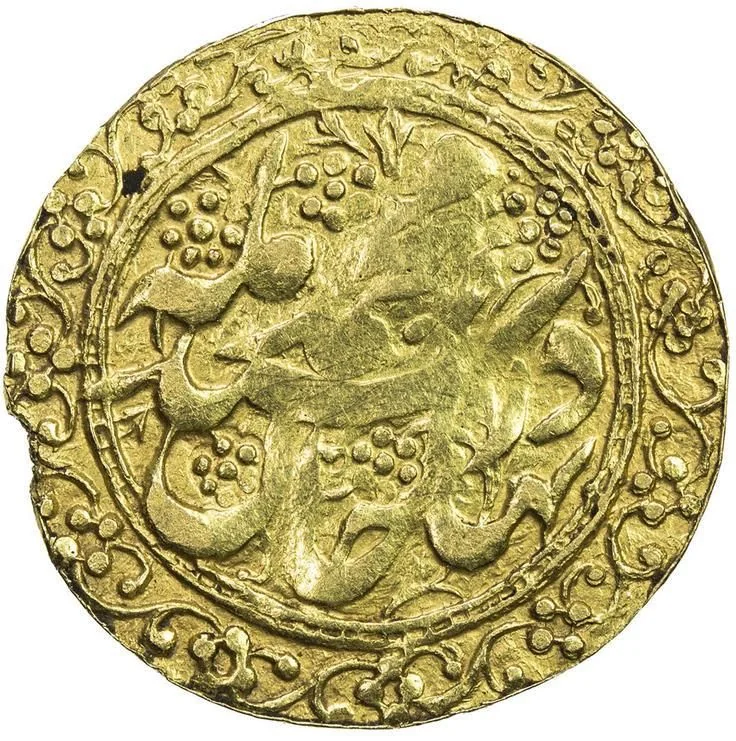
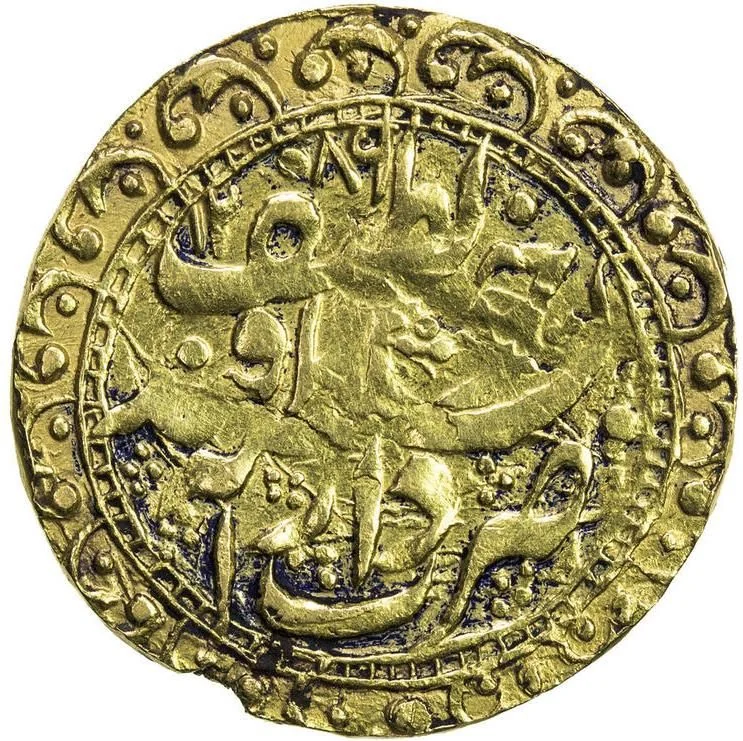
1 Tilla – Khoqand Khanate
Context
Years: 1871–1873
Country: Central Asia
Issuer: Khoqand Khanate
Currency:
(1796—1876)
Demonetized: Yes
Material
References
Numista: #352417
Value
Bullion value: $729.18
Mints
| Name | Mark |
|---|---|
| Kashgar Mint | — |
Mintings
| Year | Mint Mark | Mintage | Quality | Collection |
|---|---|---|---|---|
| 1871 | — | — | ||
| 1872 | — | — | ||
| 1873 | — | — |
Historical background
In 1871, the Khoqand Khanate was in a state of severe monetary and economic crisis, a direct symptom of its political disintegration. The Khanate, a Central Asian state situated along the Silk Road, had long seen its currency debased by successive rulers to finance military campaigns and court expenditures. By this period, following heavy defeats by the Russian Empire and the loss of key territories and revenues, the state treasury was depleted. The ruling Khan, Khudayar, faced constant internal revolts from powerful tribal leaders and religious factions, forcing him to resort to the accelerated minting of low-quality, copper-based tanga coins with minimal silver content. This led to rampant inflation and a collapse in public trust in the official currency.
The monetary landscape was consequently chaotic and fragmented. Alongside the devalued official coinage, older, purer silver tangas from earlier reigns remained in circulation but were hoarded, while barter became increasingly common in rural areas. Furthermore, a flood of foreign currencies filled the vacuum, particularly Russian rubles and gold coins (tillas), which were preferred for major transactions and trade with the advancing Russian forces. The Khanate's traditional trade routes were disrupted, and its economy, once buoyed by agriculture and commerce, was crippled by war indemnities imposed by Russia and the cost of maintaining a fragile hold on power.
This currency instability was both a cause and a consequence of the Khanate's terminal decline. The inability to manage a stable monetary system undermined Khudayar's authority, fueled social unrest, and crippled the state's capacity to function. Just five years later, in 1876, the economic collapse and political turmoil culminated in the Russian Empire's full annexation of the Khanate, ending its sovereignty. The currency crisis of 1871 thus stands as a stark indicator of a state in its final, irreversible phase of collapse.
The monetary landscape was consequently chaotic and fragmented. Alongside the devalued official coinage, older, purer silver tangas from earlier reigns remained in circulation but were hoarded, while barter became increasingly common in rural areas. Furthermore, a flood of foreign currencies filled the vacuum, particularly Russian rubles and gold coins (tillas), which were preferred for major transactions and trade with the advancing Russian forces. The Khanate's traditional trade routes were disrupted, and its economy, once buoyed by agriculture and commerce, was crippled by war indemnities imposed by Russia and the cost of maintaining a fragile hold on power.
This currency instability was both a cause and a consequence of the Khanate's terminal decline. The inability to manage a stable monetary system undermined Khudayar's authority, fueled social unrest, and crippled the state's capacity to function. Just five years later, in 1876, the economic collapse and political turmoil culminated in the Russian Empire's full annexation of the Khanate, ending its sovereignty. The currency crisis of 1871 thus stands as a stark indicator of a state in its final, irreversible phase of collapse.

✨ Legendary