

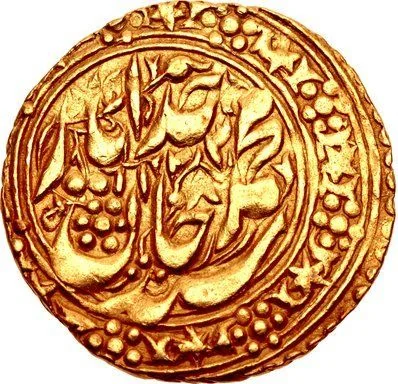
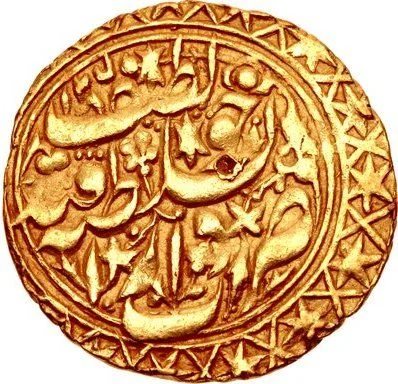
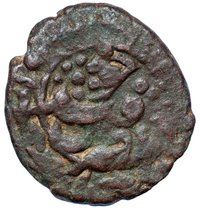
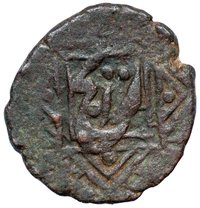
1 tilla – Khoqand Khanate
Add to wishlist
Context
Years: 1865–1872
Country: Central Asia
Issuer: Khoqand Khanate
Ruler: Muhammad Khudayar Khan
Currency:
(1796—1876)
Demonetized: Yes
Material
Diameter: 22 mm
Weight: 4.5 g
Gold Weight:: 4.50 g
Shape: Irregular round
Composition: Gold
Magnetic: No
References
Numista: #352403
Value
Bullion value: $690.85
Mints
| Name | Mark |
|---|---|
| Khoqand | — |
Mintings
| Year | Mint Mark | Mintage | Quality | Collection |
|---|---|---|---|---|
| 1865 | — | — | ||
| 1866 | — | — | ||
| 1868 | — | — | ||
| 1869 | — | — | ||
| 1871 | — | — | ||
| 1872 | — | — |
Historical background
By 1865, the currency system of the Khoqand Khanate was in a state of severe crisis, mirroring the political and military disintegration of the state itself. The Khanate, a Central Asian polity situated on the Silk Road, had historically issued its own silver tanga and copper pul coins. However, decades of internal strife, succession wars, and extravagant court expenditures had led successive khans to drastically debase the coinage. By the 1860s, the silver content of the tanga had become negligible, and the market was flooded with inferior copper coins of varying weights and alloys, often crudely struck at multiple mints with little central control.
This monetary chaos was exacerbated by intense external pressure. The Russian Empire was advancing steadily into Central Asia, and by 1865, its forces had captured the major city of Tashkent, a severe blow that stripped Khoqand of a key economic hub. The concurrent expansion of the Russian ruble into conquered territories and the circulation of more stable Bukharan and Kashgari coins along the borders further undermined confidence in Khoqand's currency. Trade, the lifeblood of the Khanate, became increasingly hampered as merchants refused the debased coins or demanded exorbitant exchange rates, leading to price inflation and economic hardship for the population.
Ultimately, the currency collapse of 1865 was a symptom of a failing state. The reign of Khudayar Khan, who oscillated between submission and rebellion against Russia, lacked the authority to implement monetary reform. As Russian troops tightened their encirclement, the Khanate's economy fractured into localized barter and the use of older, purer coins hoarded from earlier periods. The complete annexation of the Khanate by Russia in 1876 formally ended its independent currency, replacing it with the imperial Russian monetary system and closing the final chapter on Khoqand's turbulent financial history.
This monetary chaos was exacerbated by intense external pressure. The Russian Empire was advancing steadily into Central Asia, and by 1865, its forces had captured the major city of Tashkent, a severe blow that stripped Khoqand of a key economic hub. The concurrent expansion of the Russian ruble into conquered territories and the circulation of more stable Bukharan and Kashgari coins along the borders further undermined confidence in Khoqand's currency. Trade, the lifeblood of the Khanate, became increasingly hampered as merchants refused the debased coins or demanded exorbitant exchange rates, leading to price inflation and economic hardship for the population.
Ultimately, the currency collapse of 1865 was a symptom of a failing state. The reign of Khudayar Khan, who oscillated between submission and rebellion against Russia, lacked the authority to implement monetary reform. As Russian troops tightened their encirclement, the Khanate's economy fractured into localized barter and the use of older, purer coins hoarded from earlier periods. The complete annexation of the Khanate by Russia in 1876 formally ended its independent currency, replacing it with the imperial Russian monetary system and closing the final chapter on Khoqand's turbulent financial history.
✨ Legendary