

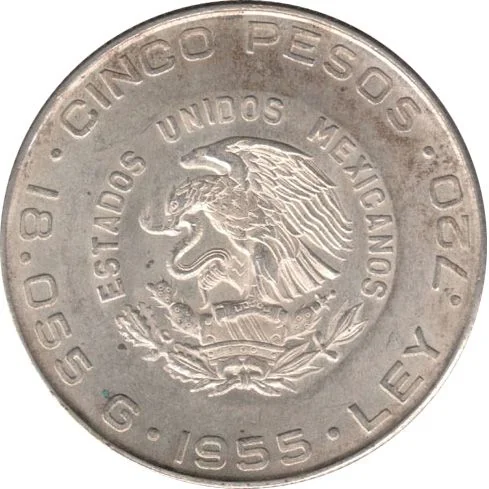
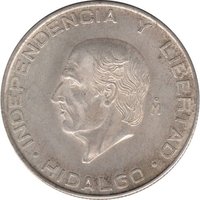
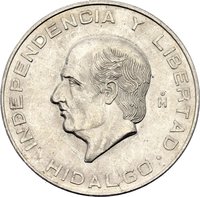
Obverse
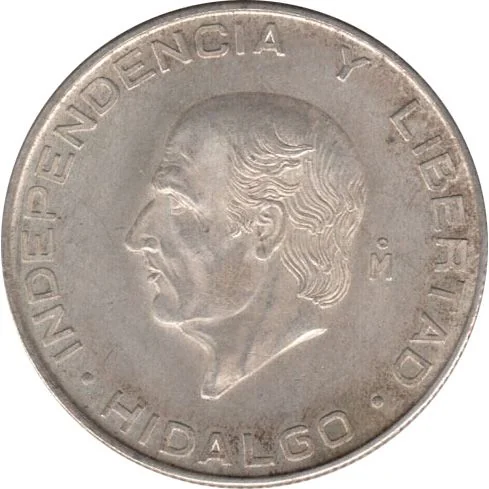
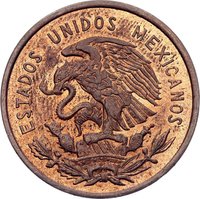
Reverse
Edge
Reeded.
Categories
| Symbols> Coat of Arms |
| Person> Religious figure |
Mints
| Name | Mark |
|---|---|
| Mexican Mint | (Mo) |
Mintings
| Year | Mint Mark | Mintage | Quality | Collection |
|---|---|---|---|---|
| 1955 | Mo | 4,271,000 | ||
| 1956 | Mo | 4,596,000 | ||
| 1957 | Mo | 3,464,000 |
Historical background
In 1955, Mexico's currency situation was defined by a period of relative stability and controlled management under the fixed exchange rate system established in 1954. Following a devaluation crisis in 1948-49 and subsequent instability, the government of President Adolfo Ruiz Cortines, in consultation with the International Monetary Fund (IMF), made a decisive move. On April 19, 1954, the peso was devalued from 8.65 to 12.50 per US dollar, a rate that would remain fixed and unchanging for the next 22 years. This "12.50 peso dollar" became a cornerstone of the country's economic policy, known as the "Desarrollo Estabilizador" (Stabilizing Development) model.
This fixed parity was not left to market forces but was rigorously defended by the Banco de México. The central bank maintained strict control over the money supply and held substantial reserves of foreign currency, primarily U.S. dollars, to guarantee the exchange rate. The policy was underpinned by a period of strong economic growth, low inflation, and increasing industrialization, which boosted exports and attracted foreign investment. The stability of the peso became a symbol of national pride and a key tool for planning, as businesses and the government could operate with certainty regarding international costs and obligations.
However, this stability came with underlying tensions and required significant discipline. To maintain the fixed rate, Mexico had to subordinate other economic objectives, such as independent monetary policy, to the goal of exchange rate stability. The system also relied heavily on consistent trade performance and foreign capital inflows. While successful in the 1950s and 1960s, these conditions would eventually strain under later pressures, setting the stage for the crises of the 1970s and 1980s. Thus, 1955 represents a calm and confident point within a longer narrative, marking the beginning of an era of predictable currency value after a period of turbulence.
This fixed parity was not left to market forces but was rigorously defended by the Banco de México. The central bank maintained strict control over the money supply and held substantial reserves of foreign currency, primarily U.S. dollars, to guarantee the exchange rate. The policy was underpinned by a period of strong economic growth, low inflation, and increasing industrialization, which boosted exports and attracted foreign investment. The stability of the peso became a symbol of national pride and a key tool for planning, as businesses and the government could operate with certainty regarding international costs and obligations.
However, this stability came with underlying tensions and required significant discipline. To maintain the fixed rate, Mexico had to subordinate other economic objectives, such as independent monetary policy, to the goal of exchange rate stability. The system also relied heavily on consistent trade performance and foreign capital inflows. While successful in the 1950s and 1960s, these conditions would eventually strain under later pressures, setting the stage for the crises of the 1970s and 1980s. Thus, 1955 represents a calm and confident point within a longer narrative, marking the beginning of an era of predictable currency value after a period of turbulence.
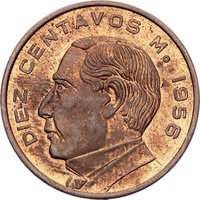
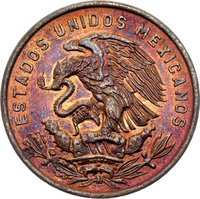
Series: 1955 Mexico circulation coins
🌱 Common