

2 Francs – New Caledonia
France
Context
Years: 1973–2020
Country: France 
Issuer: New Caledonia
Issuing organization: Overseas Institution of Issue
Period:
(since 1958)
Currency:
(since 1945)
Demonetization: 30 November 2022
Total mintage: 42,245,900
Material
References
KM: #Click to copy to clipboard14
Numista: #1398
Value
Exchange value: 2 XPF
Inflation-adjusted value: 15.08 XPF
Obverse
Description:
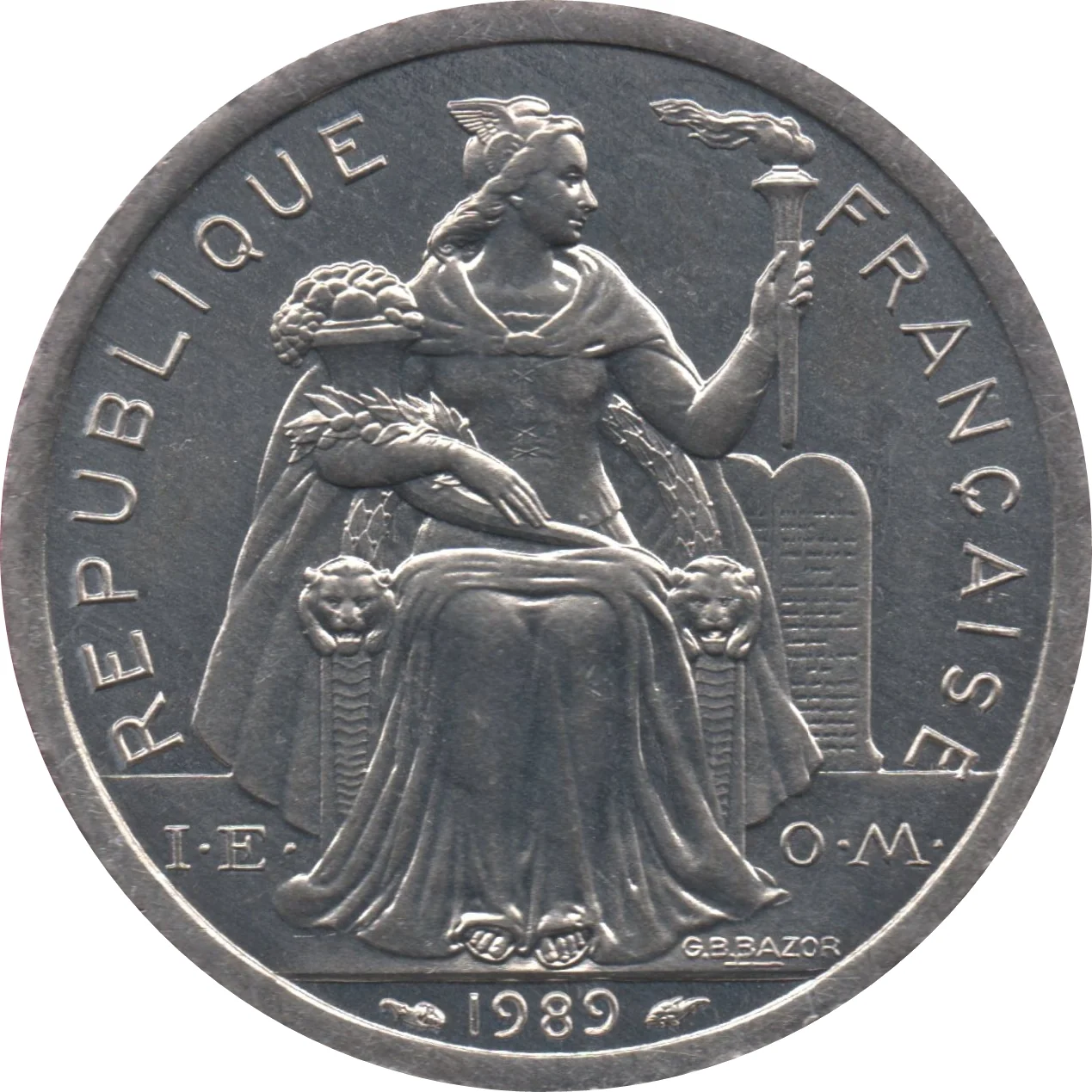
Liberty seated left on throne, holding a lit torch in her left hand and a cornucopia of fruit in her right arm.
Inscription:
REPUBLIQUE FRANÇAISE
I·E· O·M·
G.B.BAZOR
1989
I·E· O·M·
G.B.BAZOR
1989
Translation:
FRENCH REPUBLIC
JESUS, SAVIOUR OF MANKIND
G.B.BAZOR
1989
JESUS, SAVIOUR OF MANKIND
G.B.BAZOR
1989
Script: Latin
Engraver: Lucien Georges Bazor
Reverse
Description:
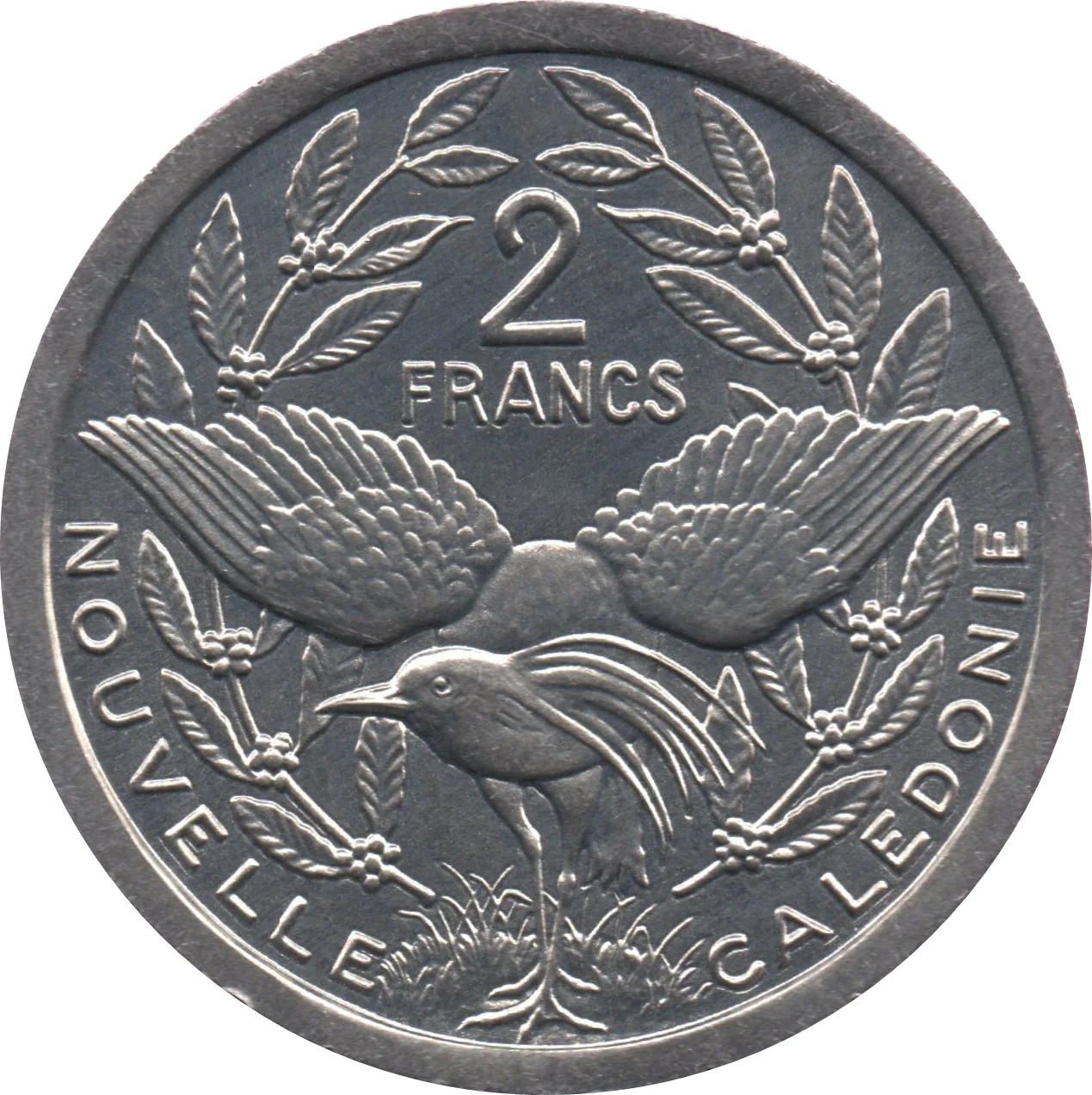
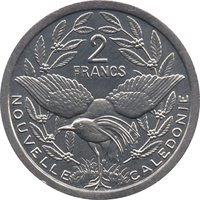
Kagu bird amid sprigs below value.
Inscription:
2
FRANCS
NOUVELLE CALEDONIE
FRANCS
NOUVELLE CALEDONIE
Script: Latin
Engraver: Lucien Georges Bazor
Edge
Plain
Mints
| Name | Mark |
|---|---|
| Monnaie de Paris | — |
Mintings
| Year | Mint Mark | Mintage | Quality | Collection |
|---|---|---|---|---|
| 1973 | — | 400,000 | ||
| 1977 | — | 1,500,000 | ||
| 1982 | — | 1,000,200 | ||
| 1983 | — | 2,000,200 | ||
| 1987 | — | 2,000,000 | ||
| 1989 | — | 1,200,000 | ||
| 1990 | — | 1,500,000 | ||
| 1991 | — | 1,500,000 | ||
| 1995 | — | 400,000 | ||
| 1996 | — | 900,000 | ||
| 1997 | — | 400,000 | ||
| 1998 | — | 400,000 | ||
| 1999 | — | 800,000 | ||
| 2000 | — | 700,000 | ||
| 2001 | — | 800,000 | ||
| 2002 | — | 1,200,000 | ||
| 2003 | — | 2,400,000 | ||
| 2004 | — | 2,000,000 | ||
| 2005 | — | 532,000 | ||
| 2006 | — | 1,200,000 | ||
| 2007 | — | 600,000 | ||
| 2008 | — | 2,400,000 | ||
| 2009 | — | 2,520,000 | ||
| 2011 | — | 1,098,000 | ||
| 2012 | — | 1,943,500 | ||
| 2013 | — | 884,000 | ||
| 2014 | — | 1,768,000 | ||
| 2015 | — | 2,444,000 | ||
| 2016 | — | 1,560,000 | ||
| 2017 | — | 1,040,000 | ||
| 2018 | — | 3,156,000 | ||
| 2019 | — | — | ||
| 2020 | — | — |
Historical background
In 1973, New Caledonia remained under French colonial administration, and its currency situation was a direct reflection of this political status. The sole legal tender was the CFP franc (Franc des Colonies Françaises du Pacifique), a currency created in 1945 and guaranteed by the French Treasury. This arrangement firmly anchored New Caledonia's economy to that of metropolitan France, with the CFP franc's value pegged first to the French franc and, following the Bretton Woods system's collapse, to a fixed exchange rate. This provided monetary stability and facilitated trade with France, but it also meant the territory had no independent monetary policy, with its economic health heavily dependent on decisions made in Paris.
The early 1970s were a period of significant economic transition for the territory, driven by a nickel boom. Major investments in mining and metallurgy, particularly the opening of the large-scale smelter in Nouméa, spurred rapid growth and immigration. This boom intensified the demand for capital and integrated the territory more deeply into global commodity markets. However, the fixed currency regime meant that the inflationary pressures and economic distortions caused by this sudden influx of wealth were managed through a Paris-centric framework, with local authorities having little direct control over monetary levers.
Politically, 1973 fell within a decade of rising Kanak nationalism and calls for independence, which would culminate later in the 1970s and 1980s. While the currency itself was not yet a central point of political contention, the CFP franc was a tangible symbol of continued French sovereignty and economic control. The monetary system's structure underscored the core dependency of the colonial relationship, a fact increasingly scrutinized by pro-independence voices who would later question the economic and political costs of an arrangement that prioritized stability and integration with France over potential monetary autonomy.
The early 1970s were a period of significant economic transition for the territory, driven by a nickel boom. Major investments in mining and metallurgy, particularly the opening of the large-scale smelter in Nouméa, spurred rapid growth and immigration. This boom intensified the demand for capital and integrated the territory more deeply into global commodity markets. However, the fixed currency regime meant that the inflationary pressures and economic distortions caused by this sudden influx of wealth were managed through a Paris-centric framework, with local authorities having little direct control over monetary levers.
Politically, 1973 fell within a decade of rising Kanak nationalism and calls for independence, which would culminate later in the 1970s and 1980s. While the currency itself was not yet a central point of political contention, the CFP franc was a tangible symbol of continued French sovereignty and economic control. The monetary system's structure underscored the core dependency of the colonial relationship, a fact increasingly scrutinized by pro-independence voices who would later question the economic and political costs of an arrangement that prioritized stability and integration with France over potential monetary autonomy.
🌱 Very Common