

20 euro – France
Add to wishlist
France
Context
Material
Diameter: 37 mm
Weight: 31.1 g
Silver Weight:: 31.07 g
Shape: Round
Composition: 99.9% Silver
Standard: Silver ounce
Magnetic: No
Technique: Milled
Alignment: Medal alignment
flip
References
KM: #
Numista: #351322
Value
Exchange value: 20 EUR
Bullion value: $79.39
Inflation-adjusted value: 23.13 EUR
Obverse
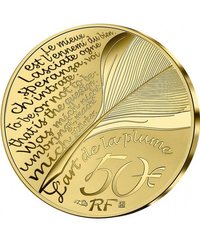
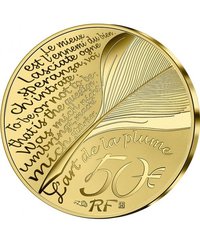
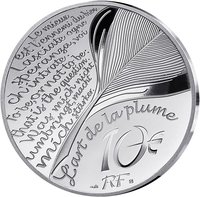
Description:
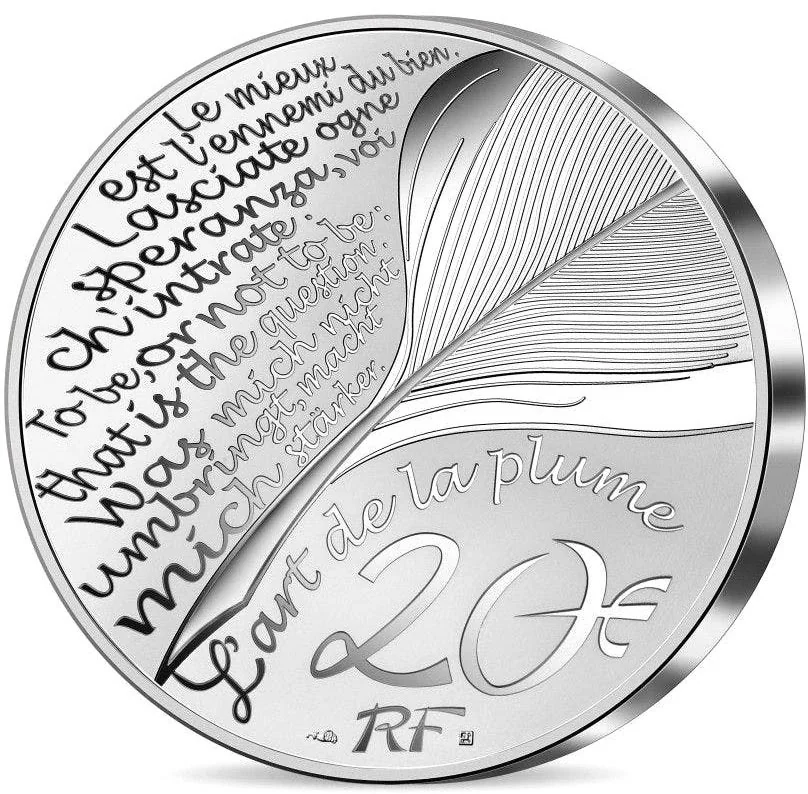
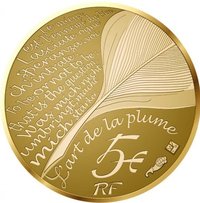
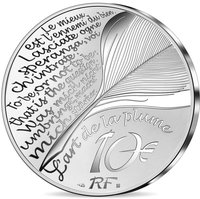
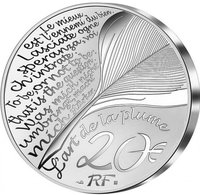
Feather, face value, and emblematic quotations from Voltaire, Dante, Shakespeare, and Nietzsche.
Inscription:
Le mieux est l’ennemi du bien
Lasciate ogne speranza voi ch’intrate
To be or not to be: that is the question
Was mich nicht umbringt, macht mich stärker
L'art de la plume
20 €
RF
Lasciate ogne speranza voi ch’intrate
To be or not to be: that is the question
Was mich nicht umbringt, macht mich stärker
L'art de la plume
20 €
RF
Translation:
The perfect is the enemy of the good.
Abandon all hope, ye who enter here.
To be or not to be: that is the question.
What does not kill me makes me stronger.
The art of the pen.
20 €
RF
Abandon all hope, ye who enter here.
To be or not to be: that is the question.
What does not kill me makes me stronger.
The art of the pen.
20 €
RF
Scripts: Latin, Latin (cursive)
Reverse
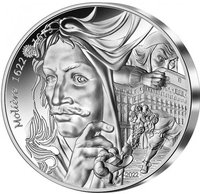
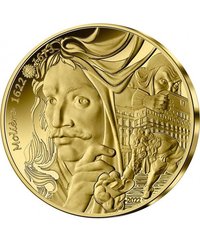
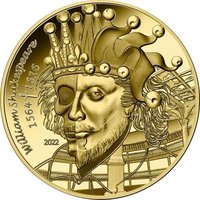
Description:
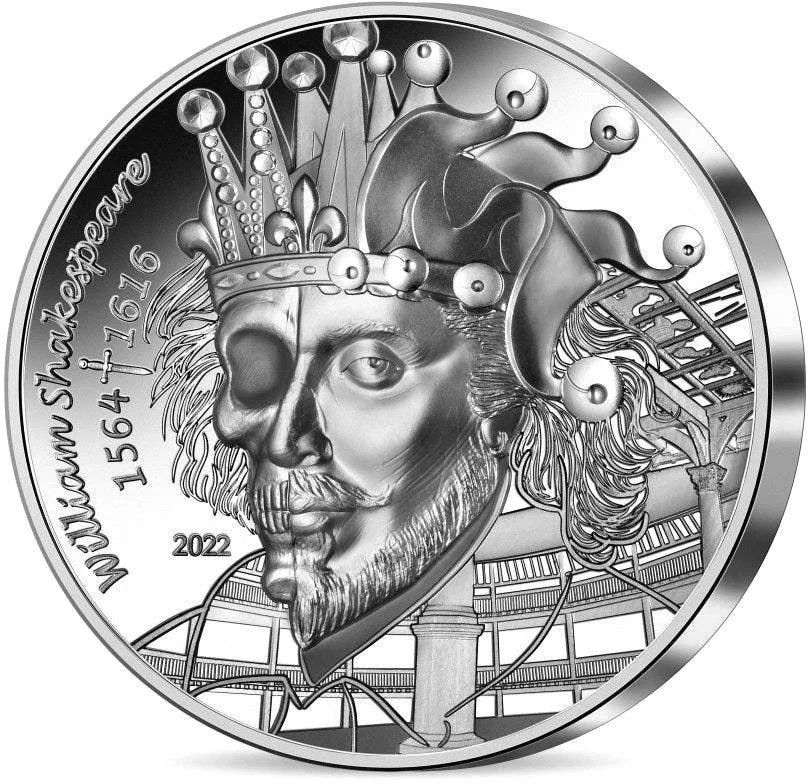
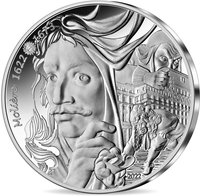
Shakespeare's face split: a fool's hat on the living side, a crowned skull on the other.
Inscription:
William Shakespeare
1564 1616
2022
1564 1616
2022
Scripts: Latin, Latin (cursive)
Edge
Plain
Categories
| Object> Firearms |
| Art> Literature |
| Art> Theatre |
| Mustache/Beard |
| Symbol> Crown |
| Person> Artist |
Mints
| Name | Mark |
|---|---|
| Monnaie de Paris | — |
Mintings
| Year | Mint Mark | Mintage | Quality | Collection |
|---|---|---|---|---|
| 2022 | — | 3,000 | Proof |
Historical background
In 2022, France, as a member of the Eurozone, continued to use the euro (€) as its sole legal tender, a currency managed by the European Central Bank (ECB). The primary monetary policy context for the year was defined by a historic shift as the ECB, after years of ultra-low interest rates and quantitative easing, began aggressively tightening monetary policy to combat surging inflation. This inflation, initially dismissed as "transitory," was driven by post-pandemic supply chain bottlenecks and, critically, the energy price shocks following Russia's invasion of Ukraine in February 2022. For French households and businesses, this meant rising borrowing costs and a focus on the ECB's balancing act between curbing price increases and avoiding a severe recession.
Domestically, the strength and stability of the euro were of paramount concern. The euro depreciated significantly against the US dollar throughout the year, briefly reaching parity—a 20-year low. This weakness, while boosting export competitiveness, further exacerbated inflation by making energy imports (denominated in dollars) more expensive. The French government, under President Emmanuel Macron, responded to the cost-of-living crisis with substantial fiscal measures, including state-mandated caps on gas and electricity price increases, fuel subsidies, and targeted welfare payments. This created a policy tension: the ECB was trying to cool the economy with higher rates, while national spending was adding demand-side pressure.
The currency situation also had political dimensions within the European framework. France, a traditional proponent of deeper Eurozone integration, maintained its advocacy for a "genuine Economic and Monetary Union" with common fiscal capacities, a stance that gained renewed relevance as the bloc faced a symmetric shock. Furthermore, the digital euro project, an initiative for a central bank digital currency (CBDC), remained in its investigation phase, with the Banque de France actively participating in experiments. Overall, France's currency situation in 2022 was one of navigating imported inflation and a weakening euro, managed through a complex interplay of ECB policy and national fiscal shields, all set against a backdrop of geopolitical turmoil and ongoing debates about the future of European monetary architecture.
Domestically, the strength and stability of the euro were of paramount concern. The euro depreciated significantly against the US dollar throughout the year, briefly reaching parity—a 20-year low. This weakness, while boosting export competitiveness, further exacerbated inflation by making energy imports (denominated in dollars) more expensive. The French government, under President Emmanuel Macron, responded to the cost-of-living crisis with substantial fiscal measures, including state-mandated caps on gas and electricity price increases, fuel subsidies, and targeted welfare payments. This created a policy tension: the ECB was trying to cool the economy with higher rates, while national spending was adding demand-side pressure.
The currency situation also had political dimensions within the European framework. France, a traditional proponent of deeper Eurozone integration, maintained its advocacy for a "genuine Economic and Monetary Union" with common fiscal capacities, a stance that gained renewed relevance as the bloc faced a symmetric shock. Furthermore, the digital euro project, an initiative for a central bank digital currency (CBDC), remained in its investigation phase, with the Banque de France actively participating in experiments. Overall, France's currency situation in 2022 was one of navigating imported inflation and a weakening euro, managed through a complex interplay of ECB policy and national fiscal shields, all set against a backdrop of geopolitical turmoil and ongoing debates about the future of European monetary architecture.
Series: L'art de la plume




💎 Extremely Rare