

500 francs cfa – Central African States
Add to wishlist
Context
Years: 1976–1984
Issuer: Central African States
Issuing organization: Bank of Central African States
Currency:
(since 1973)
Total mintage: 9,700,000
Material
References
KM: #
Numista: #3511
Value
Exchange value: 500 XAF
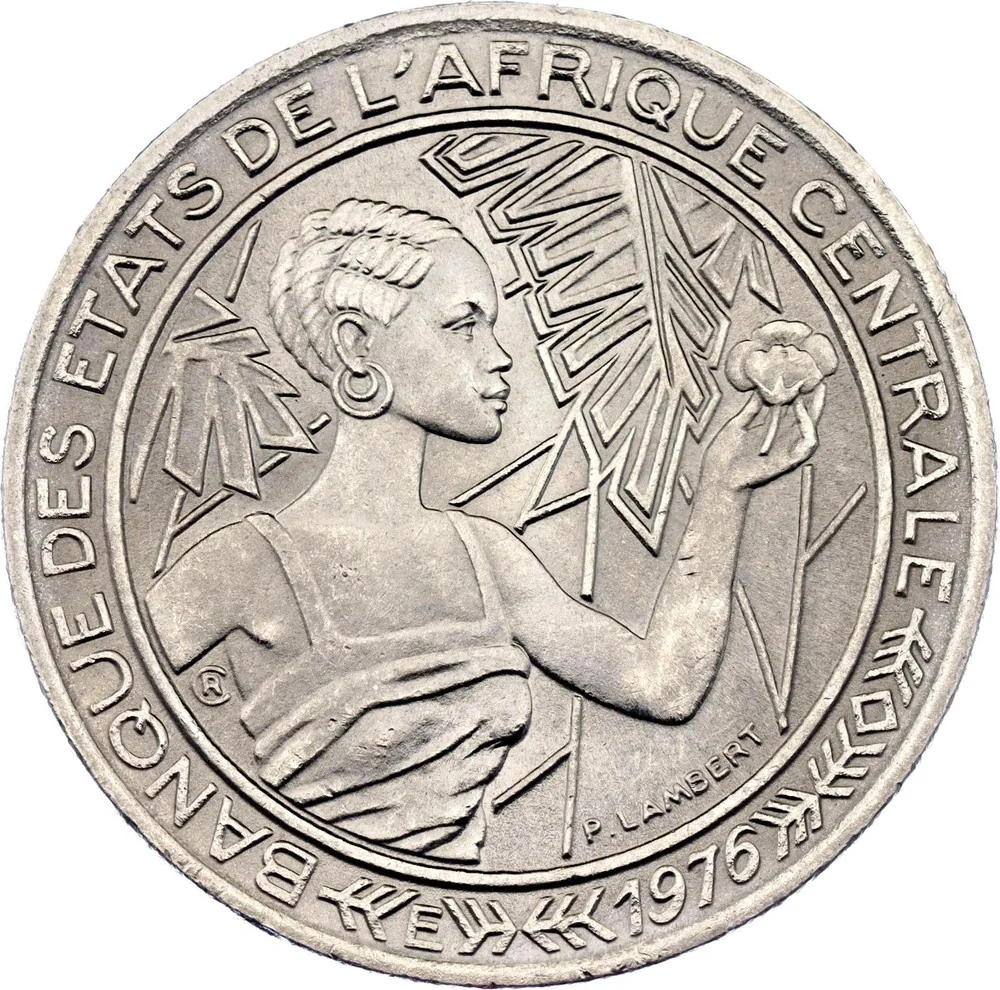
Obverse
Description:
Half-length woman in circle, date lower right.
Inscription:
BANQUE DES ÉTATS DE L'AFRIQUE CENTRALE
1976
E
1976
E
Translation:
BANK OF THE CENTRAL AFRICAN STATES
1976
1976
Script: Latin
Language: French
Engraver: Robert Cochet d'après Pierrette Lambert
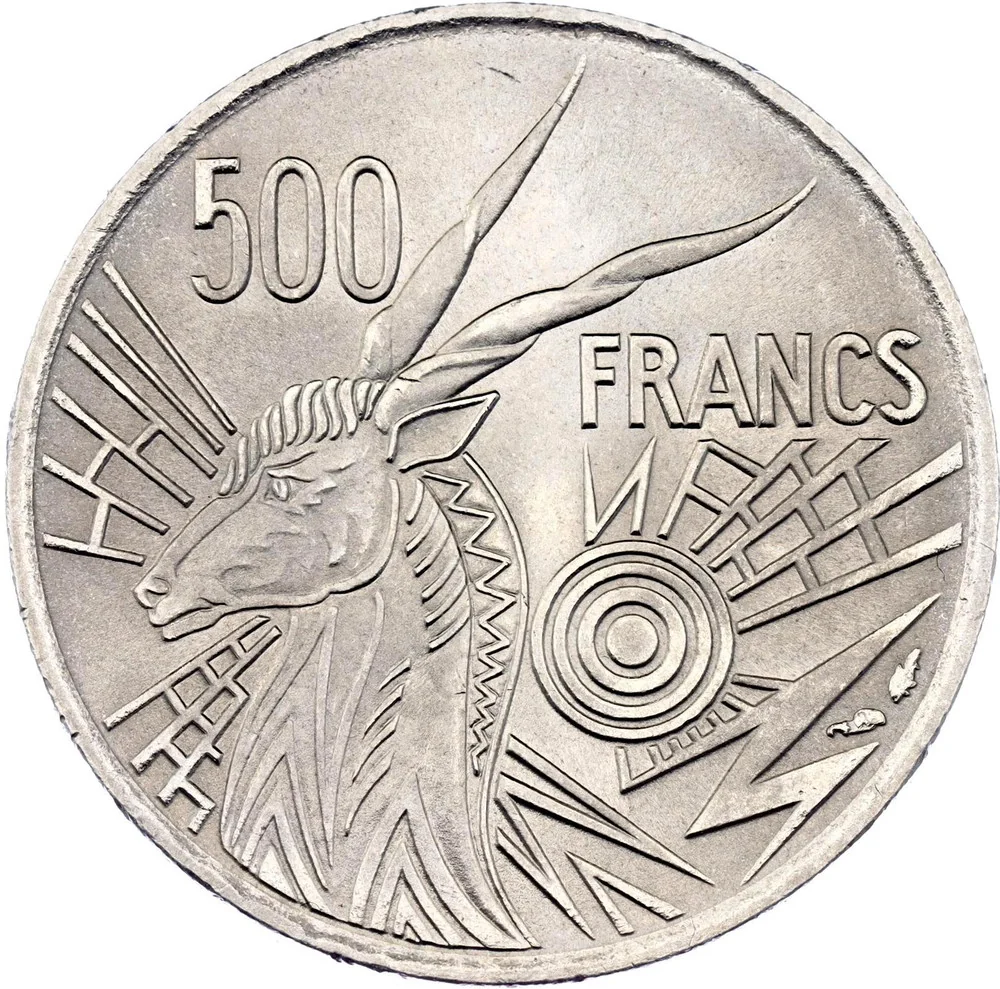
Reverse
Description:
Giant Eland.
Inscription:
500
FRANCS
FRANCS
Script: Latin
Engraver: Robert Cochet d'après Pierrette Lambert
Edge
Reeded
Mints
| Name | Mark |
|---|---|
| Monnaie de Paris | — |
Mintings
| Year | Mint Mark | Mintage | Quality | Collection |
|---|---|---|---|---|
| 1976 | A | 4,000,000 | ||
| 1976 | B | — | ||
| 1976 | C | — | ||
| 1976 | D | — | ||
| 1976 | E | — | ||
| 1977 | A | 4,000,000 | ||
| 1977 | B | — | ||
| 1977 | C | — | ||
| 1977 | D | — | ||
| 1977 | E | — | ||
| 1979 | D | — | ||
| 1979 | E | — | ||
| 1979 | B | 500,000 | ||
| 1982 | D | 200,000 | ||
| 1984 | D | 200,000 | ||
| 1984 | E | 200,000 | ||
| 1984 | B | 200,000 | ||
| 1984 | A | 200,000 | ||
| 1984 | C | 200,000 |
Historical background
In 1976, the currency situation in the Central African States was defined by the operations of the Central African Monetary Union (UMAC) and its shared currency, the CFA franc (BEAC). This franc, created in 1945 as the "Colonies Françaises d'Afrique," was by this time guaranteed by France and pegged to the French franc at a fixed rate of 1 French franc = 50 CFA francs. The monetary union, comprising Chad, the Central African Republic, Congo, Gabon, and Cameroon (with Equatorial Guinea joining later), was overseen by the Bank of Central African States (BEAC), established just four years prior in 1972. This system provided monetary stability and facilitated trade with France, but also meant member states ceded direct control over monetary policy, credit issuance, and foreign exchange reserves to the collective institution.
The year 1976 fell within a period of relative economic prosperity for the core members, driven largely by oil exports from Gabon, Congo, and Cameroon. This resource wealth, however, created underlying tensions within the union. The system's structure, where foreign reserves were pooled, led to concerns from wealthier members about effectively subsidizing the fiscal deficits of poorer partners. Furthermore, the fixed peg to the French franc, while ensuring low inflation and convertibility, was criticized for potentially overvaluing the currency, making non-oil exports less competitive and tying the region's economic fortunes closely to French monetary policy.
Politically, the arrangement was a legacy of the French colonial monetary zone and was viewed by some as a continuation of French influence in its chasse gardée (private hunting ground). While it provided crucial macroeconomic stability for the often politically volatile region, debates about sovereignty and the unequal distribution of benefits were simmering. Thus, in 1976, the currency situation was one of institutionalized stability underpinned by external guarantees, but it was also a system beginning to reveal the economic disparities and political compromises inherent in a multi-state monetary union.
The year 1976 fell within a period of relative economic prosperity for the core members, driven largely by oil exports from Gabon, Congo, and Cameroon. This resource wealth, however, created underlying tensions within the union. The system's structure, where foreign reserves were pooled, led to concerns from wealthier members about effectively subsidizing the fiscal deficits of poorer partners. Furthermore, the fixed peg to the French franc, while ensuring low inflation and convertibility, was criticized for potentially overvaluing the currency, making non-oil exports less competitive and tying the region's economic fortunes closely to French monetary policy.
Politically, the arrangement was a legacy of the French colonial monetary zone and was viewed by some as a continuation of French influence in its chasse gardée (private hunting ground). While it provided crucial macroeconomic stability for the often politically volatile region, debates about sovereignty and the unequal distribution of benefits were simmering. Thus, in 1976, the currency situation was one of institutionalized stability underpinned by external guarantees, but it was also a system beginning to reveal the economic disparities and political compromises inherent in a multi-state monetary union.
🌱 Common