


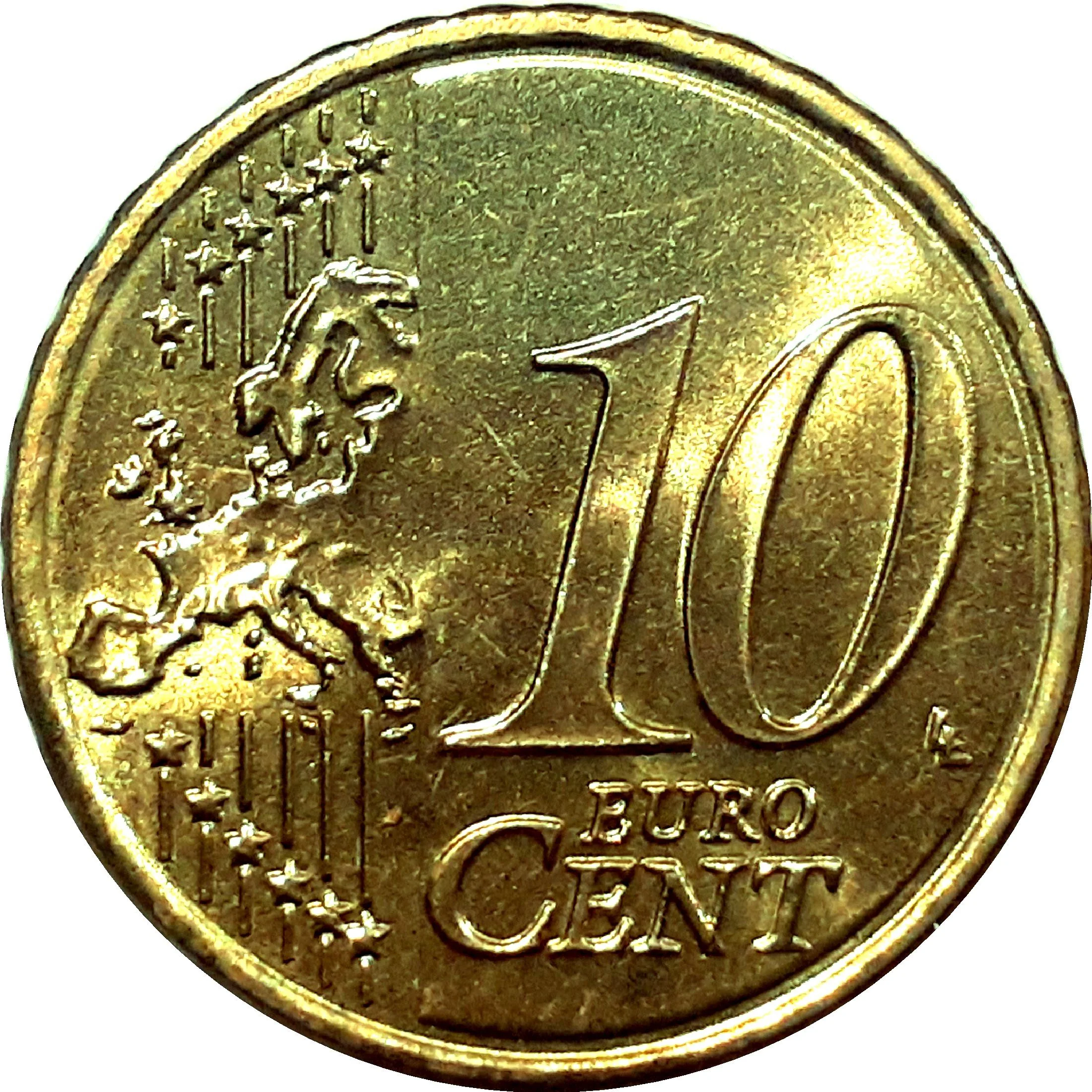
10 euro cents – France
Add to wishlist
France

Obverse
Description:
The Sower walks left amid rays and lines, encircled by the EU's 12 stars.
Inscription:
RF 2011 L. JORIO d'ap. O. ROTY
Translation:
RF 2011 L. JORIO after O. ROTY
Script: Latin
Language: French
Engraver: Laurent Jorio
Reverse
Edge
Indented
Categories
| Symbol> Phrygian cap |
| Map |
| Symbol> Allegory |
Mints
| Name | Mark |
|---|---|
| Monnaie de Paris | — |
Mintings
| Year | Mint Mark | Mintage | Quality | Collection |
|---|---|---|---|---|
| 2007 | — | 90,100,000 | ||
| 2007 | — | 60,000 | BU | |
| 2007 | — | 7,500 | Proof | |
| 2008 | — | 178,700,000 | ||
| 2008 | — | 60,000 | BU | |
| 2008 | — | 7,500 | Proof | |
| 2009 | — | 142,710,000 | ||
| 2009 | — | 7,500 | Proof | |
| 2009 | — | 52,000 | BU | |
| 2010 | — | 76,000,000 | ||
| 2010 | — | 55,500 | BU | |
| 2010 | — | 8,992 | Proof | |
| 2011 | — | 42,500 | BU | |
| 2011 | — | 9,000 | Proof | |
| 2011 | — | 100,000,000 | ||
| 2012 | — | 77,000,000 | ||
| 2012 | — | 43,000 | BU | |
| 2012 | — | 7,804 | Proof | |
| 2013 | — | 135,000,000 | ||
| 2013 | — | 28,500 | BU | |
| 2013 | — | 6,661 | Proof | |
| 2014 | — | 35,000,000 | ||
| 2014 | — | 28,500 | BU | |
| 2014 | — | 5,338 | Proof | |
| 2015 | — | 70,990,000 | ||
| 2015 | — | 28,500 | BU | |
| 2015 | — | 7,500 | Proof | |
| 2016 | — | 115,905,600 | ||
| 2016 | — | 28,500 | BU | |
| 2016 | — | 7,500 | Proof | |
| 2017 | — | 27,500 | BU | |
| 2017 | — | 7,500 | Proof | |
| 2017 | — | 90,000,000 | ||
| 2018 | — | 99,300,000 | ||
| 2018 | — | 28,500 | BU | |
| 2018 | — | 7,500 | Proof | |
| 2019 | — | 77,011,000 | ||
| 2019 | — | 16,000 | BU | |
| 2019 | — | 7,500 | Proof | |
| 2020 | — | 7,500 | Proof | |
| 2020 | — | 83,261,000 | ||
| 2020 | — | 18,500 | BU | |
| 2021 | — | 15,000 | BU | |
| 2021 | — | 7,500 | Proof | |
| 2021 | — | 80,300,000 | ||
| 2022 | — | 40,420,800 | ||
| 2022 | — | 25,000 | BU | |
| 2022 | — | 10,000 | Proof | |
| 2023 | — | — | ||
| 2023 | — | 7,500 | Proof | |
| 2023 | — | 25,000 | BU |
Historical background
In 2007, France was a core member of the Eurozone, having adopted the euro as its physical currency six years prior in 2002. The period was characterized by a degree of economic stability under the single currency, with the European Central Bank (ECB) managing monetary policy for the entire bloc. For France, this meant relinquishing control over its national interest rates and franc exchange rates, but it also provided benefits like reduced transaction costs, eliminated currency risk with major trading partners, and a symbol of deeper European integration. The euro was generally seen as a success, having firmly replaced the French franc in daily life.
However, underlying tensions were beginning to surface. The "one-size-fits-all" monetary policy of the ECB was increasingly scrutinized as not being perfectly aligned with France's specific economic conditions. The country experienced relatively sluggish growth compared to the Eurozone average, with high structural unemployment and persistent public spending deficits. Some economists and political figures began to quietly question whether the euro's stability pact constraints were hindering France's ability to stimulate its own economy, though outright calls to leave the currency were still fringe.
The global financial crisis, which began in the United States in mid-2007, would soon dramatically shift this landscape. By the end of the year, the crisis was spreading to European banks, setting the stage for the severe Eurozone sovereign debt crisis that would erupt in 2009-2010. Thus, 2007 represents the final year of relative calm for the euro before a decade of existential stress tests. France's currency situation was stable on the surface, but its economic vulnerabilities within the Eurozone framework were about to be exposed under immense pressure.
However, underlying tensions were beginning to surface. The "one-size-fits-all" monetary policy of the ECB was increasingly scrutinized as not being perfectly aligned with France's specific economic conditions. The country experienced relatively sluggish growth compared to the Eurozone average, with high structural unemployment and persistent public spending deficits. Some economists and political figures began to quietly question whether the euro's stability pact constraints were hindering France's ability to stimulate its own economy, though outright calls to leave the currency were still fringe.
The global financial crisis, which began in the United States in mid-2007, would soon dramatically shift this landscape. By the end of the year, the crisis was spreading to European banks, setting the stage for the severe Eurozone sovereign debt crisis that would erupt in 2009-2010. Thus, 2007 represents the final year of relative calm for the euro before a decade of existential stress tests. France's currency situation was stable on the surface, but its economic vulnerabilities within the Eurozone framework were about to be exposed under immense pressure.
Series: 2007 France circulation coins


🌱 Very Common