

10 centimos – Costa Rica
Add to wishlist
Costa Rica
Context
Years: 1951–1976
Issuer: Costa Rica
Issuing organization: Central Bank of Costa Rica
Period:
(since 1948)
Currency:
(since 1896)
Demonetized: Yes
Total mintage: 77,505,001
Material
References
KM: #
Numista: #3508
Value
Exchange value: 0.10 CRC
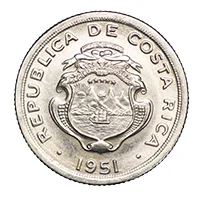
Obverse
Description:
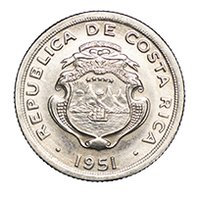
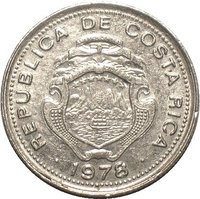
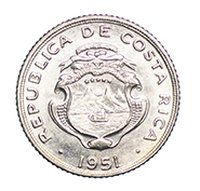
Costa Rica's coat of arms features seven stars for its provinces, three volcanoes for its mountain ranges, two ships for its position between the Atlantic and Pacific, and a rising sun.
Inscription:
REPUBLICA DE COSTA RICA
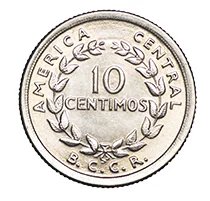
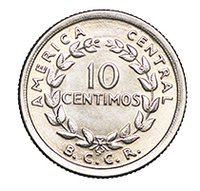
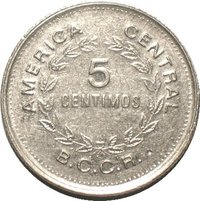
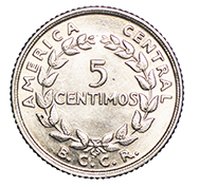
AMERICA CENTRAL
REPUBLICA DE COSTA RICA
• 1969 •
AMERICA CENTRAL
REPUBLICA DE COSTA RICA
• 1969 •
Translation:
REPUBLIC OF COSTA RICA
CENTRAL AMERICA
REPUBLIC OF COSTA RICA
• 1969 •
CENTRAL AMERICA
REPUBLIC OF COSTA RICA
• 1969 •
Script: Latin
Language: Spanish
Reverse
Edge
Milled
Categories
| Geography> Mountain |
| Symbols> Coat of Arms |
| Symbol> Wreath |
| Transportation> Watercraft |
Mints
| Name | Mark |
|---|---|
| Casa de Moneda de Guatemala | — |
| Royal Canadian Mint of Winnipeg | — |
| Sherritt Mint | — |
| United States Mint of Denver | — |
| United States Mint of Philadelphia | — |
Mintings
| Year | Mint Mark | Mintage | Quality | Collection |
|---|---|---|---|---|
| 1951 | — | 2,500,000 | ||
| 1969 | — | 10,000,000 | ||
| 1972 | — | 20,000,000 | ||
| 1975 | — | 5,000,000 | ||
| 1976 | — | 5,001 | Proof | |
| 1976 | — | 40,000,000 |
Historical background
In 1951, Costa Rica's currency situation was characterized by a managed system under the authority of the International Monetary Fund (IMF), which the country had joined just two years prior. The official currency was the Costa Rican colón, which was pegged to the U.S. dollar at a fixed rate of 5.60 colones per dollar. This peg was a cornerstone of the government's economic policy, intended to provide stability and curb the high inflation that had plagued the post-World War II period. The arrangement required disciplined fiscal and monetary policy to maintain, as the Central Bank of Costa Rica, established in 1950, was tasked with managing reserves to defend the fixed exchange rate.
However, this formal stability existed alongside significant economic pressures. The country was heavily dependent on agricultural exports, primarily coffee and bananas, making the colón vulnerable to fluctuations in global commodity prices. Furthermore, the ambitious social reforms and state-led development projects of the 1940s, following the 1948 Civil War, had created persistent fiscal deficits. These deficits were often financed by the Central Bank, creating underlying inflationary pressures that strained the fixed exchange rate system and led to periodic discussions about devaluation.
Consequently, 1951 represented a period of precarious balance. While the official colón-dollar parity held firm, the fundamental economic imbalances foreshadowed future instability. The tension between the fixed exchange rate, expansionary fiscal policies, and a vulnerable export economy would culminate in a major devaluation just three years later, in 1954, when the peg was adjusted to 8.57 colones per dollar. Thus, the currency situation in 1951 was one of apparent but fragile stability, marking a critical juncture before a significant monetary adjustment.
However, this formal stability existed alongside significant economic pressures. The country was heavily dependent on agricultural exports, primarily coffee and bananas, making the colón vulnerable to fluctuations in global commodity prices. Furthermore, the ambitious social reforms and state-led development projects of the 1940s, following the 1948 Civil War, had created persistent fiscal deficits. These deficits were often financed by the Central Bank, creating underlying inflationary pressures that strained the fixed exchange rate system and led to periodic discussions about devaluation.
Consequently, 1951 represented a period of precarious balance. While the official colón-dollar parity held firm, the fundamental economic imbalances foreshadowed future instability. The tension between the fixed exchange rate, expansionary fiscal policies, and a vulnerable export economy would culminate in a major devaluation just three years later, in 1954, when the peg was adjusted to 8.57 colones per dollar. Thus, the currency situation in 1951 was one of apparent but fragile stability, marking a critical juncture before a significant monetary adjustment.
🌱 Very Common