

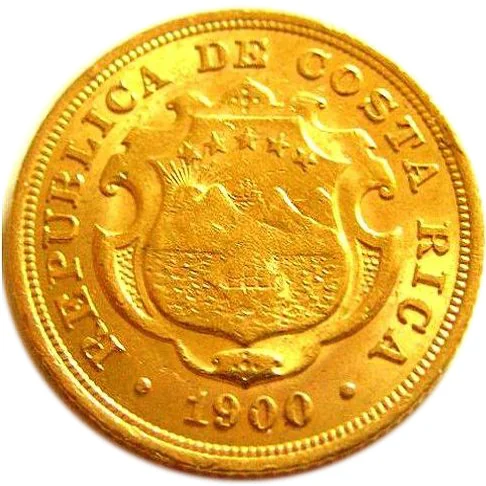
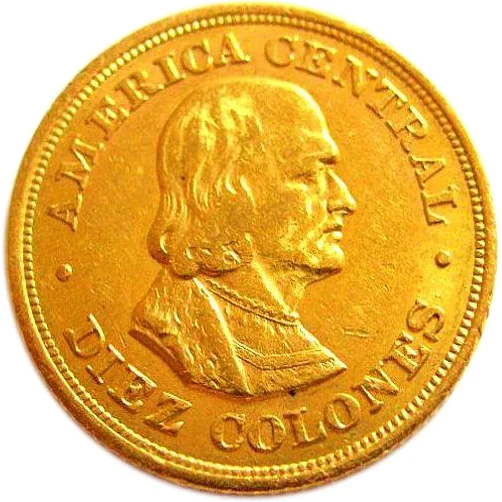
10 Colones – Costa Rica
Costa Rica
Context
Years: 1897–1900
Issuer: Costa Rica 
Period:
(1848—1948)
Currency:
(since 1896)
Demonetized: Yes
Total mintage: 250,000
Material
References
KM: #Click to copy to clipboard140
Numista: #35042
Value
Exchange value: 10 CRC
Bullion value: $1167.47
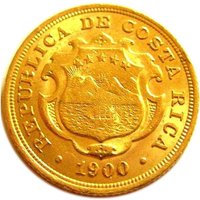
Obverse
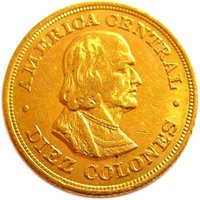
Reverse
Edge
Categories
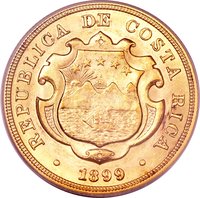
| Symbols> Coat of Arms |
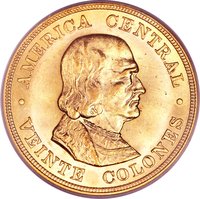
| Person> Explorer |
Mints
| Name | Mark |
|---|---|
| United States Mint of Philadelphia | — |
Mintings
| Year | Mint Mark | Mintage | Quality | Collection |
|---|---|---|---|---|
| 1897 | — | 60,000 | ||
| 1899 | — | 50,000 | ||
| 1900 | — | 140,000 |
Historical background
In 1897, Costa Rica's currency system was a complex and unstable mixture of metallic and paper money, reflecting the nation's post-colonial economic challenges and its integration into the global market. The official currency was the silver Peso, divisible into 100 Centavos, but the reality was far more fragmented. Alongside silver coins, gold coins from Europe and North America circulated freely, and most significantly, paper banknotes issued by private commercial banks were prevalent. This lack of a unified, state-controlled currency led to frequent fluctuations in value and exchange rates between the different forms of money, creating uncertainty for both domestic commerce and international trade, which was heavily focused on coffee and banana exports.
The period was marked by a significant devaluation of the silver peso against the gold standard, which was becoming the global benchmark. As the price of silver fell worldwide in the late 19th century, Costa Rica's silver-based currency lost value relative to gold-backed currencies like the British pound sterling and the US dollar. This devaluation increased the cost of importing manufactured goods and servicing foreign debt, which were often denominated in gold. The government's attempts to manage this through decrees and exchange rate fixes proved largely ineffective, highlighting the weakness of a system reliant on private banknotes and a depreciating metal.
Consequently, 1897 existed within a crucial transitional decade that would lead to major monetary reform. The financial instability of this era, characterized by the coexistence of devaluing silver, foreign gold, and unregulated private paper money, built strong political consensus for change. This pressure culminated just a few years later with the founding of the Banco Internacional de Costa Rica in 1900, which was granted the exclusive right of note issue, and the eventual adoption of the gold-backed Colón in 1900, formally replacing the peso at a rate of one colón to one peso, in a move to stabilize the national economy and modernize the financial system.
The period was marked by a significant devaluation of the silver peso against the gold standard, which was becoming the global benchmark. As the price of silver fell worldwide in the late 19th century, Costa Rica's silver-based currency lost value relative to gold-backed currencies like the British pound sterling and the US dollar. This devaluation increased the cost of importing manufactured goods and servicing foreign debt, which were often denominated in gold. The government's attempts to manage this through decrees and exchange rate fixes proved largely ineffective, highlighting the weakness of a system reliant on private banknotes and a depreciating metal.
Consequently, 1897 existed within a crucial transitional decade that would lead to major monetary reform. The financial instability of this era, characterized by the coexistence of devaluing silver, foreign gold, and unregulated private paper money, built strong political consensus for change. This pressure culminated just a few years later with the founding of the Banco Internacional de Costa Rica in 1900, which was granted the exclusive right of note issue, and the eventual adoption of the gold-backed Colón in 1900, formally replacing the peso at a rate of one colón to one peso, in a move to stabilize the national economy and modernize the financial system.
💎 Very Rare