

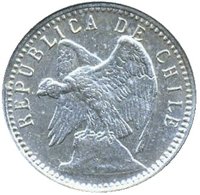
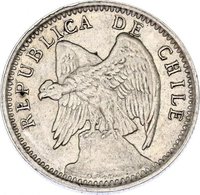
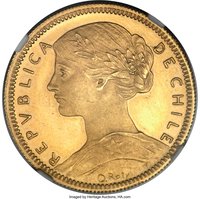
Obverse
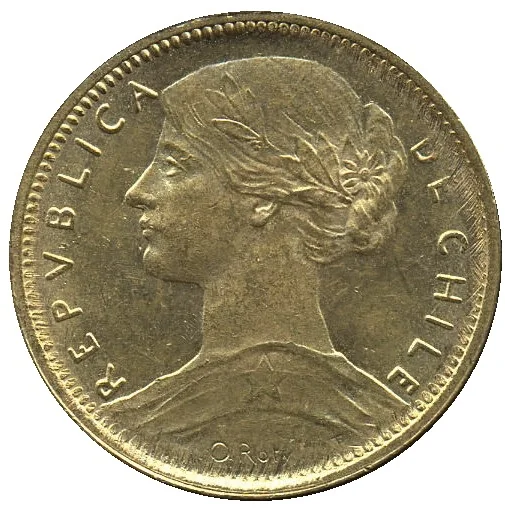
Description:
Turn left.
Inscription:
REPVBLICA DE CHILE
O'Roty
O'Roty
Script: Latin
Engraver: Oscar Roty (1846 -1911)
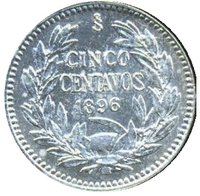
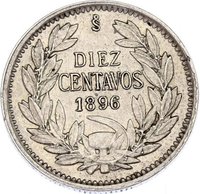
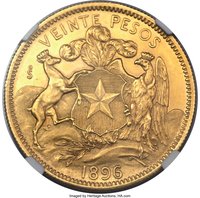
Reverse
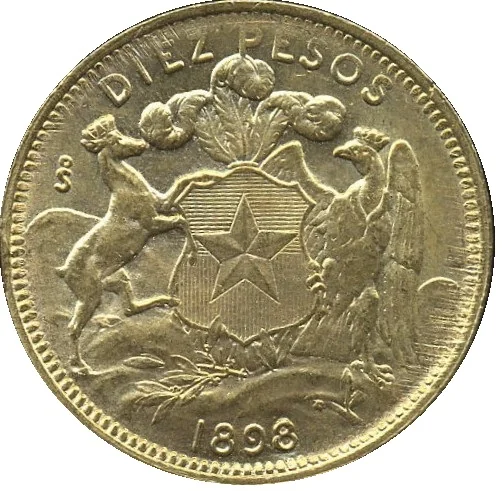
Description:
Arms with supporters, denomination above, date below.
Inscription:
DIEZ PESOS
So
1898
So
1898
Script: Latin
Edge
Reeded
Mints
| Name | Mark |
|---|---|
| Casa de Moneda de Chile | (So) |
Mintings
| Year | Mint Mark | Mintage | Quality | Collection |
|---|---|---|---|---|
| 1896 | So | 1,163,000 | ||
| 1898 | So | 276,000 | ||
| 1901 | So | 1,651,000 |
Historical background
In 1896, Chile operated under a bimetallic monetary system anchored by the peso, but the reality was one of significant instability and transition. The country's official standard was based on both gold and silver, yet the global decline in silver prices throughout the 1870s and 1880s had caused a severe devaluation of the silver peso. This led to a practical move toward a de facto gold standard, as the government and major financial institutions began conducting large transactions in gold-based currencies like the British pound sterling and the French franc to ensure stability in international trade and debt payments.
This monetary confusion created a complex domestic environment. Multiple types of coins circulated simultaneously, including devalued silver pesos, gold condores (worth 10 pesos), and various fractional currency. The result was widespread public inconvenience, price distortions, and difficulties in everyday commerce. The situation was exacerbated by the economic strains following the War of the Pacific (1879-1883); while the victory brought vast nitrate and copper revenues, it also led to heavy foreign borrowing and speculative booms, making a stable and uniform currency a pressing concern for economic governance.
Consequently, the year 1896 fell within a critical period of reform. Political and economic debates were intensely focused on formally abandoning bimetallism. These discussions culminated just a year later, in 1897, with the Law of Monetary Conversion, which officially established the gold standard in Chile. The law pegged the peso to the British pound and mandated the minting of new gold coins, finally providing the unified and stable currency that the economy of the late 1890s urgently required to consolidate its export-driven growth.
This monetary confusion created a complex domestic environment. Multiple types of coins circulated simultaneously, including devalued silver pesos, gold condores (worth 10 pesos), and various fractional currency. The result was widespread public inconvenience, price distortions, and difficulties in everyday commerce. The situation was exacerbated by the economic strains following the War of the Pacific (1879-1883); while the victory brought vast nitrate and copper revenues, it also led to heavy foreign borrowing and speculative booms, making a stable and uniform currency a pressing concern for economic governance.
Consequently, the year 1896 fell within a critical period of reform. Political and economic debates were intensely focused on formally abandoning bimetallism. These discussions culminated just a year later, in 1897, with the Law of Monetary Conversion, which officially established the gold standard in Chile. The law pegged the peso to the British pound and mandated the minting of new gold coins, finally providing the unified and stable currency that the economy of the late 1890s urgently required to consolidate its export-driven growth.
Series: 1896 Chile circulation coins
💎 Extremely Rare