

Obverse
Description:
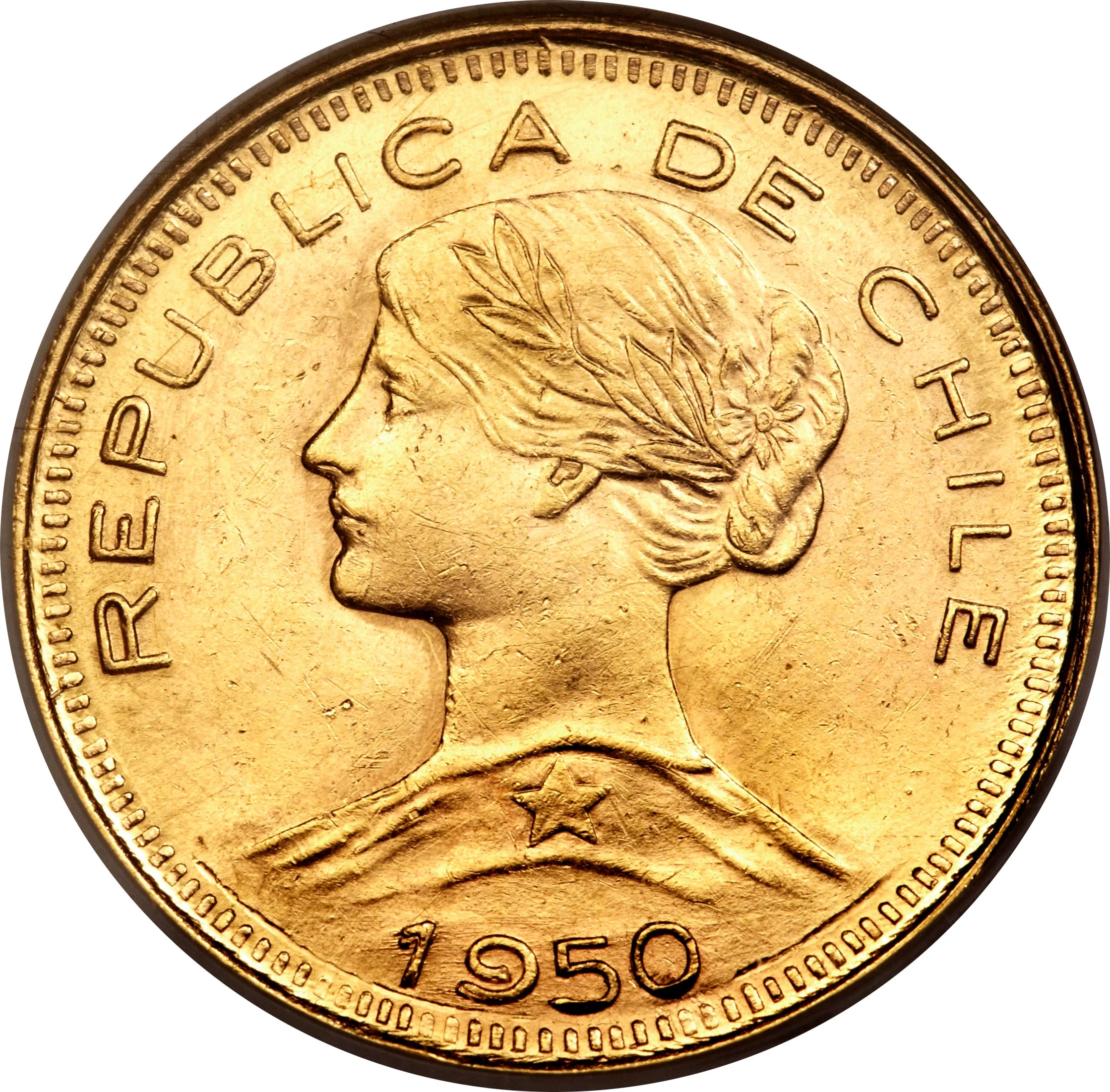
Left-facing head, date below, updated bust and legend.
Inscription:
REPUBLICA DE CHILE
1950
1950
Translation:
REPUBLIC OF CHILE
1950
1950
Script: Latin
Language: Spanish
Engraver: Oscar Roty (1846 -1911)
Reverse
Description:
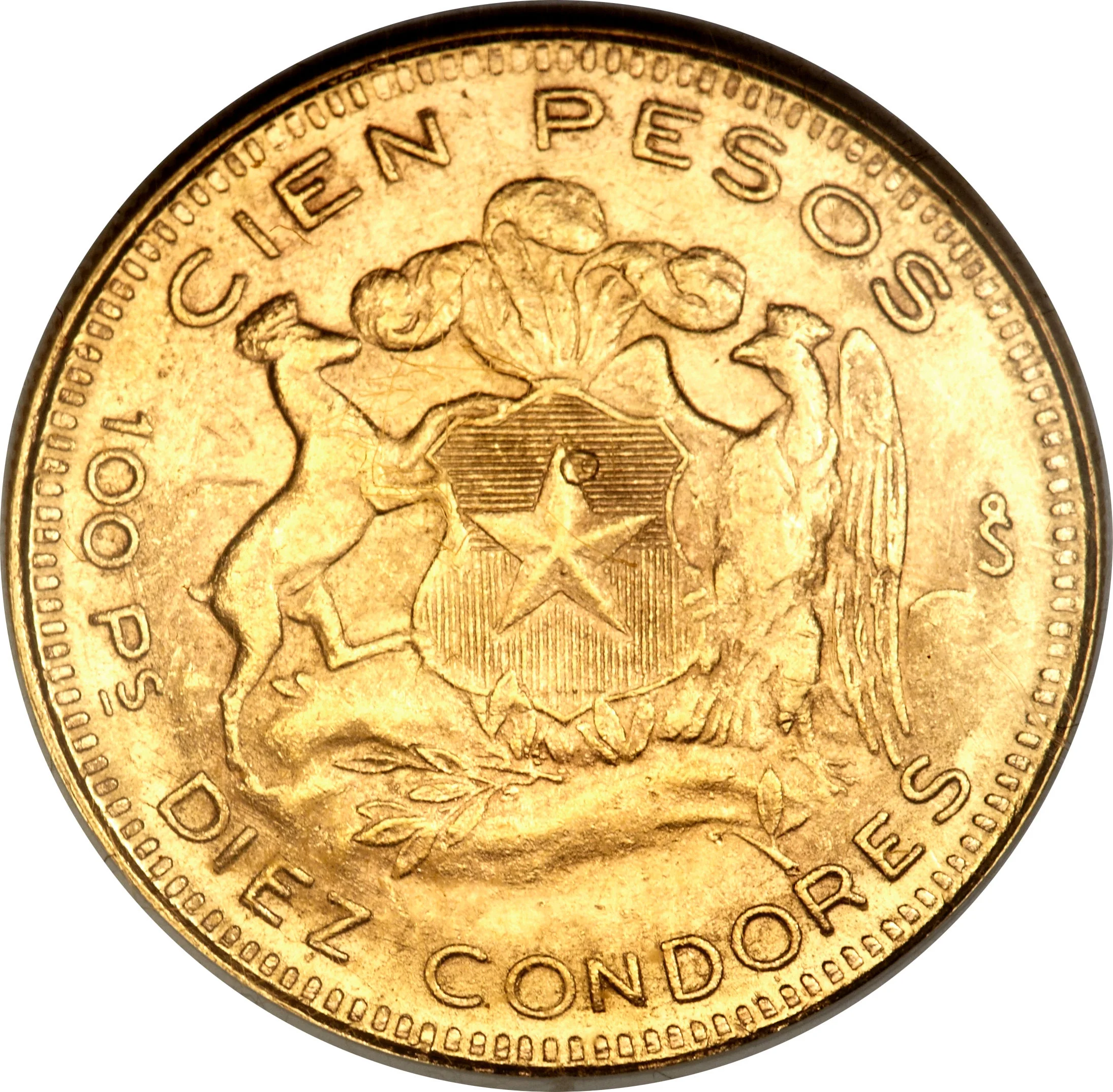
Coat of arms with denomination in three formats.
Inscription:
CIEN PESOS
100 Ps So
DIEZ CONDORES
100 Ps So
DIEZ CONDORES
Script: Latin
Edge
Mints
| Name | Mark |
|---|---|
| Casa de Moneda de Chile | (So) |
Mintings
| Year | Mint Mark | Mintage | Quality | Collection |
|---|---|---|---|---|
| 1932 | So | 9,315 | ||
| 1946 | So | 260,000 | ||
| 1947 | So | 540,000 | ||
| 1948 | So | 420,000 | ||
| 1949 | So | 310,000 | ||
| 1950 | So | 20,000 | ||
| 1951 | So | 145,000 | ||
| 1952 | So | 245,000 | ||
| 1953 | So | 175,000 | ||
| 1954 | So | 190,000 | ||
| 1955 | So | 150,000 | ||
| 1956 | So | 60,000 | ||
| 1957 | So | 40,000 | ||
| 1958 | So | 157,000 | ||
| 1959 | So | 90,000 | ||
| 1960 | So | 200,000 | ||
| 1961 | So | 295,000 | ||
| 1962 | So | 260,000 | ||
| 1963 | So | 210,000 | ||
| 1964 | So | — | ||
| 1968 | So | — | ||
| 1969 | So | — | ||
| 1970 | So | — | ||
| 1971 | So | — | ||
| 1972 | So | — | ||
| 1973 | So | — | ||
| 1974 | So | — | ||
| 1976 | So | 172,000 | ||
| 1977 | So | 25,000 | ||
| 1979 | So | 100,000 | ||
| 1980 | So | 50,000 |
Historical background
In 1932, Chile was in the throes of a profound economic and political crisis, a direct consequence of the Great Depression's collapse in global demand for its vital nitrate and copper exports. This external shock triggered a deep fiscal crisis, massive unemployment, and severe social unrest, culminating in a year of remarkable political instability that saw three different governments. The state's inability to service its debts or fund basic operations led to a critical loss of confidence in its financial management, directly setting the stage for a currency crisis.
The core of the currency situation was the collapse of the gold standard and the exhaustion of foreign reserves. To defend the fixed exchange rate of the peso, the government had spent its dwindling gold and hard currency reserves until they were virtually depleted. With no means to support the peso's value or finance essential imports, Chile was forced to abandon the gold standard in 1932. This led to a sharp, uncontrolled devaluation of the peso and a period of effective floating exchange rate, causing severe inflation and further eroding public trust in the monetary system.
This chaotic backdrop prompted the return of former President Arturo Alessandri Palma in late 1932, who prioritized monetary and fiscal reform. His administration, with advice from the Kemmerer Mission, established the Central Bank of Chile in 1925, but its foundational laws were fully implemented in the years following the 1932 crisis to restore order. Thus, 1932 represents the nadir of Chile's Depression-era turmoil, a year of monetary breakdown that directly necessitated the creation of a modern, independent central banking system to provide stability and prevent a repeat of such a devastating financial collapse.
The core of the currency situation was the collapse of the gold standard and the exhaustion of foreign reserves. To defend the fixed exchange rate of the peso, the government had spent its dwindling gold and hard currency reserves until they were virtually depleted. With no means to support the peso's value or finance essential imports, Chile was forced to abandon the gold standard in 1932. This led to a sharp, uncontrolled devaluation of the peso and a period of effective floating exchange rate, causing severe inflation and further eroding public trust in the monetary system.
This chaotic backdrop prompted the return of former President Arturo Alessandri Palma in late 1932, who prioritized monetary and fiscal reform. His administration, with advice from the Kemmerer Mission, established the Central Bank of Chile in 1925, but its foundational laws were fully implemented in the years following the 1932 crisis to restore order. Thus, 1932 represents the nadir of Chile's Depression-era turmoil, a year of monetary breakdown that directly necessitated the creation of a modern, independent central banking system to provide stability and prevent a repeat of such a devastating financial collapse.
🌟 Limited