

20 cash – Chihli Province
Add to wishlist
China
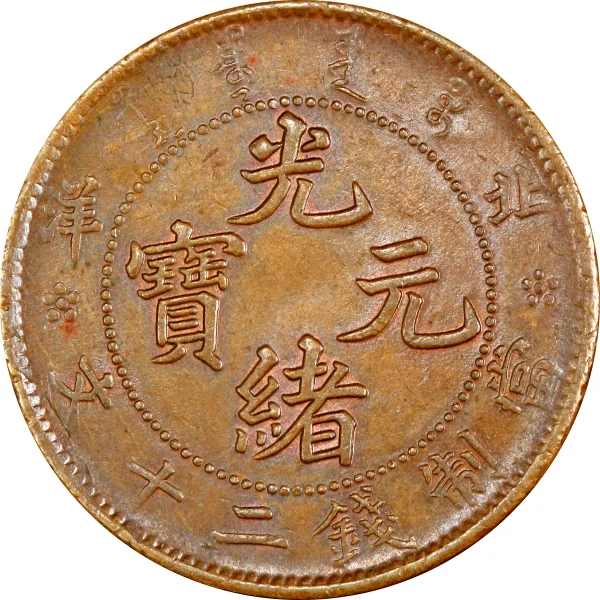
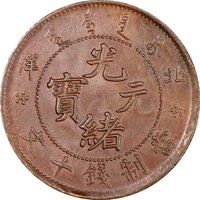
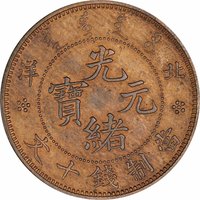
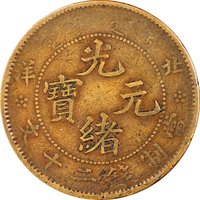
Obverse
Description:
Four Chinese characters read top-down, right-left, with Manchu text above them and additional characters alongside.
Inscription:
ᠪᠠᡩᠠᠷᠠᠩᡤᠠ ᡩᠣᠷᠣ ᡳ᠋ ᠶᡠᠸᠠᠨ ᠪᠣᠣ
洋北
光
寶元
緒
文十二錢制當
洋北
光
寶元
緒
文十二錢制當
Translation:
Badarangga doro i yuwan boo
光
緒
寶
文
元
十
二
錢
制
當
YANG-BEI
(Note: The inscription appears to be a mix of Manchu and Chinese, arranged in a specific coin format. The Manchu text "Badarangga doro i yuwan boo" translates to "Board of Revenue of the Guangxu reign." The Chinese characters are read in the order: Top-Bottom-Right-Left, starting with "Guangxu" on the right, then "Tongbao" on the left, "Hubu" on the top, and "Dangzhi" on the bottom. The central characters are "Wen" on the right and "Yuan" on the left, with "Shi'er" (Twelve) above and a now unreadable character below. The final two characters on the reverse are "Yang-Bei" (Foreign-Made), indicating it was minted abroad.)
Here is the reconstructed and translated inscription:
**Obverse (Center):**
* Manchu: Badarangga doro i yuwan boo (Board of Revenue of the Guangxu reign)
**Obverse (Square Legend, read top-bottom-right-left):**
* Top: 戶 (Hubu - Board of Revenue)
* Bottom: 當制 (Dangzhi - Standard Value)
* Right: 光緒 (Guangxu - [Reign of] Guangxu)
* Left: 通寶 (Tongbao - Circulating Coin)
**Obverse (Inner Flank, right and left):**
* Right: 文 (Wen - Cash)
* Left: 元 (Yuan - First/Principal)
**Obverse (Outer Flank, top and bottom):**
* Top: 十二 (Shi'er - Twelve)
* Bottom: [Unreadable/Obscured character, likely the denomination unit "文" (Wen) or similar]
**Reverse:**
* 洋北 (Yang-Bei - Foreign-Made, or more specifically, "Made in a Northern Foreign Country")
**Complete Translation:**
Board of Revenue of the Guangxu reign. Guangxu Circulating Coin, Board of Revenue, Standard Value. Twelve [Cash?]. Foreign-Made.
光
緒
寶
文
元
十
二
錢
制
當
YANG-BEI
(Note: The inscription appears to be a mix of Manchu and Chinese, arranged in a specific coin format. The Manchu text "Badarangga doro i yuwan boo" translates to "Board of Revenue of the Guangxu reign." The Chinese characters are read in the order: Top-Bottom-Right-Left, starting with "Guangxu" on the right, then "Tongbao" on the left, "Hubu" on the top, and "Dangzhi" on the bottom. The central characters are "Wen" on the right and "Yuan" on the left, with "Shi'er" (Twelve) above and a now unreadable character below. The final two characters on the reverse are "Yang-Bei" (Foreign-Made), indicating it was minted abroad.)
Here is the reconstructed and translated inscription:
**Obverse (Center):**
* Manchu: Badarangga doro i yuwan boo (Board of Revenue of the Guangxu reign)
**Obverse (Square Legend, read top-bottom-right-left):**
* Top: 戶 (Hubu - Board of Revenue)
* Bottom: 當制 (Dangzhi - Standard Value)
* Right: 光緒 (Guangxu - [Reign of] Guangxu)
* Left: 通寶 (Tongbao - Circulating Coin)
**Obverse (Inner Flank, right and left):**
* Right: 文 (Wen - Cash)
* Left: 元 (Yuan - First/Principal)
**Obverse (Outer Flank, top and bottom):**
* Top: 十二 (Shi'er - Twelve)
* Bottom: [Unreadable/Obscured character, likely the denomination unit "文" (Wen) or similar]
**Reverse:**
* 洋北 (Yang-Bei - Foreign-Made, or more specifically, "Made in a Northern Foreign Country")
**Complete Translation:**
Board of Revenue of the Guangxu reign. Guangxu Circulating Coin, Board of Revenue, Standard Value. Twelve [Cash?]. Foreign-Made.
Scripts: Chinese, Mongolian / Manchu
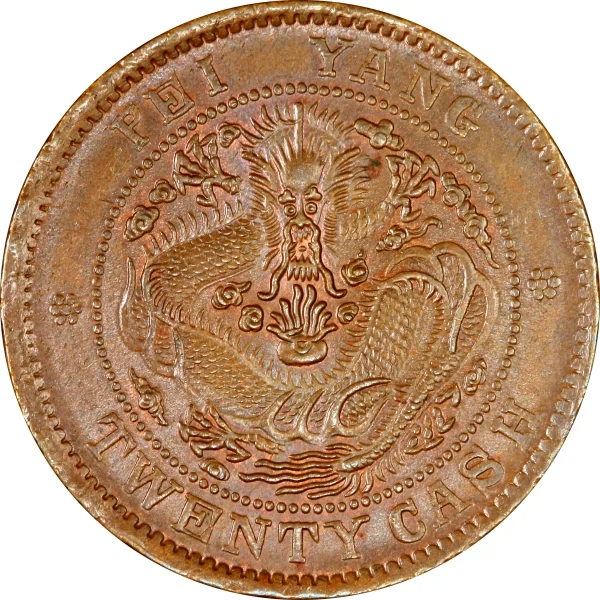
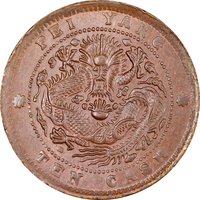
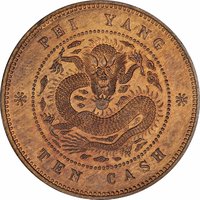
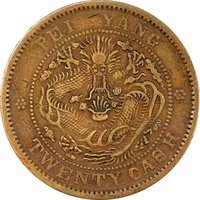
Reverse
Description:
Dragon encircling a pearl, surrounded by English text.
Inscription:
PEI YANG
TWENTY CASH
TWENTY CASH
Script: Latin
Edge
Plain
Categories
| Mythology> Fantastic animal |
Mintings
| Year | Mint Mark | Mintage | Quality | Collection |
|---|---|---|---|---|
| 1906 | — | — |
Historical background
In 1906, Chihli Province (roughly modern-day Hebei, including Beijing and Tianjin) was at the epicenter of a severe and chaotic monetary crisis that reflected the crumbling fiscal sovereignty of the Qing Dynasty. The province, containing the imperial capital and major treaty ports, was a zone of intense competition between multiple circulating currencies. These included silver sycee (by weight and purity), copper cash strings for daily transactions, and a growing influx of foreign silver dollars (particularly Mexican Eagles), which were preferred for their standardized weight and reliability. Most debilitating, however, was the flood of unbacked banknotes issued by various domestic financial institutions, from official Qing banks to private qianzhuang (native banks) and even foreign concession banks. This proliferation led to wild fluctuations in exchange rates between silver, copper, and paper, causing widespread confusion and commercial distrust.
The core of the crisis was the disastrous depreciation of the official copper coinage. In a failed attempt to modernize the currency and raise revenue, provincial and central mints had engaged in the excessive debasement and minting of new copper coins. This oversupply caused the market exchange rate between silver and copper to collapse; where roughly 1,000 copper cash had once equaled one silver tael, by 1906 it could take 1,500 or more. This devastated the peasantry and laborers, who were paid in copper but often paid taxes assessed in silver, effectively increasing their burdens. Meanwhile, the value of privately issued paper notes could vary dramatically from one district to another, and bank failures were common, wiping out the savings of merchants and ordinary citizens alike.
The Qing government, recognizing the threat to stability in its very capital region, made attempts at reform. In 1905, the Board of Revenue Bank (Hubu Bank) was established in Beijing, aiming to issue unified official banknotes and regulate finance. However, by 1906, these efforts had proven largely ineffective. Public confidence in official institutions was too low, the scale of the problem too vast, and the entrenched interests of foreign powers and local financiers too powerful. Thus, the currency situation in Chihli remained a volatile tangle of competing systems, serving as a potent symbol of the dynasty's inability to control its own economy and a direct contributor to the rising social unrest that would culminate in the 1911 Revolution.
The core of the crisis was the disastrous depreciation of the official copper coinage. In a failed attempt to modernize the currency and raise revenue, provincial and central mints had engaged in the excessive debasement and minting of new copper coins. This oversupply caused the market exchange rate between silver and copper to collapse; where roughly 1,000 copper cash had once equaled one silver tael, by 1906 it could take 1,500 or more. This devastated the peasantry and laborers, who were paid in copper but often paid taxes assessed in silver, effectively increasing their burdens. Meanwhile, the value of privately issued paper notes could vary dramatically from one district to another, and bank failures were common, wiping out the savings of merchants and ordinary citizens alike.
The Qing government, recognizing the threat to stability in its very capital region, made attempts at reform. In 1905, the Board of Revenue Bank (Hubu Bank) was established in Beijing, aiming to issue unified official banknotes and regulate finance. However, by 1906, these efforts had proven largely ineffective. Public confidence in official institutions was too low, the scale of the problem too vast, and the entrenched interests of foreign powers and local financiers too powerful. Thus, the currency situation in Chihli remained a volatile tangle of competing systems, serving as a potent symbol of the dynasty's inability to control its own economy and a direct contributor to the rising social unrest that would culminate in the 1911 Revolution.
💎 Very Rare