

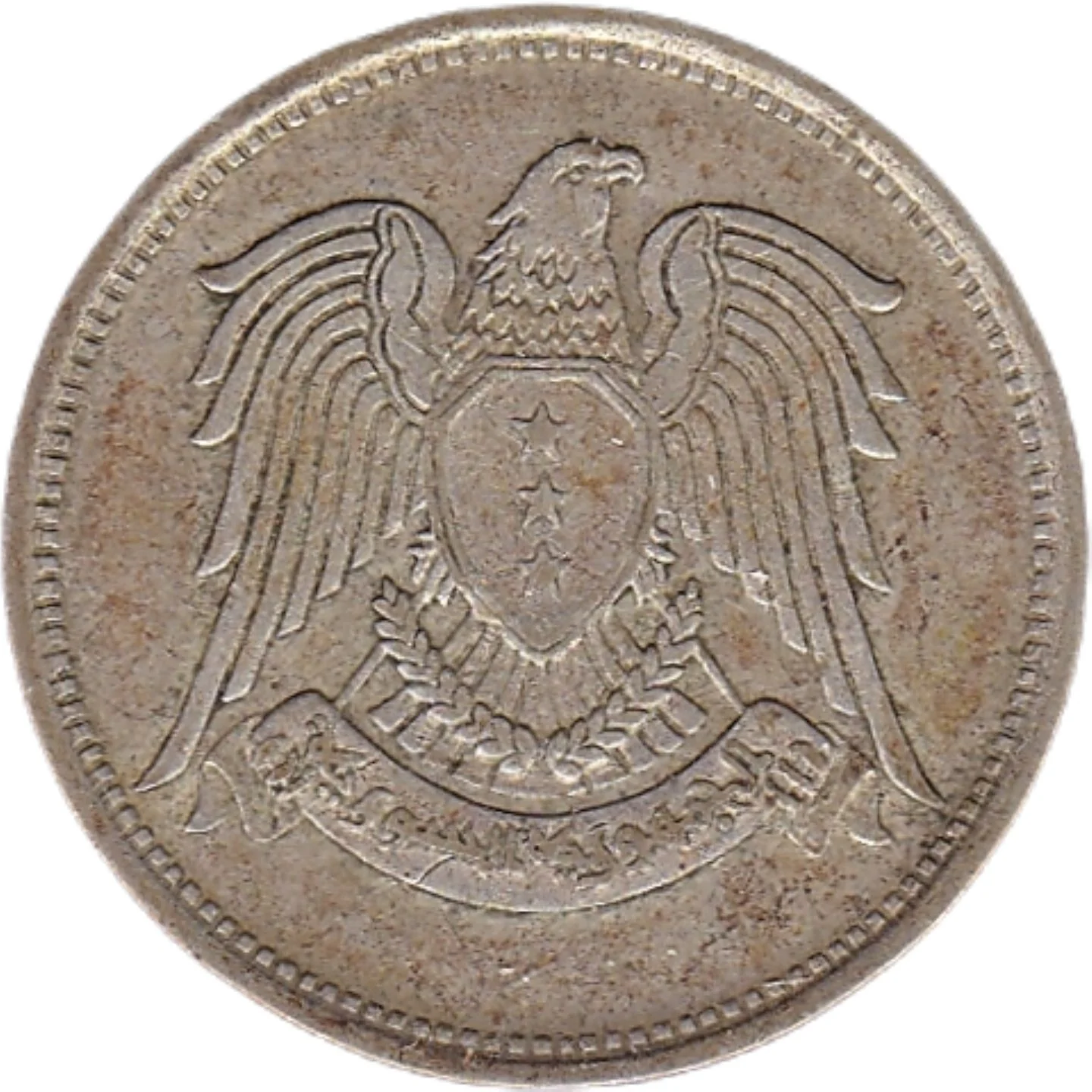
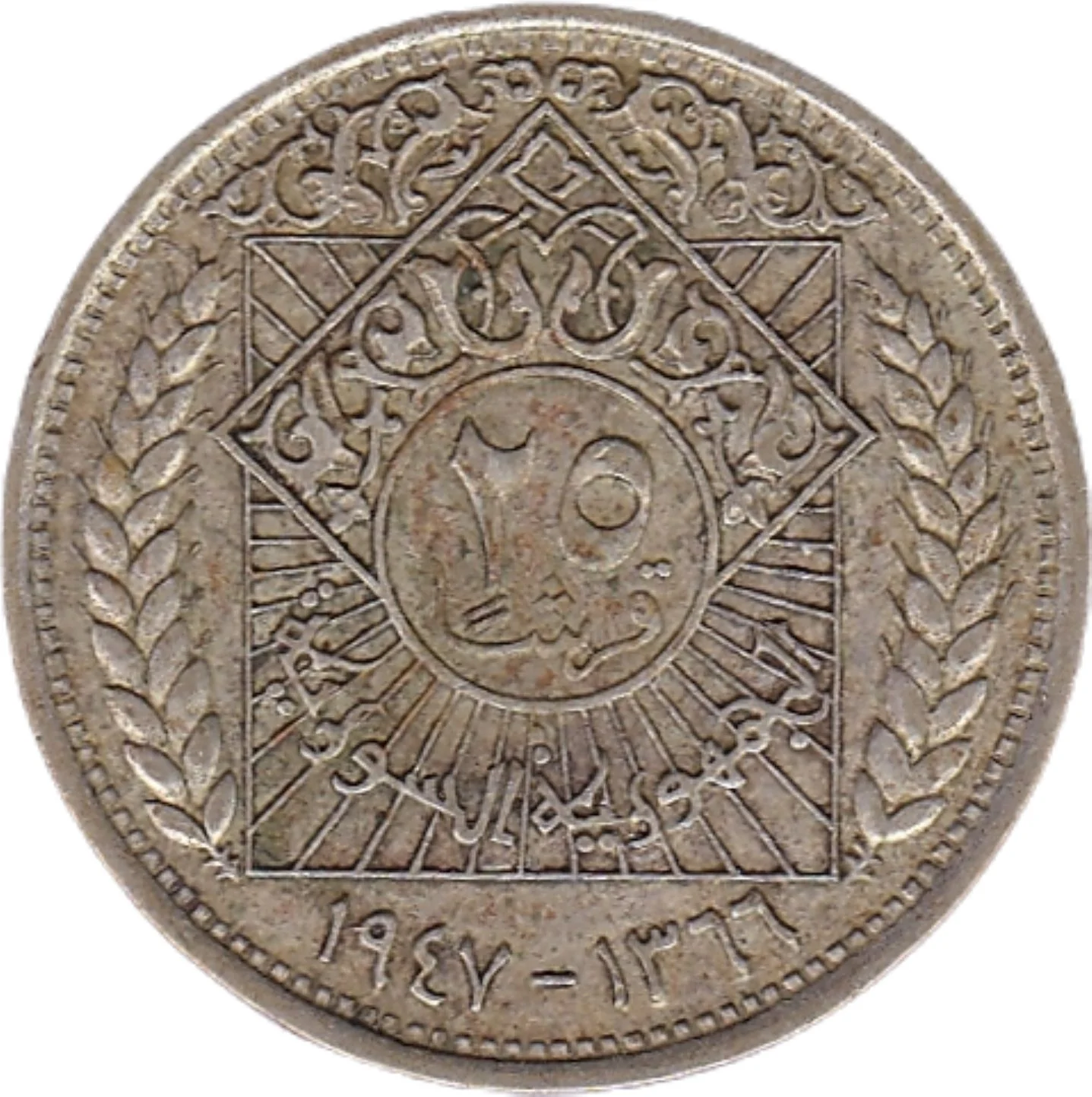
25 piastres – Syria
Add to wishlist
Syria
Context
Year: 1947
Islamic (Hijri) Year:: 1366
Issuer: Syria
Period:
(1946—1958)
Currency:
(since 1919)
Demonetized: Yes
Total mintage: 6,300,000
Material
References
KM: #
Numista: #13935
Value
Exchange value: 0.25 SYP
Bullion value: $3.82
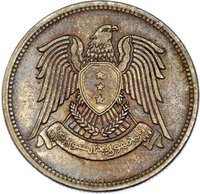
Obverse
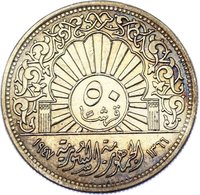
Reverse
Edge
Reeded
Mints
| Name | Mark |
|---|---|
| United States Mint of Philadelphia | — |
Mintings
| Year | Mint Mark | Mintage | Quality | Collection |
|---|---|---|---|---|
| 1947 | — | 6,300,000 |
Historical background
In 1947, Syria's currency situation was defined by its recent emergence as a fully independent republic and its continued economic ties to France. Following the end of the French Mandate in 1946, the new Syrian government inherited a monetary system anchored by the Syrian pound (or lira), which was still part of the Franc Zone. The currency was issued by a French-controlled entity, the Banque de Syrie et du Liban, and its value was pegged to the French franc. This arrangement meant that Syria's monetary policy and foreign exchange reserves were heavily influenced by Paris, a lingering symbol of colonial dependence that conflicted with the nation's newfound sovereignty.
Economically, the post-war period presented both challenges and opportunities. Syria experienced a brief boom due to high global demand for its agricultural products, particularly wheat and cotton, which increased its foreign currency earnings. However, the fixed peg to the devalued and unstable French franc was increasingly seen as a constraint. Syrian policymakers and business leaders argued that the franc link subjected the economy to unnecessary inflation and limited the government's ability to pursue independent economic development. The desire to break from the Franc Zone and establish a truly national currency became a key objective, symbolizing economic independence.
Consequently, 1947 was a pivotal year of transition. The Syrian government passed legislation to establish a national central bank, marking the first concrete step toward taking control of its monetary destiny. This move laid the institutional groundwork for the eventual introduction of a new, state-issued Syrian pound, which would be realized in 1948. The currency situation of 1947 was thus one of a nation actively dismantling the last vestiges of the mandate financial system and preparing to assert full control over its economy through a sovereign monetary policy.
Economically, the post-war period presented both challenges and opportunities. Syria experienced a brief boom due to high global demand for its agricultural products, particularly wheat and cotton, which increased its foreign currency earnings. However, the fixed peg to the devalued and unstable French franc was increasingly seen as a constraint. Syrian policymakers and business leaders argued that the franc link subjected the economy to unnecessary inflation and limited the government's ability to pursue independent economic development. The desire to break from the Franc Zone and establish a truly national currency became a key objective, symbolizing economic independence.
Consequently, 1947 was a pivotal year of transition. The Syrian government passed legislation to establish a national central bank, marking the first concrete step toward taking control of its monetary destiny. This move laid the institutional groundwork for the eventual introduction of a new, state-issued Syrian pound, which would be realized in 1948. The currency situation of 1947 was thus one of a nation actively dismantling the last vestiges of the mandate financial system and preparing to assert full control over its economy through a sovereign monetary policy.
🌱 Common