

2½ piastres – Syria
Add to wishlist
Syria
Context
Year: 1940
Issuer: Syria
Period:
(1930—1946)
Currency:
(since 1919)
Demonetized: Yes
Total mintage: 2,000,000
Material
Diameter: 21 mm
Weight: 3 g
Shape: Round with a round hole
Composition: Aluminium bronze
Magnetic: No
Technique: Milled
Alignment: Coin alignment
flip
References
KM: #
Numista: #2713
Value
Exchange value: 0.025 SYP
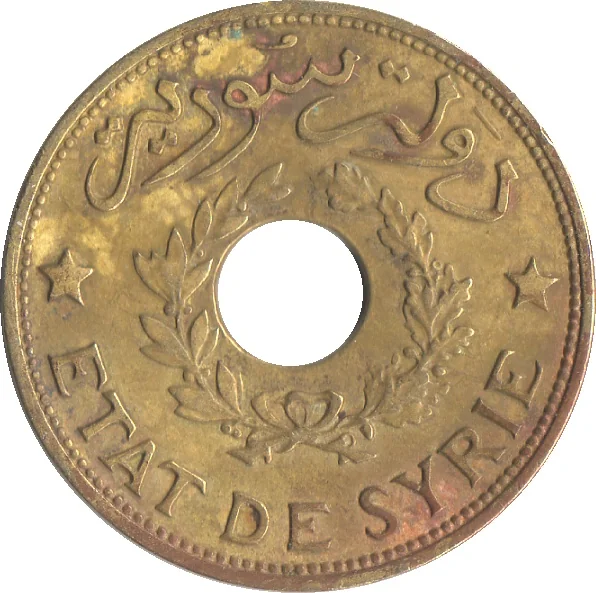
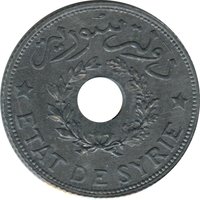
Obverse
Description:
Oak and olive wreath
Inscription:
دولة سورية
* ETAT DE SYRIE *
* ETAT DE SYRIE *
Translation:
SYRIAN STATE
* STATE OF SYRIA *
* STATE OF SYRIA *
Engraver: Lucien Georges Bazor
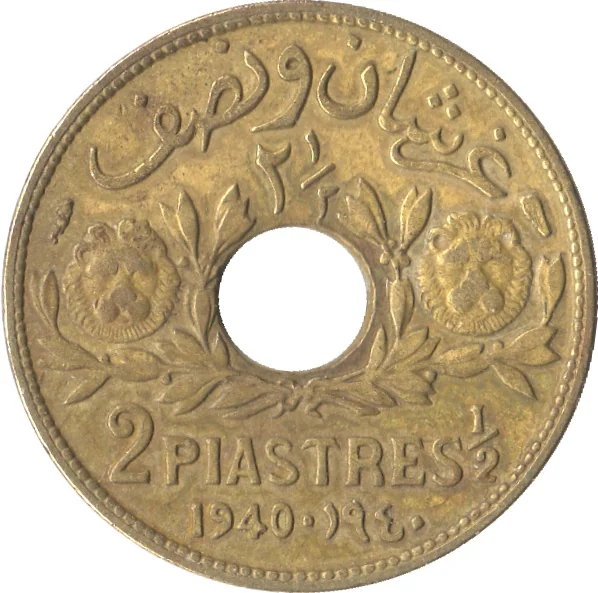
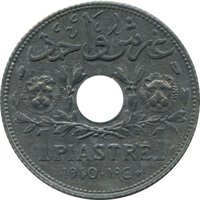
Reverse
Description:
Lion heads flanking olive branches.
Inscription:
غرشان ونصف
١/٢ ٢
2 PIASTRES 1/2
1940 ·١٩٤٠
١/٢ ٢
2 PIASTRES 1/2
1940 ·١٩٤٠
Translation:
Two Piastres and a Half
1/2 2
2 PIASTRES 1/2
1940
1/2 2
2 PIASTRES 1/2
1940
Engraver: Lucien Georges Bazor
Edge
Plain
Mints
| Name | Mark |
|---|---|
| Monnaie de Paris | — |
Mintings
| Year | Mint Mark | Mintage | Quality | Collection |
|---|---|---|---|---|
| 1940 | — | 2,000,000 |
Historical background
In 1940, Syria's currency situation was directly shaped by its political status as a French mandate under the control of the Vichy French administration following France's defeat by Nazi Germany. The official currency remained the Syrian pound (or livre syrienne), which was issued by a French-controlled private bank, the Banque de Syrie et du Grand-Liban. This currency was nominally pegged to the French franc, but this link became increasingly strained and theoretical as the war progressed, leading to significant instability.
The outbreak of World War II and the subsequent division of France created major economic disruptions. The Vichy authorities in Syria, cut off from Metropolitan France and under a British naval blockade, faced severe shortages of goods and inflationary pressures. To finance their administration and military expenditures, the Vichy regime resorted to printing currency, which led to a rapid devaluation of the Syrian pound in real terms. This period saw the emergence of a growing black market for both goods and foreign currencies, as confidence in the mandated currency eroded.
Furthermore, the geopolitical struggle for influence in the region directly impacted the monetary landscape. British and Free French forces, anticipating the eventual Allied invasion to oust the Vichy authorities (which occurred in 1941—the Syria–Lebanon campaign), began planning for a post-Vichy financial order. This set the stage for a significant currency reform in 1941, where the Syrian pound would be repegged from the French franc to the British pound sterling, marking a decisive shift in the region's economic alignment away from Vichy France and toward the Allied powers.
The outbreak of World War II and the subsequent division of France created major economic disruptions. The Vichy authorities in Syria, cut off from Metropolitan France and under a British naval blockade, faced severe shortages of goods and inflationary pressures. To finance their administration and military expenditures, the Vichy regime resorted to printing currency, which led to a rapid devaluation of the Syrian pound in real terms. This period saw the emergence of a growing black market for both goods and foreign currencies, as confidence in the mandated currency eroded.
Furthermore, the geopolitical struggle for influence in the region directly impacted the monetary landscape. British and Free French forces, anticipating the eventual Allied invasion to oust the Vichy authorities (which occurred in 1941—the Syria–Lebanon campaign), began planning for a post-Vichy financial order. This set the stage for a significant currency reform in 1941, where the Syrian pound would be repegged from the French franc to the British pound sterling, marking a decisive shift in the region's economic alignment away from Vichy France and toward the Allied powers.
🌱 Fairly Common