

10 Cents – Guyana
Guyana
Context
Years: 1967–1992
Issuer: Guyana 
Issuing organization: Bank of Guyana
Period:
(since 1970)
Ruler: Elizabeth II
Currency:
(since 1965)
Demonetization: 1992
Total mintage: 29,220,200
Material
References
KM: #Click to copy to clipboard33
Numista: #3472
Value
Exchange value: 0.10 GYD
Obverse
Description:
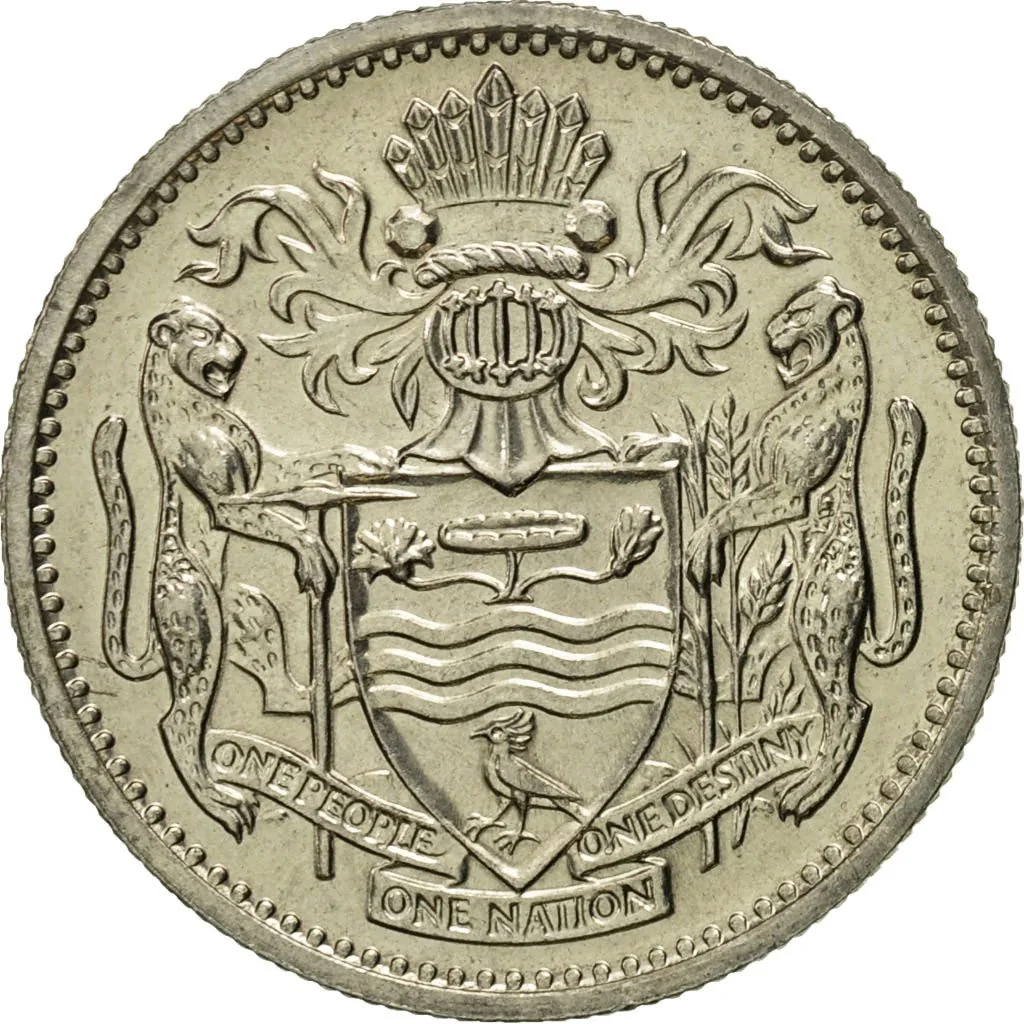
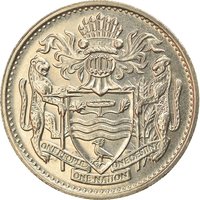
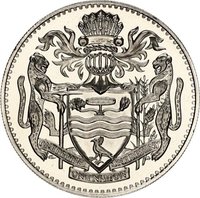
The Guyanese coat of arms features a crest with a feathered headdress, a shield with a water lily and a Canje pheasant, and supporters of jaguars holding tools. Below, a scroll bears the national motto, "One People, One Nation, One Destiny."
Inscription:
ONE PEOPLE ONE NATION ONE DESTINY
Script: Latin
Reverse
Description:
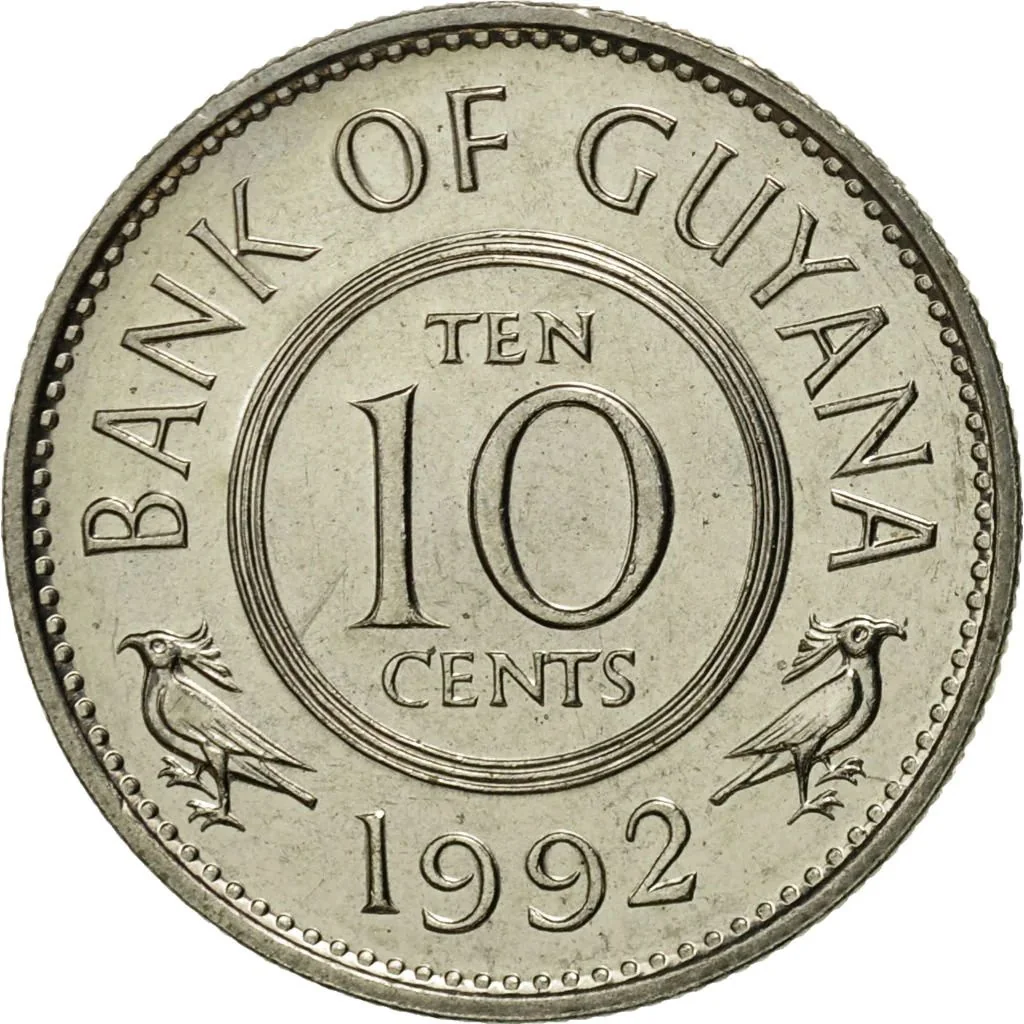
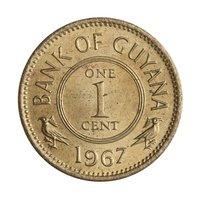
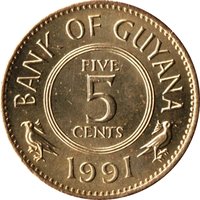
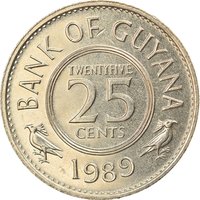
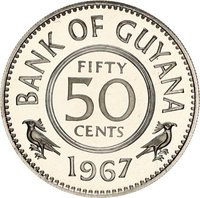
Denomination within a circle, legend above, date below. The date is flanked by Guyana’s national bird, the Hoatzin, known for its wing-clawed young and unique, cow-like cellulose digestion.
Inscription:
BANK OF GUYANA
TEN
10
CENTS
1992
TEN
10
CENTS
1992
Script: Latin
Edge
Reeded
Mints
| Name | Mark |
|---|---|
| Royal Mint | — |
Mintings
| Year | Mint Mark | Mintage | Quality | Collection |
|---|---|---|---|---|
| 1967 | — | 4,005,100 | ||
| 1967 | — | 5,100 | Proof | |
| 1973 | — | 1,500,000 | ||
| 1974 | — | 1,700,000 | ||
| 1976 | — | — | ||
| 1977 | — | 4,000,000 | ||
| 1978 | — | 2,010,000 | ||
| 1979 | — | — | ||
| 1980 | — | 1,000,000 | ||
| 1981 | — | 1,000,000 | ||
| 1982 | — | 2,000,000 | ||
| 1985 | — | 3,000,000 | ||
| 1986 | — | 4,000,000 | ||
| 1987 | — | 3,000,000 | ||
| 1988 | — | 2,000,000 | ||
| 1989 | — | — | ||
| 1990 | — | — | ||
| 1991 | — | — | ||
| 1992 | — | — |
Historical background
In 1967, Guyana's currency situation was defined by its recent independence and its continued membership in the British Caribbean Currency Board (BCCB). The nation, having gained independence in May 1966, still used the British Guiana dollar, which was pegged at par to the West Indian dollar issued by the BCCB. This arrangement meant Guyana did not have an independent monetary policy; its currency was fully backed by sterling reserves held in London, ensuring stability but ceding control over money supply and exchange rates to an external authority.
This system was increasingly seen as incompatible with the ambitions of a newly sovereign nation. The government, led by Prime Minister Forbes Burnham, viewed the BCCB as a colonial relic that constrained economic development and the ability to finance national projects. There was a strong political drive to establish a national central bank and introduce a distinct Guyanese currency, which was seen as a critical symbol of economic sovereignty and a tool for directing credit towards local industrialization and agriculture.
Consequently, 1967 was a year of active preparation for a significant monetary transition. The government was laying the legislative and institutional groundwork to replace the BCCB. This culminated in the establishment of the Bank of Guyana in late 1967, which began operations in 1968, paving the way for the introduction of the Guyanese dollar in 1969. Therefore, the currency situation in 1967 was one of a stable but externally managed system in its final phase, poised for a definitive shift toward a centrally managed national currency.
This system was increasingly seen as incompatible with the ambitions of a newly sovereign nation. The government, led by Prime Minister Forbes Burnham, viewed the BCCB as a colonial relic that constrained economic development and the ability to finance national projects. There was a strong political drive to establish a national central bank and introduce a distinct Guyanese currency, which was seen as a critical symbol of economic sovereignty and a tool for directing credit towards local industrialization and agriculture.
Consequently, 1967 was a year of active preparation for a significant monetary transition. The government was laying the legislative and institutional groundwork to replace the BCCB. This culminated in the establishment of the Bank of Guyana in late 1967, which began operations in 1968, paving the way for the introduction of the Guyanese dollar in 1969. Therefore, the currency situation in 1967 was one of a stable but externally managed system in its final phase, poised for a definitive shift toward a centrally managed national currency.
Series: 1967 Guyana circulation coins
🌱 Very Common