

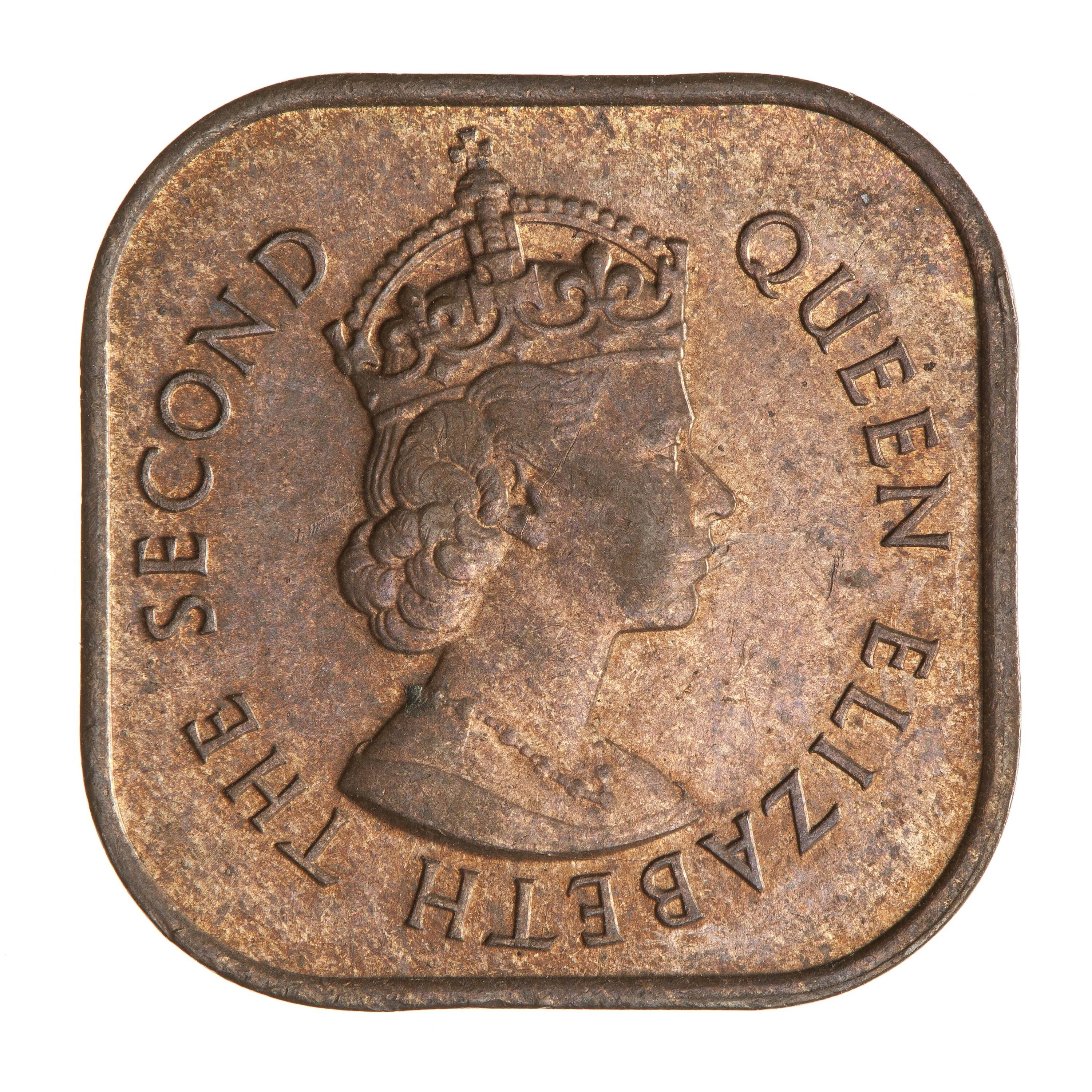
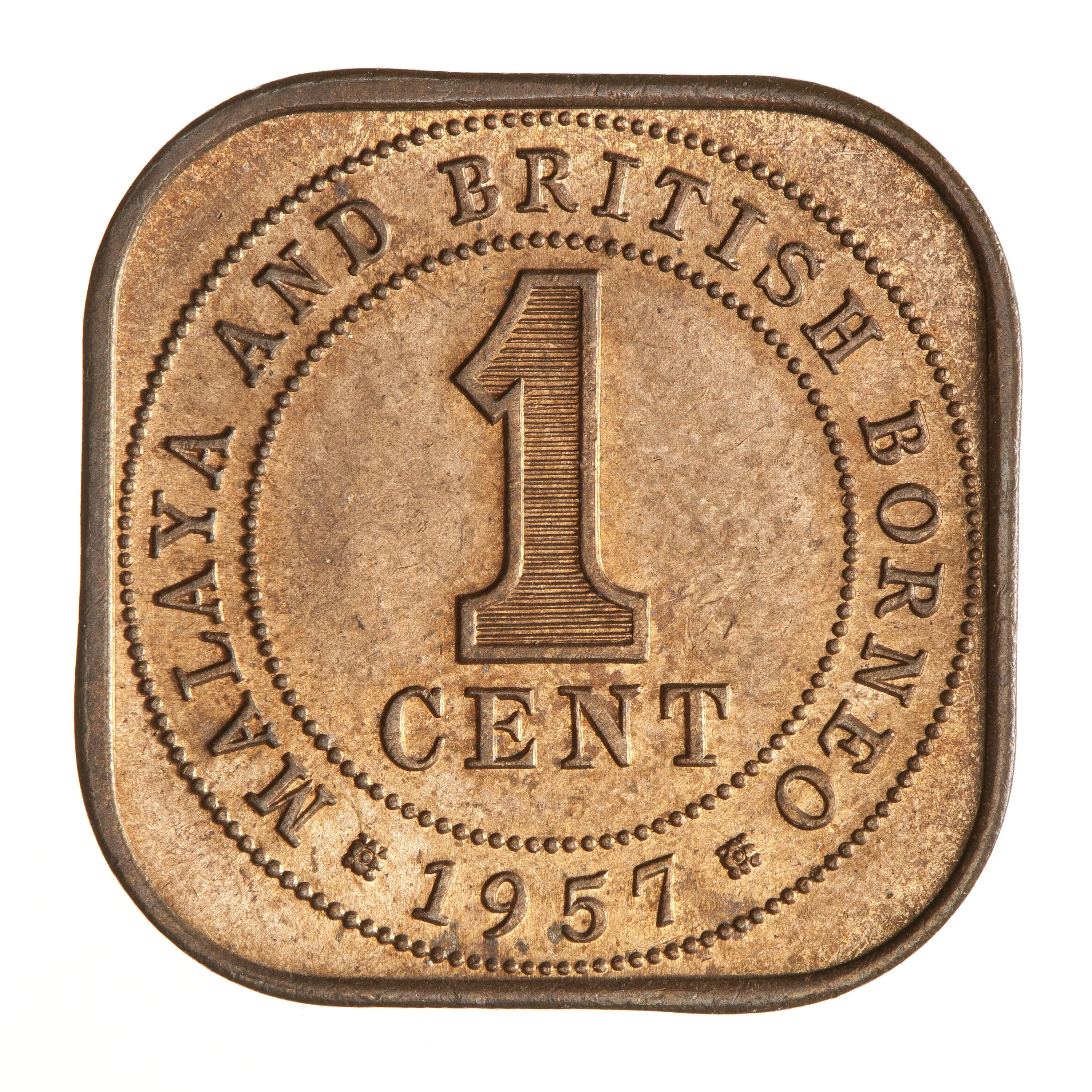
1 Cent – Malaya
Malaysia
Context

Material
Weight: 4.21 g
Thickness: 1.64 mm
Shape: Square with rounded corners
Composition: Bronze
Magnetic: No
Technique: Milled
Alignment: Medal alignment
flip
References
KM: #Click to copy to clipboard6
Numista: #3461
Obverse
Description:
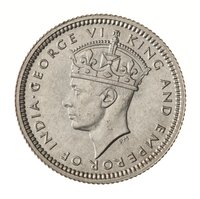
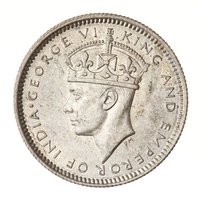
Crowned left-facing bust.
Inscription:
GEORGE VI KING EMPEROR
PM
PM
Translation:
GEORGE VI KING EMPEROR
PM
PM
Script: Latin
Language: English
Engraver: Percy Metcalfe
Reverse
Description:
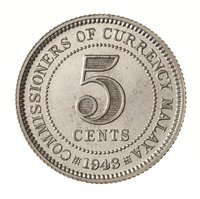
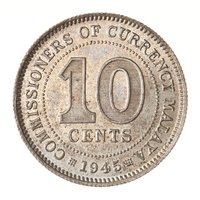
Beaded circle value
Inscription:
COMMISSIONERS OF CURRENCY MALAYA
1
CENT
1945
1
CENT
1945
Script: Latin
Edge
Plain
Mints
| Name | Mark |
|---|---|
| Royal Mint (Tower Hill) | — |
Mintings
| Year | Mint Mark | Mintage | Quality | Collection |
|---|---|---|---|---|
| 1943 | — | 50,000,000 | ||
| 1943 | — | — | Proof | |
| 1945 | — | 40,033,000 | ||
| 1945 | — | — | Proof |
Historical background
In 1943, the currency situation in Japanese-occupied Malaya was one of severe hyperinflation and economic collapse, driven by the unchecked printing of currency by the Japanese Military Administration. Following their conquest in early 1942, the Japanese outlawed the pre-war Straits Settlements currency and introduced their own "Malayan dollar," commonly known as "banana money" due to the banana tree motif on some notes. With no tangible reserves to back the currency, the Japanese authorities financed their occupation and war efforts simply by printing increasingly vast quantities of these notes, flooding the economy.
The result was a catastrophic loss of public confidence and a rapid devaluation of the currency. Prices soared as the money supply exploded, leading to a situation where consumers needed sacks of cash to buy basic necessities like rice or cloth. A thriving black market emerged where goods were bartered or traded for pre-war British currency, gold, or Japanese occupation "gunpyō" (military scrip), which held slightly more value. The official currency became virtually worthless, pushing the civilian population into severe hardship and contributing to widespread malnutrition and poverty.
This monetary chaos was part of a broader economic stranglehold, as Malaya’s export-oriented rubber and tin industries were severed from their global markets and repuriented to serve Japan’s war machine. The hyperinflation eroded savings and wages, forcing people to rely on subsistence farming and barter for survival. The complete collapse of the currency by 1943 underscored the brutal reality of the occupation, leaving a lasting legacy of economic trauma that would challenge post-war reconstruction.
The result was a catastrophic loss of public confidence and a rapid devaluation of the currency. Prices soared as the money supply exploded, leading to a situation where consumers needed sacks of cash to buy basic necessities like rice or cloth. A thriving black market emerged where goods were bartered or traded for pre-war British currency, gold, or Japanese occupation "gunpyō" (military scrip), which held slightly more value. The official currency became virtually worthless, pushing the civilian population into severe hardship and contributing to widespread malnutrition and poverty.
This monetary chaos was part of a broader economic stranglehold, as Malaya’s export-oriented rubber and tin industries were severed from their global markets and repuriented to serve Japan’s war machine. The hyperinflation eroded savings and wages, forcing people to rely on subsistence farming and barter for survival. The complete collapse of the currency by 1943 underscored the brutal reality of the occupation, leaving a lasting legacy of economic trauma that would challenge post-war reconstruction.
Series: 1943 Malaya circulation coins
🌱 Very Common