

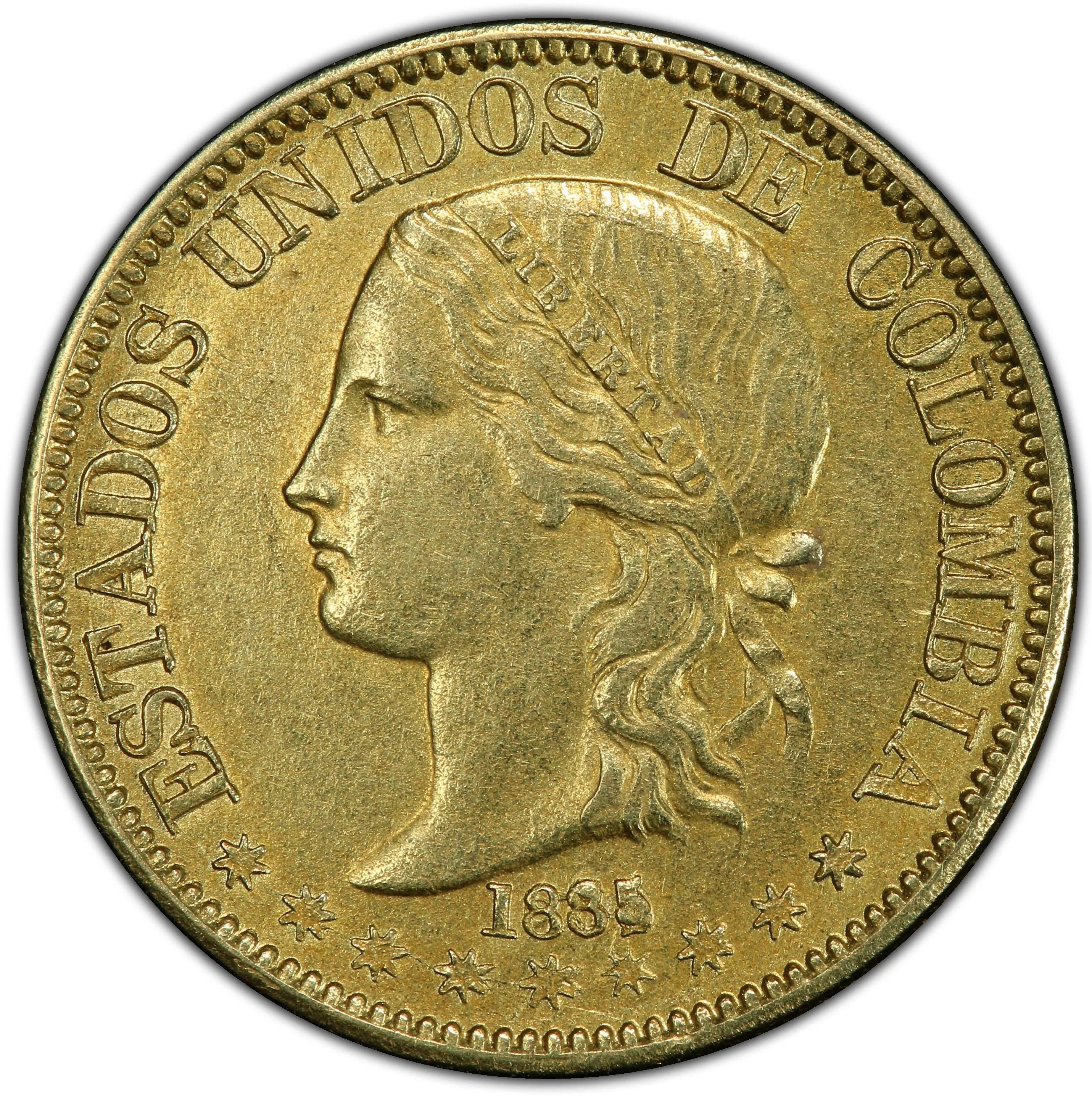
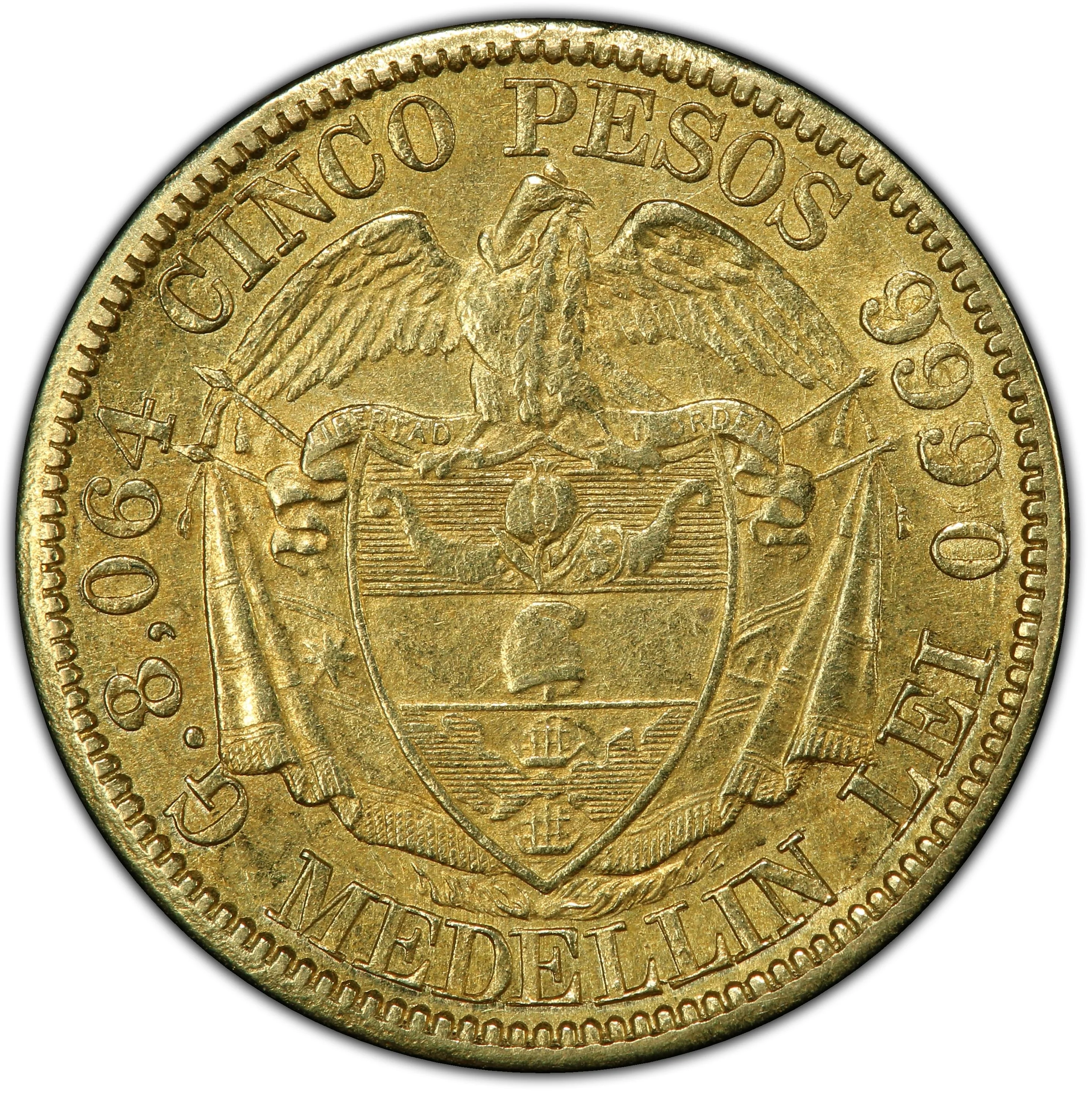
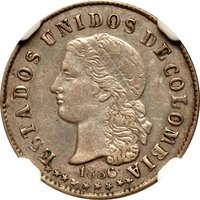
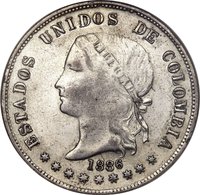
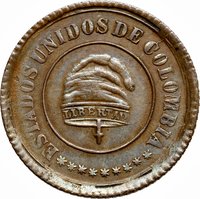
Obverse
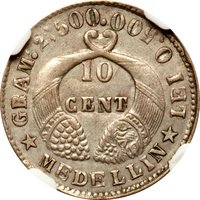
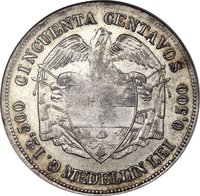
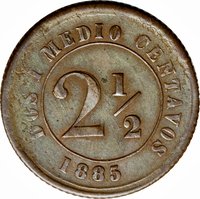
Reverse
Description:
Coat of arms centered, weight left, value above, fineness right, mint below.
Inscription:
CINCO PESOS
G. 8,064
LEI 0,666
MEDELLIN
G. 8,064
LEI 0,666
MEDELLIN
Script: Latin
Edge
Mints
| Name | Mark |
|---|---|
| Casa de Moneda de Colombia | MEDELLIN |
Mintings
| Year | Mint Mark | Mintage | Quality | Collection |
|---|---|---|---|---|
| 1885 | MEDELLIN | — |
Historical background
In 1885, Colombia was emerging from a period of profound political and economic fragmentation known as the "Radical Olympus" (1863-1885) under the federal constitution of Rionegro. This era granted immense autonomy to its nine sovereign states, each of which issued its own paper currency, leading to a chaotic monetary landscape. The country was saturated with a multitude of banknotes of wildly varying credibility and value, from the pesos of the Estado Soberano de Antioquia to those of Cundinamarca and Cauca. This proliferation of currency, largely unbacked by specie, caused severe inflation, crippled interstate trade, and reflected the weak central authority of the national government in Bogotá.
The political turning point came in 1885 with the victory of the Regeneration movement under President Rafael Núñez, who decisively ended the federal system with a new centralist constitution in 1886. A primary objective of this political consolidation was to establish monetary order and national economic unity. Consequently, the government moved aggressively to abolish the monetary authority of the individual states and began the process of centralizing currency issuance under a single, national bank.
Therefore, the currency situation in 1885 stands at a critical juncture. It marks the final year of a disordered, inflationary multi-currency system and the immediate prelude to the creation of a unified national currency. The Regeneration government would soon charter the Banco Nacional (1887) as its exclusive issuing entity, laying the institutional groundwork for the eventual introduction of the Colombian peso as the sole legal tender, aiming to stabilize commerce and solidify the financial power of the newly centralized Colombian state.
The political turning point came in 1885 with the victory of the Regeneration movement under President Rafael Núñez, who decisively ended the federal system with a new centralist constitution in 1886. A primary objective of this political consolidation was to establish monetary order and national economic unity. Consequently, the government moved aggressively to abolish the monetary authority of the individual states and began the process of centralizing currency issuance under a single, national bank.
Therefore, the currency situation in 1885 stands at a critical juncture. It marks the final year of a disordered, inflationary multi-currency system and the immediate prelude to the creation of a unified national currency. The Regeneration government would soon charter the Banco Nacional (1887) as its exclusive issuing entity, laying the institutional groundwork for the eventual introduction of the Colombian peso as the sole legal tender, aiming to stabilize commerce and solidify the financial power of the newly centralized Colombian state.
Series: 1885 Colombia circulation coins
✨ Legendary