

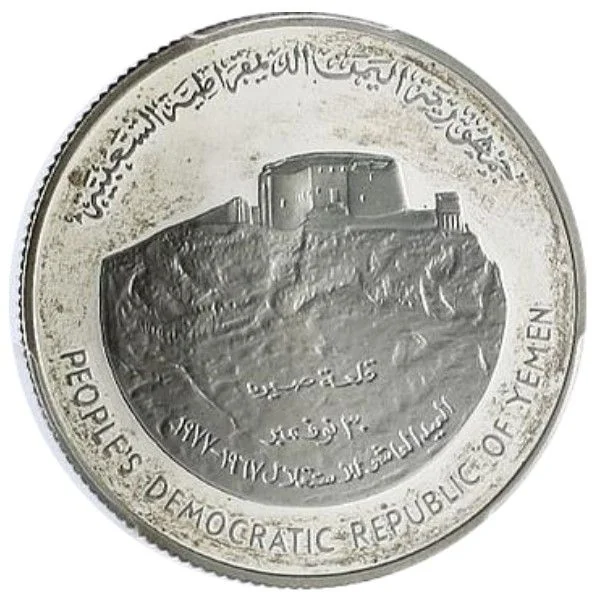
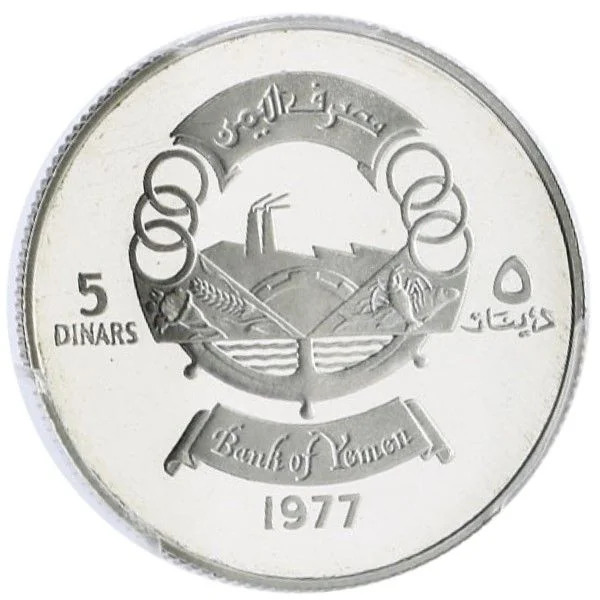
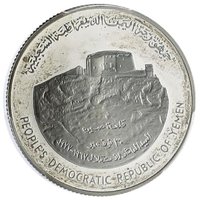
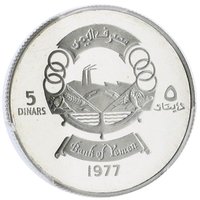
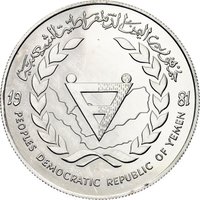
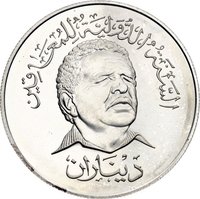
5 dinars (independence) – People's Democratic Republic of Yemen
Add to wishlist
Non-circulating coins
Commemoration: 10th anniversary of independence
Yemen
Obverse
Reverse
Edge
Categories
| Event> Independence |
Mints
| Name | Mark |
|---|---|
| Royal Mint | — |
Mintings
| Year | Mint Mark | Mintage | Quality | Collection |
|---|---|---|---|---|
| 1977 | — | 6,000 | Proof |
Historical background
In 1977, the currency situation in the People's Democratic Republic of Yemen (PDRY, or South Yemen) was characterized by the exclusive use of the South Yemeni Dinar (YDD). Introduced in 1972 to replace the South Arabian Dinar, the currency was a symbol of the state's sovereignty following independence from Britain in 1967. It was a non-convertible currency, with its value and exchange tightly controlled by the Marxist-Leninist government in Aden, which maintained a fixed official exchange rate primarily pegged to a basket of currencies, with a strong link to the International Monetary Fund's Special Drawing Rights (SDR).
The economy and monetary policy were centrally planned, aligning with the state's socialist orientation. The government, through the Bank of Yemen (the central bank), strictly regulated all foreign exchange transactions, requiring licenses for most trade-related conversions. This created a significant disparity between the official exchange rate and the black-market rate, as the overvalued official dinar did not reflect the country's struggling economic realities. Chronic trade deficits, reliance on limited exports (like fish and refined petroleum from the Aden refinery), and dependence on substantial foreign aid from the Soviet Union and Arab donors placed persistent pressure on the currency.
Consequently, access to hard foreign currency was scarce for citizens and businesses, heavily rationed for state-prioritized imports. The currency's isolation reflected the PDRY's broader political and economic isolation from much of the Western world and its non-convertible neighbors, with its main financial relationships existing within the Eastern Bloc. This restrictive system aimed to conserve foreign reserves and enforce state economic control but contributed to inefficiencies, shortages, and a constrained formal economy as the decade progressed.
The economy and monetary policy were centrally planned, aligning with the state's socialist orientation. The government, through the Bank of Yemen (the central bank), strictly regulated all foreign exchange transactions, requiring licenses for most trade-related conversions. This created a significant disparity between the official exchange rate and the black-market rate, as the overvalued official dinar did not reflect the country's struggling economic realities. Chronic trade deficits, reliance on limited exports (like fish and refined petroleum from the Aden refinery), and dependence on substantial foreign aid from the Soviet Union and Arab donors placed persistent pressure on the currency.
Consequently, access to hard foreign currency was scarce for citizens and businesses, heavily rationed for state-prioritized imports. The currency's isolation reflected the PDRY's broader political and economic isolation from much of the Western world and its non-convertible neighbors, with its main financial relationships existing within the Eastern Bloc. This restrictive system aimed to conserve foreign reserves and enforce state economic control but contributed to inefficiencies, shortages, and a constrained formal economy as the decade progressed.
✨ Legendary