

1 sol – Peru
Add to wishlist
Non-circulating coins
Commemoration: Ibero-American Series II - Endangered Wildlife
Series: Ibero-American
Peru
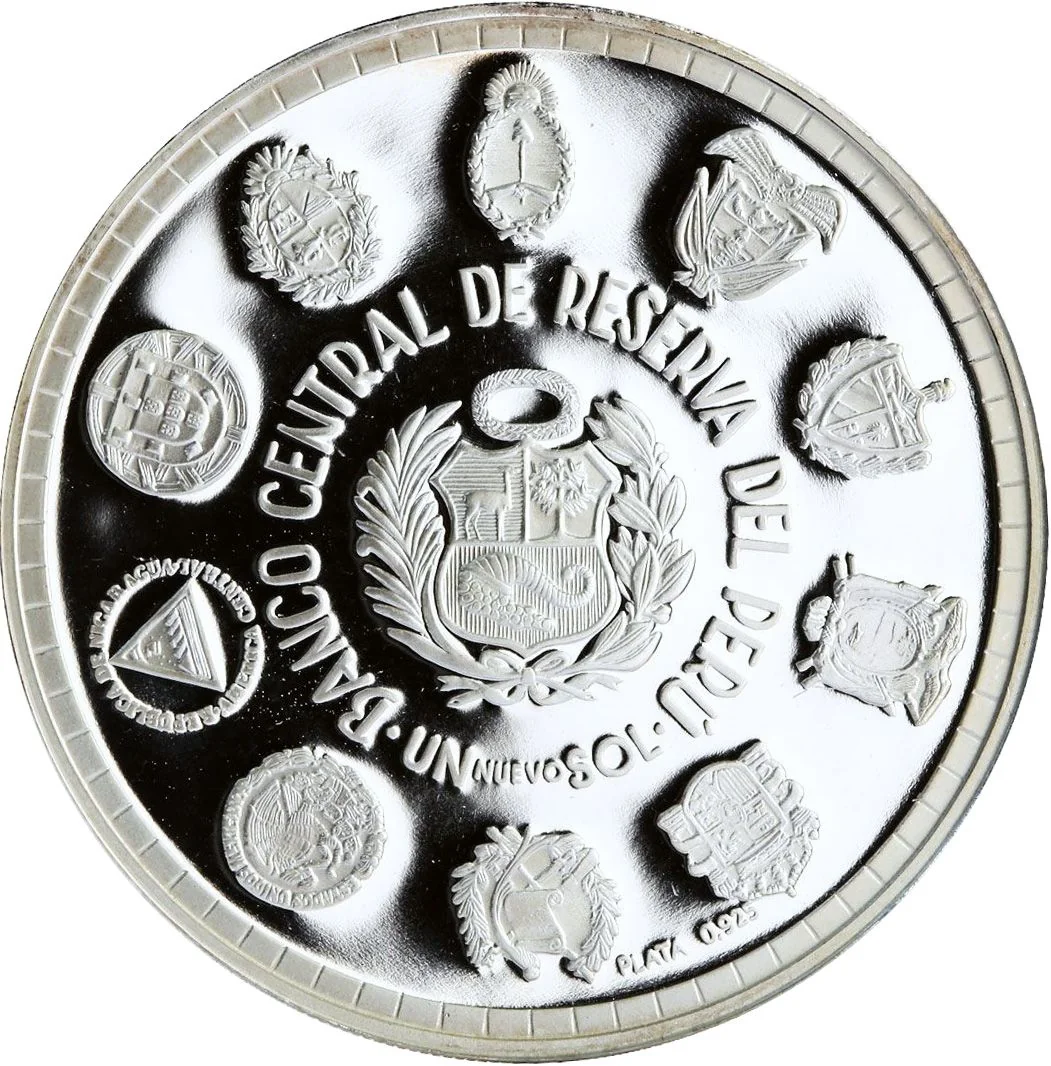
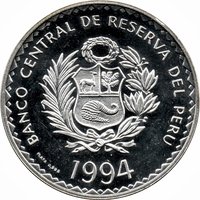
Obverse
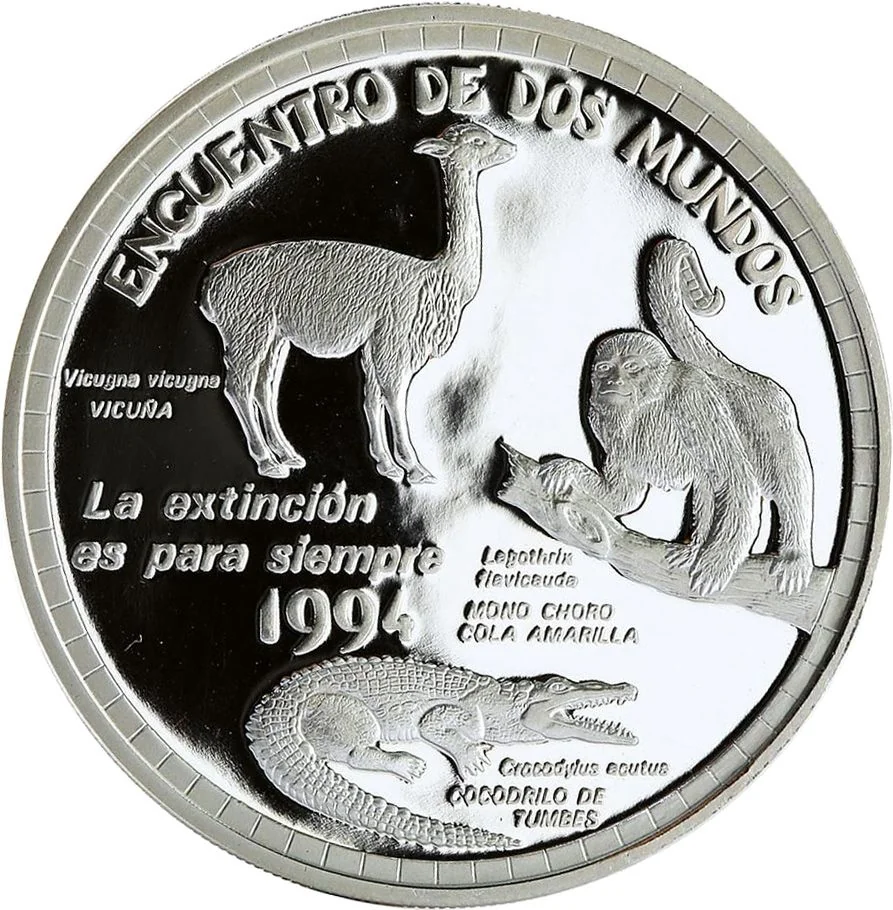
Reverse
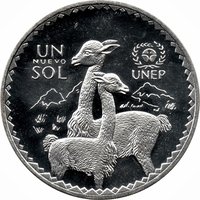
Description:
Vicuña, monkey, crocodile.
Inscription:
ENCUENTRO DE DOS MUNDOS
LA EXTINCION ES PARA SIEMPRE
1994
Vicugna vicugna
VICUÑA
Lagothrix flavicauda
MONO CHORO COLA AMARILLA
Crocodylus acutus
COCODRILO DE TUMBES
LA EXTINCION ES PARA SIEMPRE
1994
Vicugna vicugna
VICUÑA
Lagothrix flavicauda
MONO CHORO COLA AMARILLA
Crocodylus acutus
COCODRILO DE TUMBES
Translation:
ENCOUNTER OF TWO WORLDS
EXTINCTION IS FOREVER
1994
Vicugna vicugna
VICUÑA
Lagothrix flavicauda
YELLOW-TAILED WOOLLY MONKEY
Crocodylus acutus
TUMBES CROCODILE
EXTINCTION IS FOREVER
1994
Vicugna vicugna
VICUÑA
Lagothrix flavicauda
YELLOW-TAILED WOOLLY MONKEY
Crocodylus acutus
TUMBES CROCODILE
Script: Latin
Language: Spanish
Edge
Reeded
Mints
| Name | Mark |
|---|---|
| Mexican Mint | — |
Mintings
| Year | Mint Mark | Mintage | Quality | Collection |
|---|---|---|---|---|
| 1994 | — | 25,000 | Proof |
Historical background
In 1994, Peru was in the early stages of a profound economic transformation under President Alberto Fujimori and his Economy Minister, Carlos Boloña. Following the hyperinflation and economic chaos of the late 1980s, the government had implemented a severe stabilization program in 1990, known as "Fujishock." By 1994, these policies had successfully tamed inflation, which had plummeted from an annual rate of over 7,600% in 1990 to a manageable 15.4% by the end of 1994. The foundation of this stability was a tightly managed floating exchange rate regime, with the Peruvian sol being allowed to depreciate in a controlled manner to maintain export competitiveness while anchoring prices.
The currency situation was characterized by a deliberate policy of minidevaluations. The Central Reserve Bank of Peru (BCRP) actively intervened in the foreign exchange market, allowing the sol to depreciate by small, predictable amounts daily against the US dollar. This "crawling peg" system was designed to prevent sudden shocks and speculative attacks, providing businesses with a stable and predictable environment for planning. The US dollar also circulated widely alongside the sol in a highly dollarized economy, a lingering effect of the hyperinflation period, with many savings, loans, and major transactions conducted in dollars.
Overall, the currency situation in 1994 reflected a period of hard-won stability and cautious liberalization. The BCRP's management of the exchange rate was a cornerstone of the broader economic agenda that prioritized defeating inflation, attracting foreign investment, and reintegrating Peru into the global financial system. While challenges remained, including persistent dollarization and the need for deeper structural reforms, the controlled depreciation of the sol in 1994 was seen as a necessary and successful tool for consolidating the country's macroeconomic recovery.
The currency situation was characterized by a deliberate policy of minidevaluations. The Central Reserve Bank of Peru (BCRP) actively intervened in the foreign exchange market, allowing the sol to depreciate by small, predictable amounts daily against the US dollar. This "crawling peg" system was designed to prevent sudden shocks and speculative attacks, providing businesses with a stable and predictable environment for planning. The US dollar also circulated widely alongside the sol in a highly dollarized economy, a lingering effect of the hyperinflation period, with many savings, loans, and major transactions conducted in dollars.
Overall, the currency situation in 1994 reflected a period of hard-won stability and cautious liberalization. The BCRP's management of the exchange rate was a cornerstone of the broader economic agenda that prioritized defeating inflation, attracting foreign investment, and reintegrating Peru into the global financial system. While challenges remained, including persistent dollarization and the need for deeper structural reforms, the controlled depreciation of the sol in 1994 was seen as a necessary and successful tool for consolidating the country's macroeconomic recovery.
Series: Ibero-American
💎 Very Rare