

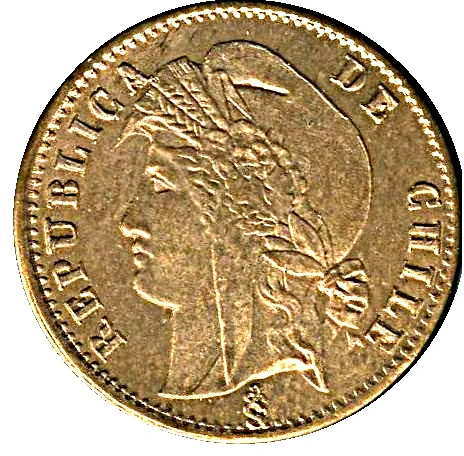

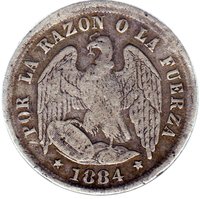
Obverse
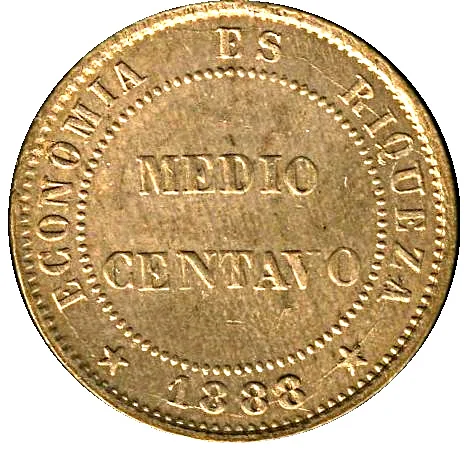
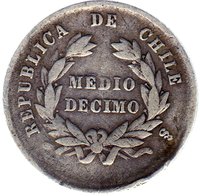
Reverse
Edge
Plain
Categories
| Symbol> Allegory |
| Symbol> Phrygian cap |
Mints
| Name | Mark |
|---|---|
| Casa de Moneda de Chile | (So) |
Mintings
| Year | Mint Mark | Mintage | Quality | Collection |
|---|---|---|---|---|
| 1883 | So | 714,000 | ||
| 1884 | So | 104,000 | ||
| 1885 | So | 132,000 | ||
| 1886 | So | 469,000 | ||
| 1888 | So | 294,000 | ||
| 1890 | So | 70,000 | ||
| 1893 | So | 71,000 | ||
| 1894 | So | 251,000 |
Historical background
In 1883, Chile's currency situation was characterized by the widespread circulation of multiple, often depreciated, forms of money, creating a complex and unstable monetary environment. The primary currency was the peso, but its value was not uniform. The country operated on a bimetallic standard in law, but in practice, it was flooded with pesos fuertes (strong pesos), fractional silver, and, most problematically, large quantities of privately issued banknotes (billetes bancarios) and inconvertible government paper money. This paper money, issued to finance the War of the Pacific (1879-1883), had led to significant inflation and a sharp divergence between the value of metallic and paper pesos, with paper trading at a steep discount.
The end of the war in 1883 found the Chilean treasury depleted and facing the urgent task of postwar economic reorganization, which included resolving the chaotic currency system. The abundance of paper money, which was not redeemable for gold or silver, created uncertainty for both domestic commerce and international trade. Furthermore, different banks issued their own notes with varying degrees of credibility, and the government itself had issued billetes fiscales (treasury notes). This lack of a uniform, trusted currency hindered economic recovery and investment.
Consequently, the period immediately following 1883 set the stage for major monetary reforms. The government recognized the necessity of retiring the inflationary paper money and restoring convertibility to stabilize the economy. This pressure culminated in the pivotal Law of Monetary Conversion of 1887, which began the process of withdrawing paper money from circulation and re-establishing a gold standard, aiming to impose discipline, attract foreign capital, and integrate Chile more firmly into the global financial system. Thus, the situation in 1883 represents the peak of monetary disorder that prompted a decisive shift toward modern financial consolidation.
The end of the war in 1883 found the Chilean treasury depleted and facing the urgent task of postwar economic reorganization, which included resolving the chaotic currency system. The abundance of paper money, which was not redeemable for gold or silver, created uncertainty for both domestic commerce and international trade. Furthermore, different banks issued their own notes with varying degrees of credibility, and the government itself had issued billetes fiscales (treasury notes). This lack of a uniform, trusted currency hindered economic recovery and investment.
Consequently, the period immediately following 1883 set the stage for major monetary reforms. The government recognized the necessity of retiring the inflationary paper money and restoring convertibility to stabilize the economy. This pressure culminated in the pivotal Law of Monetary Conversion of 1887, which began the process of withdrawing paper money from circulation and re-establishing a gold standard, aiming to impose discipline, attract foreign capital, and integrate Chile more firmly into the global financial system. Thus, the situation in 1883 represents the peak of monetary disorder that prompted a decisive shift toward modern financial consolidation.
🌟 Limited