

20 piastres – Egypt
Add to wishlist
Egypt
Context
Material
References
KM: #
Numista: #34276
Value
Exchange value: 0.20 EGP
Bullion value: $59.13
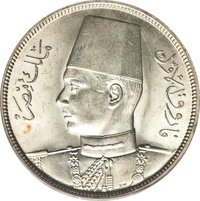
Obverse
Description:
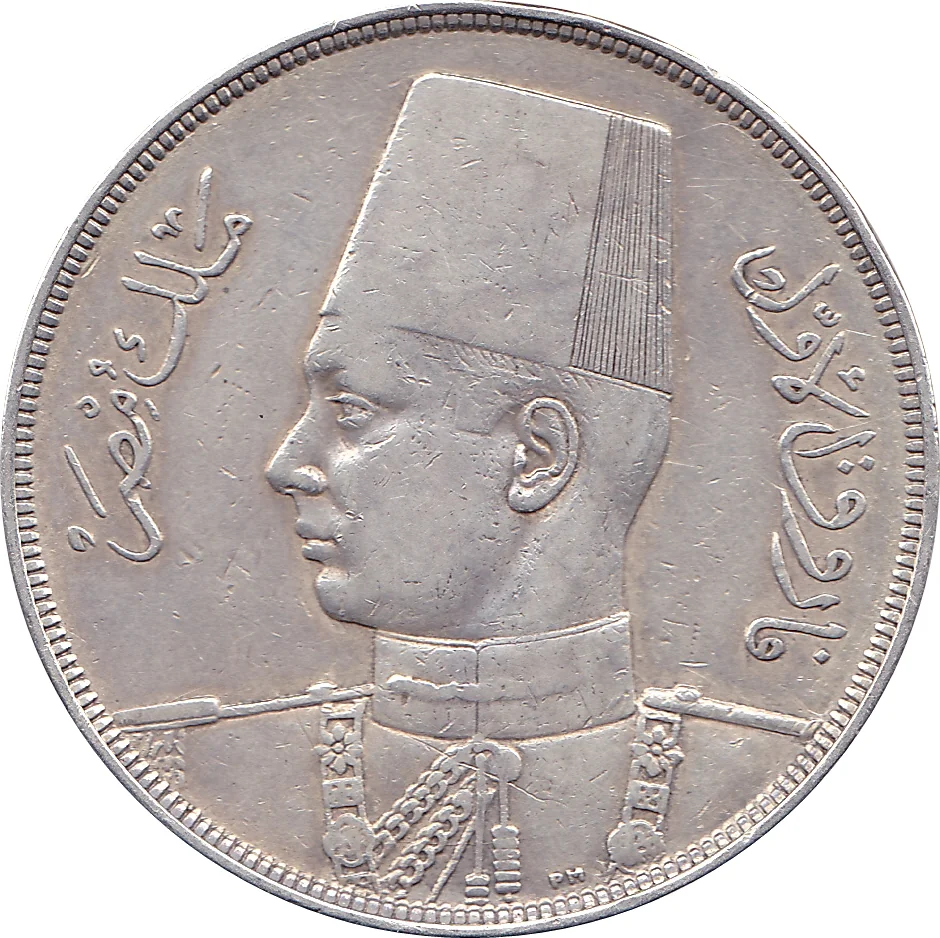
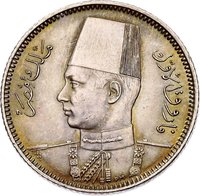
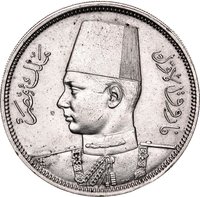
King Farouk in profile, wearing a hat.
Inscription:
فاروق الأوّل
ملك مصر
ملك مصر
Translation:
Farouk the First
King of Egypt
King of Egypt
Script: Arabic
Language: Arabic
Engraver: Percy Metcalfe
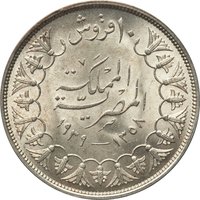
Reverse
Edge
Security Edge
Mints
| Name | Mark |
|---|---|
| Royal Mint (Tower Hill) | — |
Mintings
| Year | Mint Mark | Mintage | Quality | Collection |
|---|---|---|---|---|
| 1937 | — | 25,000 | ||
| 1937 | — | — | Proof | |
| 1939 | — | 25,000 | ||
| 1939 | — | — | Proof |
Historical background
In 1937, Egypt's currency situation was defined by its continued adherence to the gold standard and its close, formalized link to the British pound sterling. The Egyptian pound (EE), introduced in 1885, was a strong, stable currency backed by substantial gold reserves. By law, it was pegged at a fixed rate of EE 0.975 to £1 sterling, a relationship managed by the privately-owned National Bank of Egypt, which acted as the country's central bank. This sterling peg facilitated trade and capital flows within the British Empire, anchoring Egypt's financial system to London's.
This monetary arrangement, however, reflected and reinforced Egypt's constrained economic sovereignty. While providing stability, the peg inherently subordinated Egyptian monetary policy to British interests, a lingering effect of the country's status as a British protectorate until 1922 and its continued heavy influence thereafter. Egypt's large holdings of sterling securities as backing for its currency further tied its economic fortunes to Britain's. The system functioned smoothly on the surface, but it was fundamentally oriented towards serving foreign commerce and the interests of the cosmopolitan elite, rather than directed at fostering broader domestic industrial development.
The stability of 1937 existed in a delicate global context. The world was still recovering from the Great Depression, and the abandonment of the gold standard by major powers like Britain in 1931 had tested Egypt's commitment to its peg. While Egypt had successfully maintained the sterling link through that crisis, the underlying dependencies created vulnerabilities. The outbreak of World War II just two years later would profoundly stress this system, leading to the accumulation of massive sterling balances in London and eventually forcing a re-evaluation of Egypt's monetary independence in the post-war era.
This monetary arrangement, however, reflected and reinforced Egypt's constrained economic sovereignty. While providing stability, the peg inherently subordinated Egyptian monetary policy to British interests, a lingering effect of the country's status as a British protectorate until 1922 and its continued heavy influence thereafter. Egypt's large holdings of sterling securities as backing for its currency further tied its economic fortunes to Britain's. The system functioned smoothly on the surface, but it was fundamentally oriented towards serving foreign commerce and the interests of the cosmopolitan elite, rather than directed at fostering broader domestic industrial development.
The stability of 1937 existed in a delicate global context. The world was still recovering from the Great Depression, and the abandonment of the gold standard by major powers like Britain in 1931 had tested Egypt's commitment to its peg. While Egypt had successfully maintained the sterling link through that crisis, the underlying dependencies created vulnerabilities. The outbreak of World War II just two years later would profoundly stress this system, leading to the accumulation of massive sterling balances in London and eventually forcing a re-evaluation of Egypt's monetary independence in the post-war era.
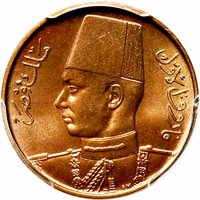
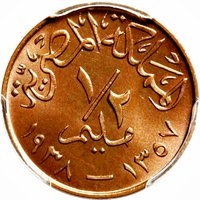
Series: 1937 Egypt circulation coins
🌟 Limited