

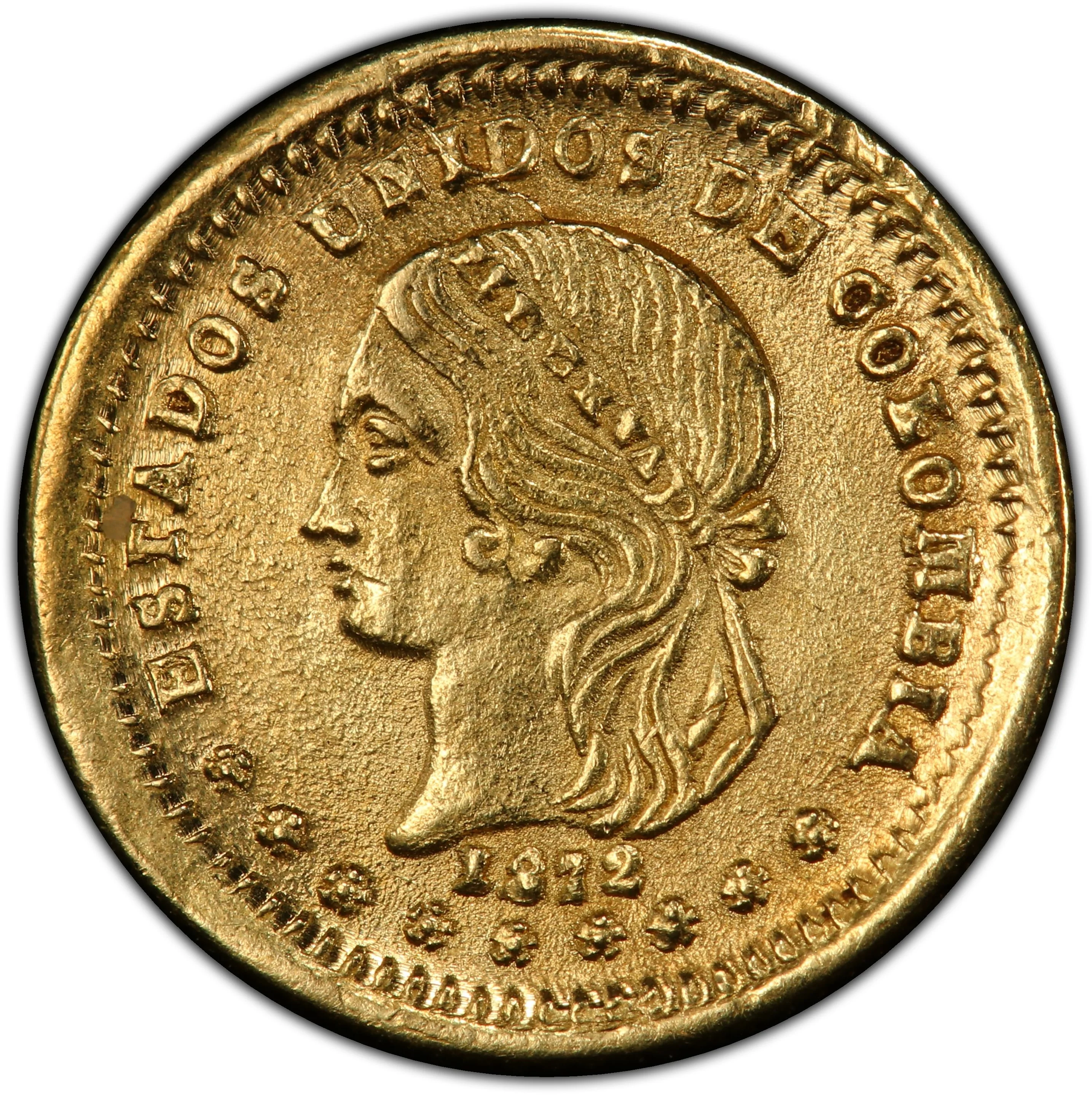
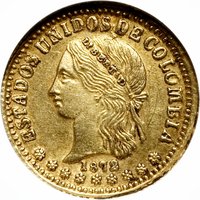
Obverse
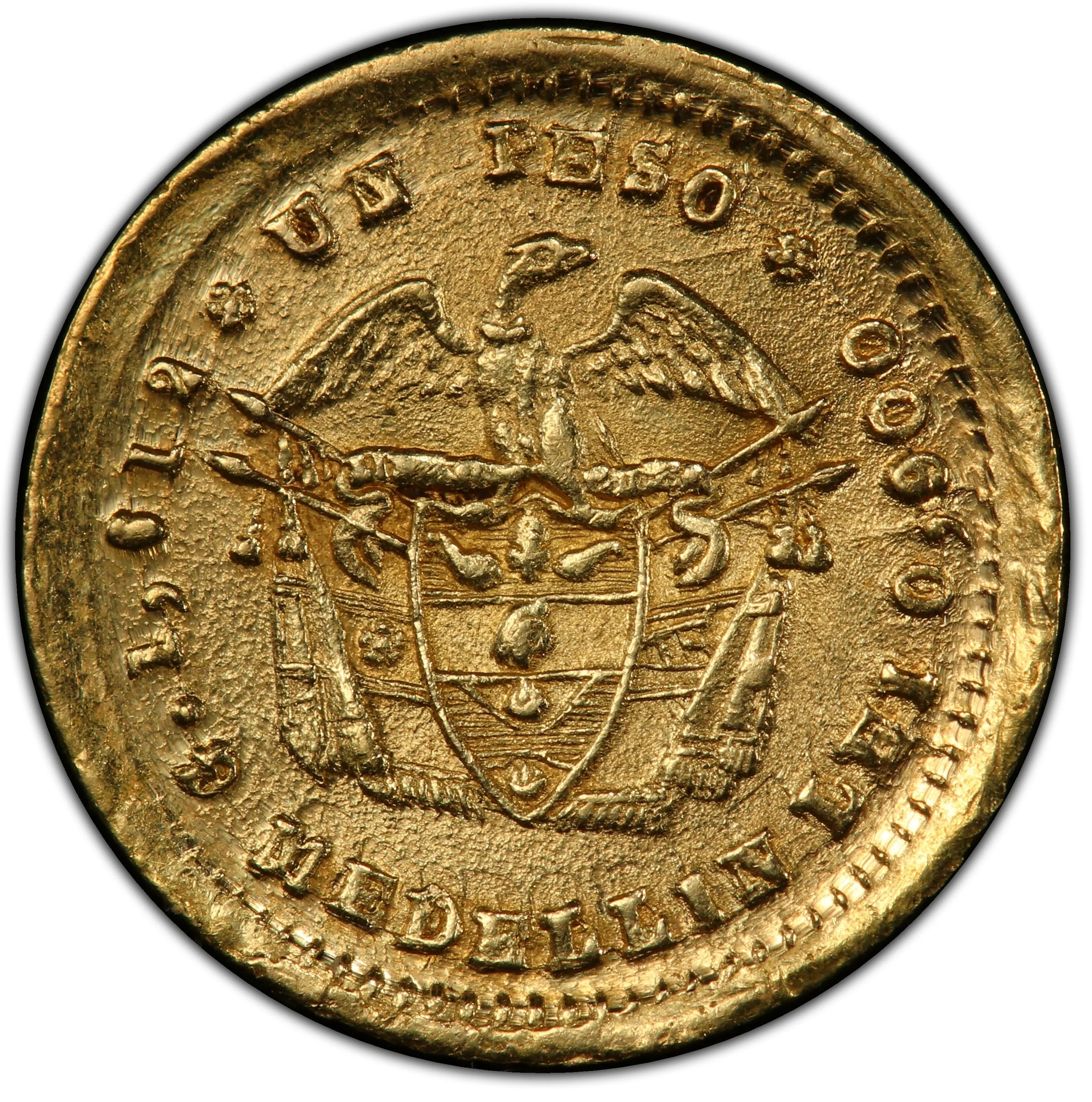
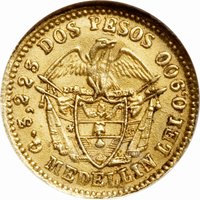
Reverse
Description:
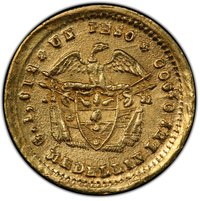
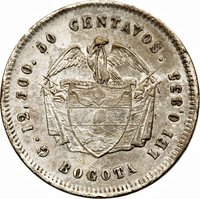
Coat of arms center; top value, left weight, right fineness, bottom mint.
Inscription:
UN PESO
G.1,612
LEI 0.900
MEDELLIN
G.1,612
LEI 0.900
MEDELLIN
Script: Latin
Edge
Mints
| Name | Mark |
|---|---|
| Casa de Moneda de Colombia | — |
Mintings
| Year | Mint Mark | Mintage | Quality | Collection |
|---|---|---|---|---|
| 1872 | — | 62,000 | ||
| 1873 | — | 18,000 |
Historical background
In 1872, Colombia’s currency situation was characterized by profound disorder and regional fragmentation, a direct legacy of the political instability following the dissolution of Gran Colombia. The country operated without a unified national currency; instead, a chaotic mix of foreign and domestic coins circulated. These included Spanish colonial doubloons, Peruvian pesos, Bolivian coins, and French francs, alongside various privately issued banknotes from nascent commercial banks. The lack of a central mint or banking authority meant exchange rates fluctuated wildly between regions and even towns, severely hampering domestic trade and economic calculation.
This monetary anarchy was exacerbated by the federalist system established by the 1863 Constitution of Rionegro, which granted sovereign states extensive powers, including the right to charter banks and authorize paper money. Consequently, multiple state-affiliated and private banks issued their own billetes (banknotes) with varying degrees of convertibility and security. The value of these notes was highly speculative, often depreciating rapidly and leading to frequent public distrust and rejection. The national government, weak and financially strained, had little power to impose monetary discipline or a standard currency across the disparate states.
The year 1872 fell within a period of attempted, but ultimately faltering, reform. Efforts were underway to establish a national bank and create a uniform currency, a push that would culminate in 1880 with the creation of the Banco Nacional and the introduction of the peso as the official currency. However, in 1872, these reforms were still in their formative stages, and the economy remained mired in complexity. The monetary confusion of this era reflected the broader challenges of nation-building in 19th-century Colombia, where political fragmentation directly undermined economic cohesion and stability.
This monetary anarchy was exacerbated by the federalist system established by the 1863 Constitution of Rionegro, which granted sovereign states extensive powers, including the right to charter banks and authorize paper money. Consequently, multiple state-affiliated and private banks issued their own billetes (banknotes) with varying degrees of convertibility and security. The value of these notes was highly speculative, often depreciating rapidly and leading to frequent public distrust and rejection. The national government, weak and financially strained, had little power to impose monetary discipline or a standard currency across the disparate states.
The year 1872 fell within a period of attempted, but ultimately faltering, reform. Efforts were underway to establish a national bank and create a uniform currency, a push that would culminate in 1880 with the creation of the Banco Nacional and the introduction of the peso as the official currency. However, in 1872, these reforms were still in their formative stages, and the economy remained mired in complexity. The monetary confusion of this era reflected the broader challenges of nation-building in 19th-century Colombia, where political fragmentation directly undermined economic cohesion and stability.
Series: 1872 Colombia circulation coins
✨ Legendary