

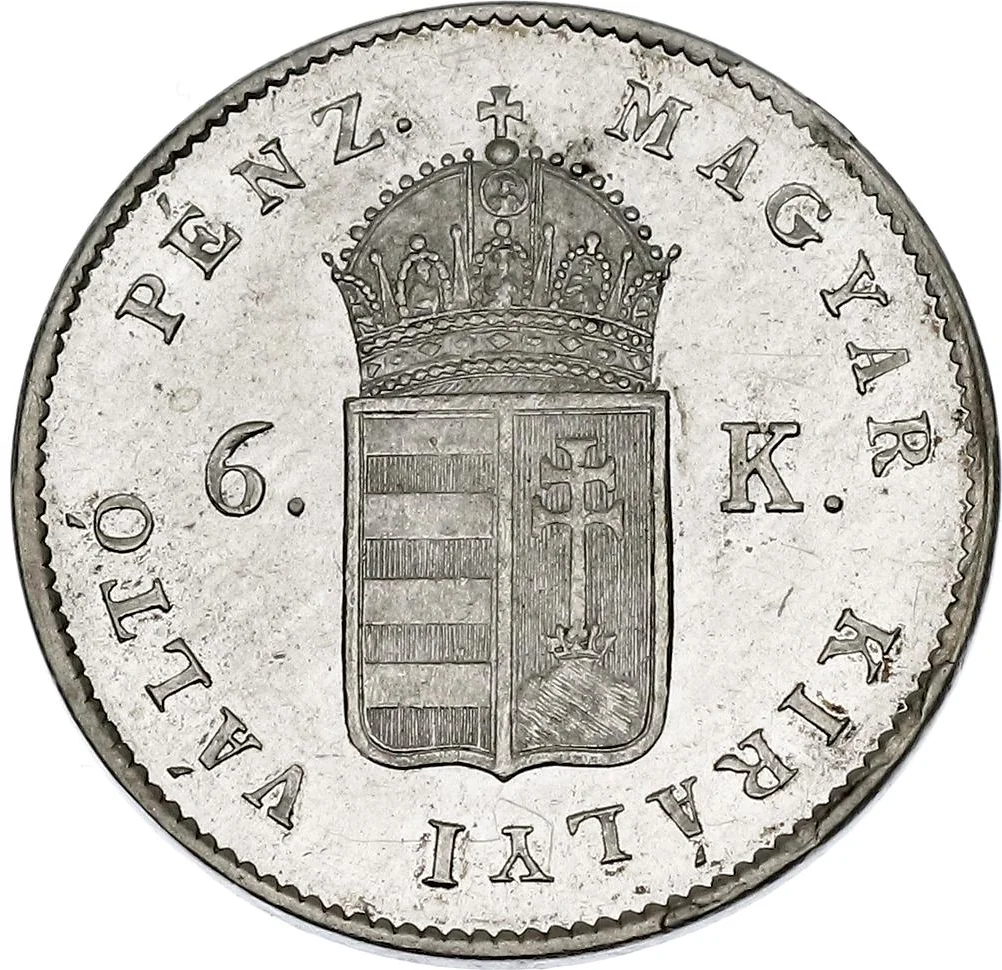
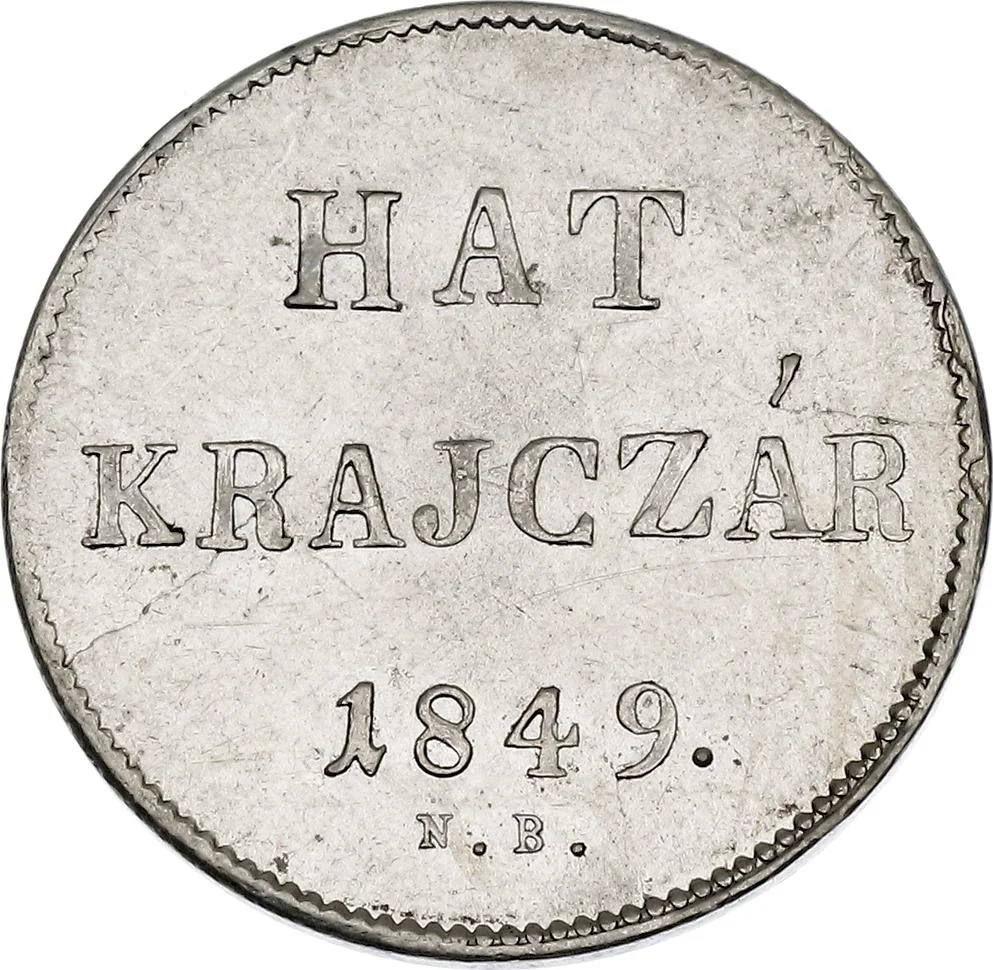
6 Kreuzers – Hungary
Hungary

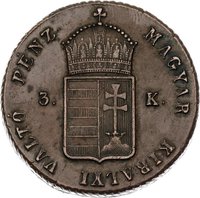
Obverse
Description:
Hungary's crowned coat of arms.
Inscription:
MAGYAR KIRÁLYI VÁLTÓPÉNZ.
6. K.
6. K.
Translation:
Royal Hungarian Change Coin.
6 K.
6 K.
Script: Latin
Language: Hungarian
Engraver: Johann Gerger
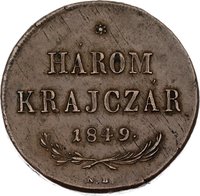
Reverse
Description:
Hungarian denomination and date.
Inscription:
HAT KRAJCZÁR
1849
N. B.
1849
N. B.
Translation:
HAT KRAJCZÁR
1849
N. B.
1849
N. B.
Script: Latin
Language: Hungarian
Engraver: Johann Gerger
Edge
Plain
Categories
| Symbols> Coat of Arms |
Mintings
| Year | Mint Mark | Mintage | Quality | Collection |
|---|---|---|---|---|
| 1849 | K. | — | ||
| 1849 | N. | — |
Historical background
In 1849, Hungary found itself in a state of revolution and war, and its currency situation was a direct reflection of this profound political crisis. Having declared independence from the Habsburg Empire in April 1848, the revolutionary Hungarian government, led by Lajos Kossuth, faced the immense financial strain of funding a national army against the Austrian and later Russian forces. The traditional Habsburg coinage (kreuzers and florins) remained in circulation but was insufficient, leading the government to resort to issuing paper money to finance the war effort.
The primary instrument was the "Kossuth bankó," a paper note issued by the Hungarian government. These notes were not backed by substantial silver or gold reserves but by the promise of future redemption after victory. As the military situation grew increasingly desperate, the government was forced to print more and more of this fiat currency to pay soldiers and suppliers, leading to rapid depreciation and severe inflation. The value of the bankó plummeted, especially in areas distant from the capital, and it often traded at a steep discount to the still-preferred Austrian silver coins.
The currency crisis culminated with the collapse of the revolution in August 1849. Following the Hungarian surrender, the victorious Habsburg authorities declared the "Kossuth bankó" null and void, rendering the vast quantities in circulation worthless and wiping out the savings of many who had supported the cause. This financial ruin compounded the political repression that followed, leaving a legacy of economic devastation and underscoring how the revolutionary government's fiscal measures, while necessary for survival, were ultimately dependent on a military victory that never came.
The primary instrument was the "Kossuth bankó," a paper note issued by the Hungarian government. These notes were not backed by substantial silver or gold reserves but by the promise of future redemption after victory. As the military situation grew increasingly desperate, the government was forced to print more and more of this fiat currency to pay soldiers and suppliers, leading to rapid depreciation and severe inflation. The value of the bankó plummeted, especially in areas distant from the capital, and it often traded at a steep discount to the still-preferred Austrian silver coins.
The currency crisis culminated with the collapse of the revolution in August 1849. Following the Hungarian surrender, the victorious Habsburg authorities declared the "Kossuth bankó" null and void, rendering the vast quantities in circulation worthless and wiping out the savings of many who had supported the cause. This financial ruin compounded the political repression that followed, leaving a legacy of economic devastation and underscoring how the revolutionary government's fiscal measures, while necessary for survival, were ultimately dependent on a military victory that never came.
🌱 Fairly Common