

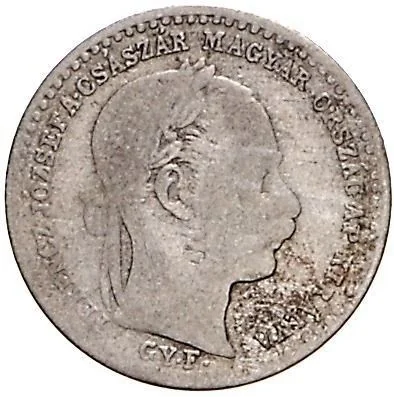
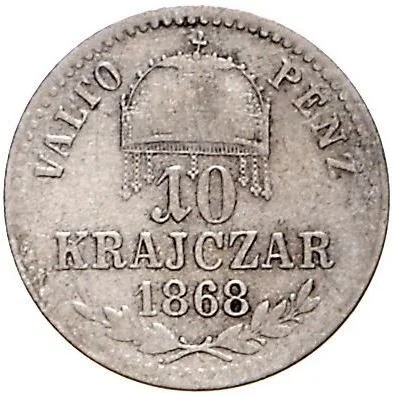
10 kreuzers – Hungary
Add to wishlist
Hungary
Context
Years: 1867–1868
Issuer: Hungary
Ruler: Francis Joseph I
Currency:
(1857—1892)
Demonetization: 31 December 1896
Total mintage: 2,101,000
Material
References
KM: #
Numista: #22239
Obverse
Inscription:
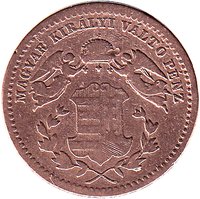
FERENCZ JOZSEF A.CSASZAR MAGYAR ORSZAG AP.KIRALYA
K.B.
K.B.
Translation:
Francis Joseph, Emperor of Austria, Apostolic King of Hungary
K.B.
K.B.
Script: Latin
Languages: Hungarian, Latin abbreviations
Engraver: Josef Tautenhayn
Reverse
Edge
Plain
Mints
| Name | Mark |
|---|---|
| Kremnica | B |
| Alba Iulia | GYF |
| Kremnica | KB |
Mintings
Historical background
Following the Austro-Hungarian Compromise of 1867, which established the Dual Monarchy, Hungary gained significant political and economic autonomy. However, it remained within a unified monetary and customs union with Austria. Consequently, Hungary did not have an independent currency but used the common Austro-Hungarian gulden (or florin), which was managed by the Austro-Hungarian Bank. This arrangement reflected the complex duality of the empire, where fiscal and monetary policy was a "common" matter decided by joint ministries, limiting Hungary's direct control over its own currency issuance and valuation.
The period was one of transition toward a more modern, gold-standard currency. The gulden, a silver-based currency, was seen as unstable and outdated for international trade. In 1867, plans were already underway for a major monetary reform, which would culminate in the introduction of the gold standard and a new currency unit, the korona (crown), in 1892. The immediate post-Compromise years were thus characterized by economic debates between Vienna and Budapest over the management of the shared debt and the path toward monetary modernization, with Hungarian politicians pushing for greater influence within the central bank.
Economically, this common currency facilitated trade and capital movement within the empire, aiding Hungary's rapid industrial development and integration into European markets. Yet, it also meant Hungary's economy was directly tied to Austrian financial policies and fortunes. The currency situation of 1867, therefore, symbolized both the benefits of the Compromise—access to a larger economic sphere—and its constraints, as Hungary sought to assert its national identity while remaining fiscally bound to its imperial partner.
The period was one of transition toward a more modern, gold-standard currency. The gulden, a silver-based currency, was seen as unstable and outdated for international trade. In 1867, plans were already underway for a major monetary reform, which would culminate in the introduction of the gold standard and a new currency unit, the korona (crown), in 1892. The immediate post-Compromise years were thus characterized by economic debates between Vienna and Budapest over the management of the shared debt and the path toward monetary modernization, with Hungarian politicians pushing for greater influence within the central bank.
Economically, this common currency facilitated trade and capital movement within the empire, aiding Hungary's rapid industrial development and integration into European markets. Yet, it also meant Hungary's economy was directly tied to Austrian financial policies and fortunes. The currency situation of 1867, therefore, symbolized both the benefits of the Compromise—access to a larger economic sphere—and its constraints, as Hungary sought to assert its national identity while remaining fiscally bound to its imperial partner.
💎 Extremely Rare