

100 rand – South Africa
Add to wishlist
South Africa
Context
Material
Diameter: 32.69 mm
Weight: 31.11 g
Gold Weight:: 31.11 g
Shape: Round
Composition: 99.99% Gold
Standard: Silver ounce
Magnetic: No
Technique: Milled
Alignment: Medal alignment
flip
References
KM: #
Numista: #342449
Value
Exchange value: 100 ZAR
Bullion value: $4775.62
Inflation-adjusted value: 283.35 ZAR
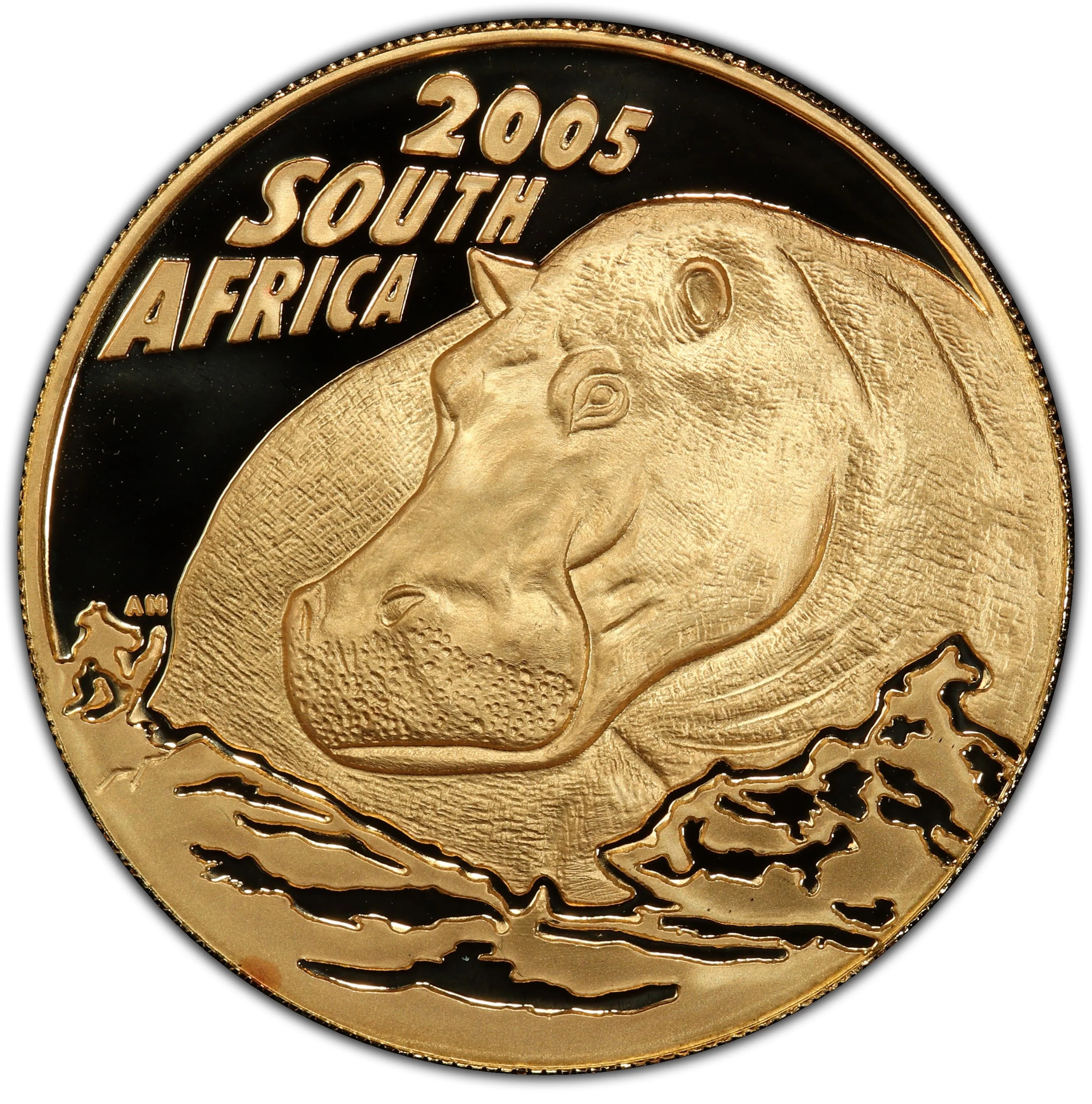
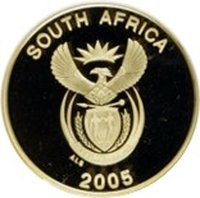
Obverse
Description:
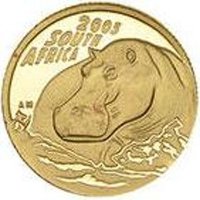
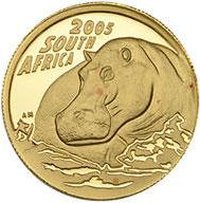
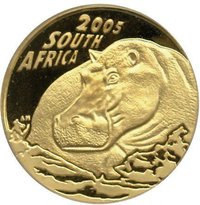
Hippo half-submerged
Inscription:
2005
SOUTH
AFRICA
AM
SOUTH
AFRICA
AM
Translation:
SOUTH AFRICA
Script: Latin
Engraver: Aldrid Minnie
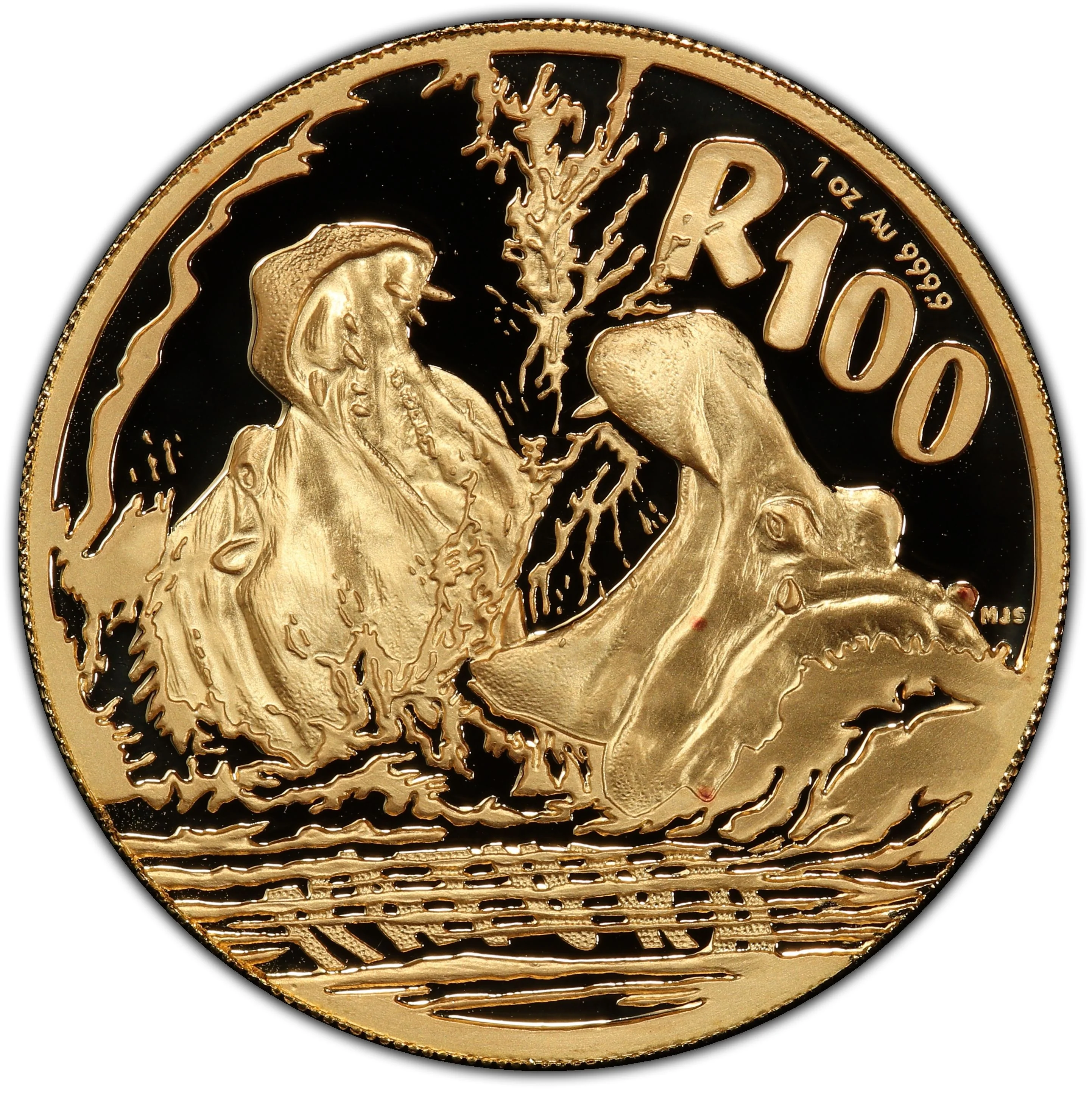
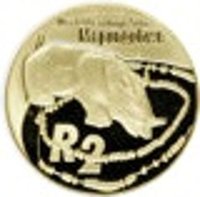
Reverse
Description:
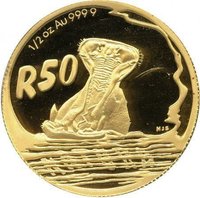
Two hippos clash in water, mouths agape.
Inscription:
1 OZ Au 999.9
R 100
NATURA
MJS
R 100
NATURA
MJS
Script: Latin
Engraver: Thinus Scheepers
Edge
Reeded
Mints
| Name | Mark |
|---|---|
| South African Mint | — |
Mintings
| Year | Mint Mark | Mintage | Quality | Collection |
|---|---|---|---|---|
| 2005 | — | 1,703 | Proof | |
| 2005 | MAPUGUBWE | 486 | Proof |
Historical background
In 2005, South Africa's currency, the rand, was in a phase of robust recovery and strength following a period of extreme volatility earlier in the decade. The rand had dramatically depreciated in late 2001, falling to nearly R13 to the US dollar, but by 2005 it had rebounded significantly, trading in a range between R6 and R7 to the dollar. This appreciation was driven by a combination of high domestic interest rates, which attracted foreign capital seeking yield (carry trade), and a sustained global commodity boom that increased demand for South Africa's mineral exports, improving the country's current account surplus.
This strong currency presented a complex economic picture for the nation. On one hand, it helped to curb imported inflation, allowing the South African Reserve Bank (SARB) some room to cautiously lower interest rates, and it reduced the cost of servicing foreign-denominated debt. On the other hand, it placed severe pressure on the country's export-oriented and import-competing industries, particularly manufacturing. Manufacturers and mining companies struggled with declining competitiveness, leading to job losses and concerns about deindustrialization, a challenge famously highlighted as "rand strength pain" by industry leaders.
The government and the SARB, under Governor Tito Mboweni, generally welcomed the stronger rand as a sign of macroeconomic stability and investor confidence, which had been bolstered by consistent fiscal discipline and inflation targeting. However, they faced the difficult policy task of managing the conflicting needs of controlling inflation versus supporting economic growth and employment. The situation in 5 thus encapsulated a classic currency dilemma: the benefits of a strong currency in terms of stability and lower inflation were offset by its negative impact on key sectors of the real economy.
This strong currency presented a complex economic picture for the nation. On one hand, it helped to curb imported inflation, allowing the South African Reserve Bank (SARB) some room to cautiously lower interest rates, and it reduced the cost of servicing foreign-denominated debt. On the other hand, it placed severe pressure on the country's export-oriented and import-competing industries, particularly manufacturing. Manufacturers and mining companies struggled with declining competitiveness, leading to job losses and concerns about deindustrialization, a challenge famously highlighted as "rand strength pain" by industry leaders.
The government and the SARB, under Governor Tito Mboweni, generally welcomed the stronger rand as a sign of macroeconomic stability and investor confidence, which had been bolstered by consistent fiscal discipline and inflation targeting. However, they faced the difficult policy task of managing the conflicting needs of controlling inflation versus supporting economic growth and employment. The situation in 5 thus encapsulated a classic currency dilemma: the benefits of a strong currency in terms of stability and lower inflation were offset by its negative impact on key sectors of the real economy.
Series: Giants of Africa
✨ Legendary