

Obverse
Description:
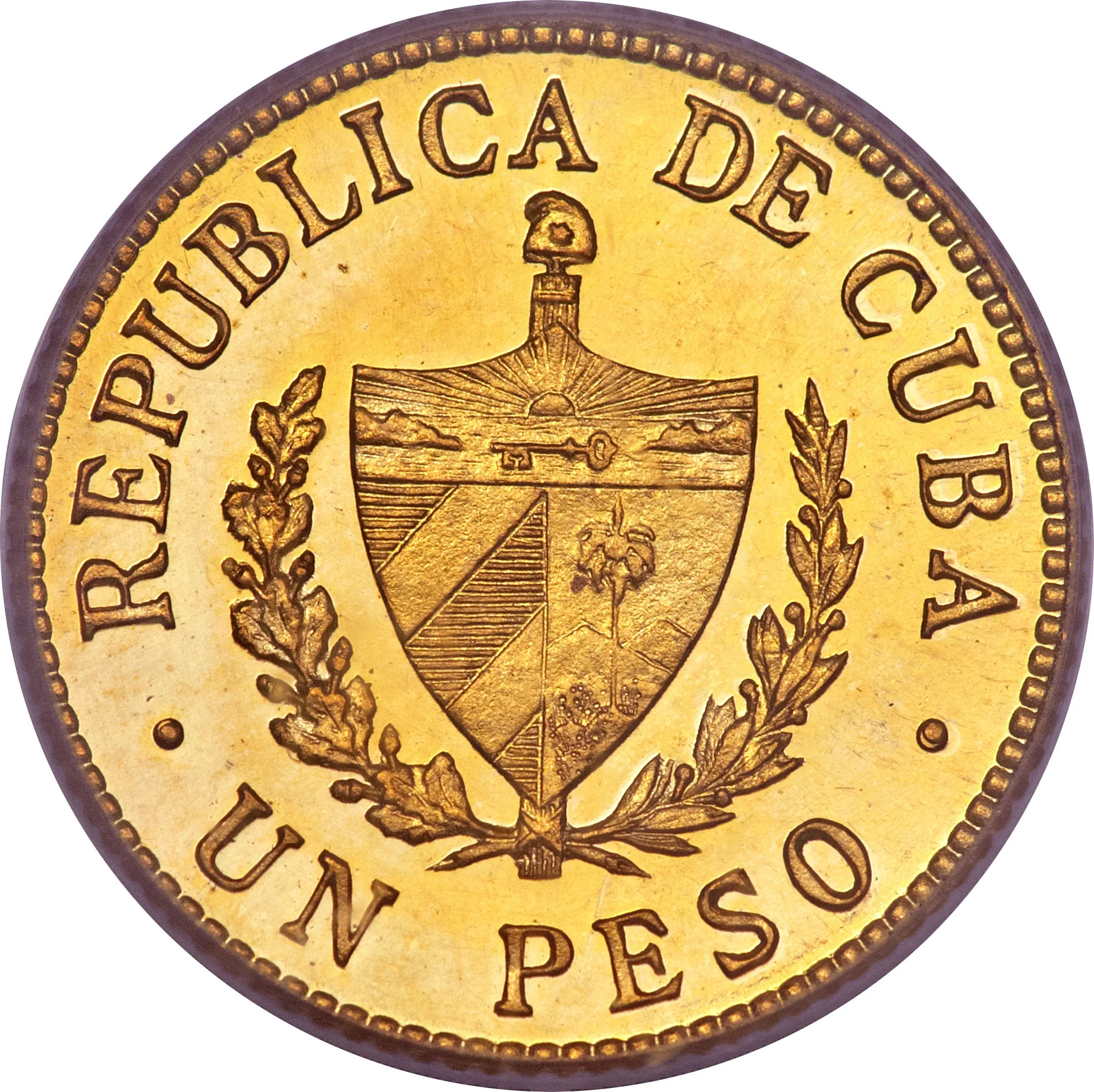
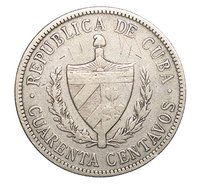
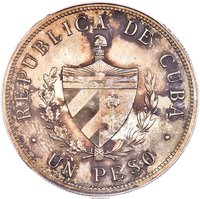
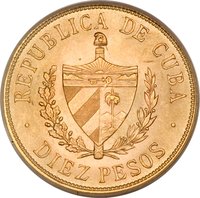
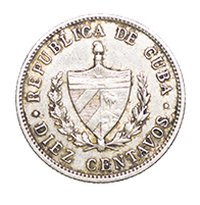
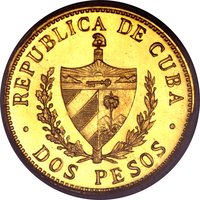
Cuban coat of arms, country name and lettered face value in curved legends, denticled rim.
Inscription:
REPUBLICA DE CUBA
• UN PESO •
• UN PESO •
Translation:
REPUBLIC OF CUBA
• ONE PESO •
• ONE PESO •
Script: Latin
Language: Spanish
Engraver: Charles Edward Barber
Reverse
Description:
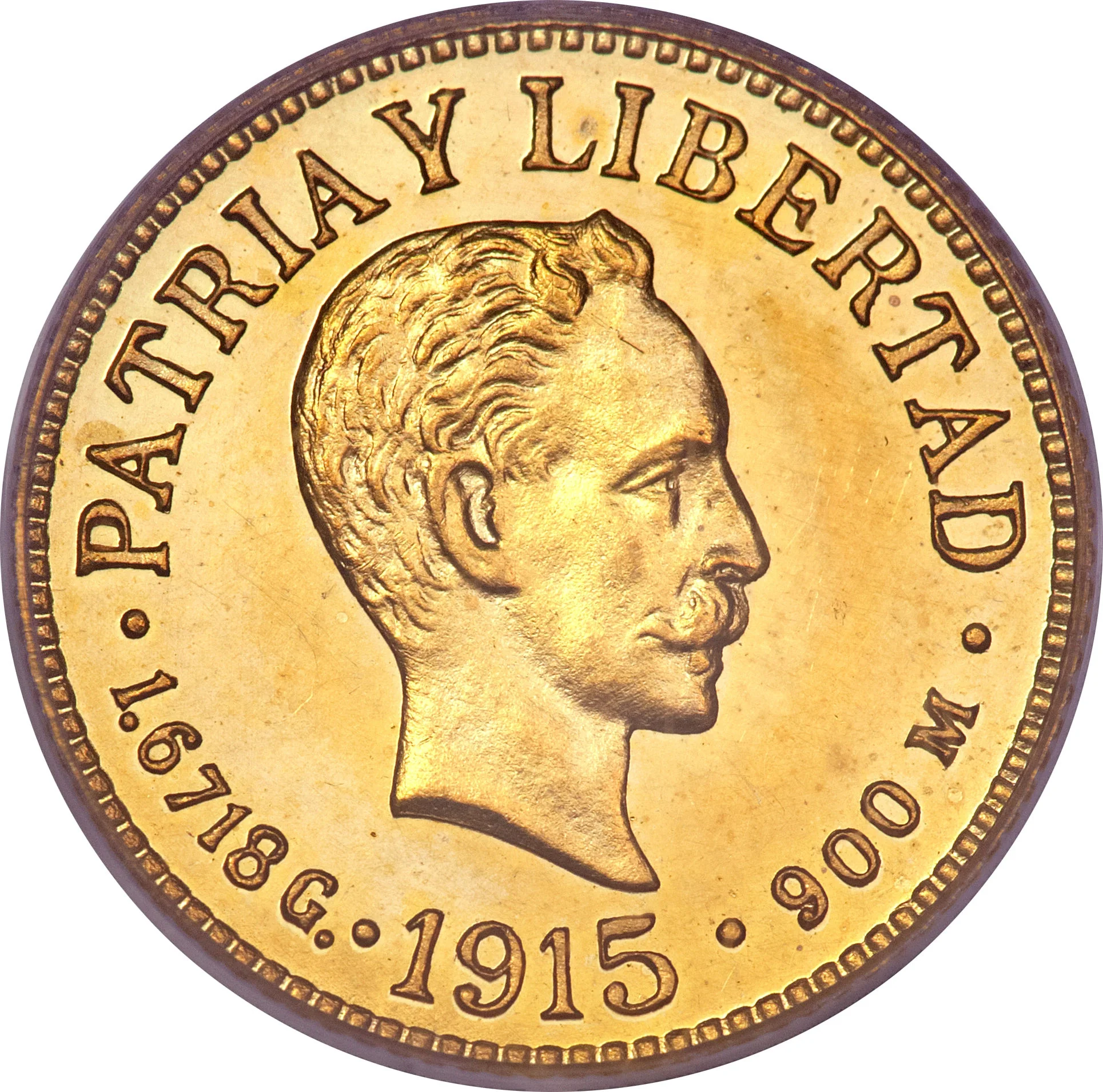
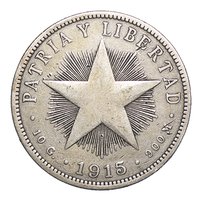
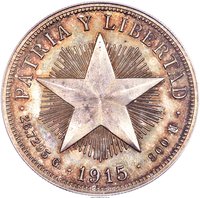
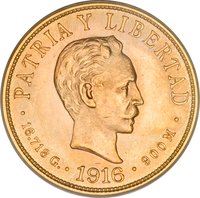
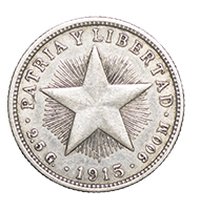
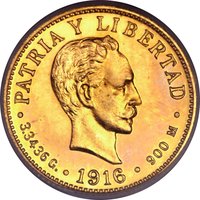
Portrait of José Martí, Cuban National Hero. Top motto: "Patria y Libertad." Exergue: dates. Sides: weight and fineness. Denticled rim.
Inscription:
PATRIA Y LIBERTAD
• 1.6718 G. • 1915 • 900 M •
• 1.6718 G. • 1915 • 900 M •
Translation:
Fatherland and Liberty
• 1.6718 G. • 1915 • 900 M •
• 1.6718 G. • 1915 • 900 M •
Script: Latin
Language: Spanish
Engraver: Charles Edward Barber
Edge
Reeded
Categories
| Symbols> Coat of Arms |
| Person> Politician |
Mints
| Name | Mark |
|---|---|
| United States Mint of Philadelphia | — |
Mintings
| Year | Mint Mark | Mintage | Quality | Collection |
|---|---|---|---|---|
| 1915 | — | 6,800 | ||
| 1915 | — | 50 | Proof | |
| 1916 | — | 10,500 | ||
| 1916 | — | 100 | Proof |
Historical background
In 1915, Cuba’s currency situation was characterized by a period of relative stability and alignment with the United States, a direct legacy of the island's recent political and economic history. Following independence and the U.S. military occupation (1898-1902), the 1903 Reciprocity Treaty and the 1904 Monetary Law had firmly pegged the Cuban peso at par with the U.S. dollar. This created a bimetallic system where U.S. gold coins and silver pesos circulated interchangeably, backed by substantial U.S. dollar reserves held in New York banks. This dollarization fostered reliable trade and investment, crucial for the booming sugar industry, which was increasingly financed by American capital.
However, this stability was externally dependent and masked underlying vulnerabilities. The Cuban treasury's reliance on the U.S. for currency backing meant its monetary policy was not autonomous. Furthermore, the global economic pressures of World War I, which began in 1914, were beginning to exert influence. While Cuba initially experienced a sugar boom due to the war, international gold flows were becoming disrupted, and the price of silver—the metal for the Cuban peso coin—was subject to volatile global markets. This posed a latent threat to the parity system, as the intrinsic value of the silver peso could potentially diverge from its fixed dollar value.
Consequently, the currency landscape of 1915 was one of de facto dollarization under a managed peg, providing surface-level commercial confidence. The system was administratively simple and beneficial for the dominant export sector and U.S. commercial interests. Yet, it was fundamentally a colonial monetary holdover, leaving Cuba's financial system exposed to external shocks and decisions made in Washington and world commodity markets—a fragility that would be tested in the coming years as the war continued to reshape the global economic order.
However, this stability was externally dependent and masked underlying vulnerabilities. The Cuban treasury's reliance on the U.S. for currency backing meant its monetary policy was not autonomous. Furthermore, the global economic pressures of World War I, which began in 1914, were beginning to exert influence. While Cuba initially experienced a sugar boom due to the war, international gold flows were becoming disrupted, and the price of silver—the metal for the Cuban peso coin—was subject to volatile global markets. This posed a latent threat to the parity system, as the intrinsic value of the silver peso could potentially diverge from its fixed dollar value.
Consequently, the currency landscape of 1915 was one of de facto dollarization under a managed peg, providing surface-level commercial confidence. The system was administratively simple and beneficial for the dominant export sector and U.S. commercial interests. Yet, it was fundamentally a colonial monetary holdover, leaving Cuba's financial system exposed to external shocks and decisions made in Washington and world commodity markets—a fragility that would be tested in the coming years as the war continued to reshape the global economic order.
Series: 1915 Cuba circulation coins
💎 Extremely Rare