

1 mark – Germany
Add to wishlist
Germany
Context
Years: 1891–1916
Issuer: Germany
Ruler: William II
Currency:
(1873—1923)
Demonetization: 20 April 1920
Total mintage: 185,455,267
Material
References
KM: #
Numista: #3412
Value
Bullion value: $12.78
Obverse
Description:
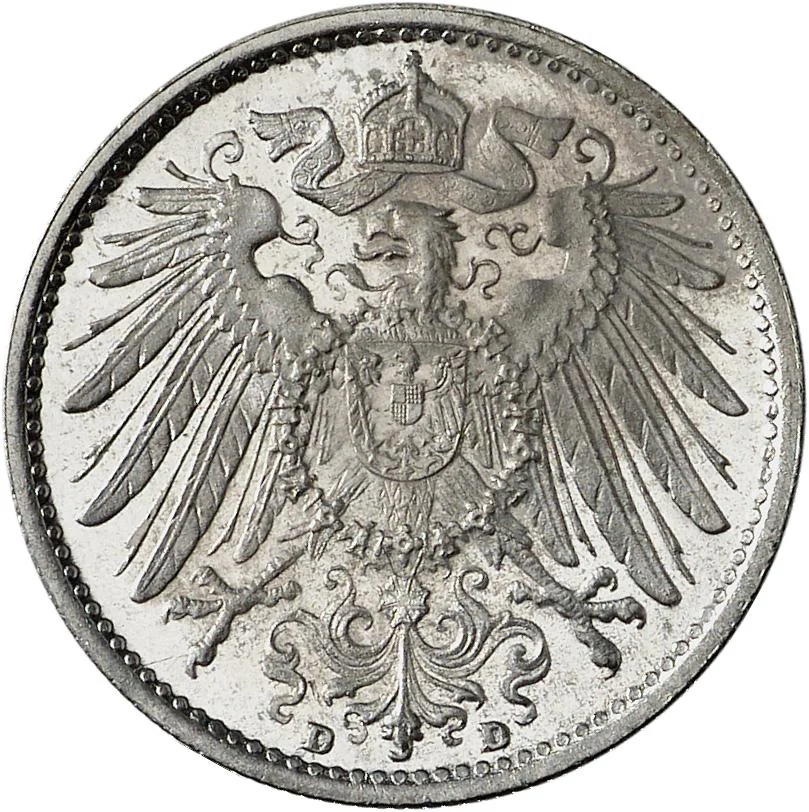
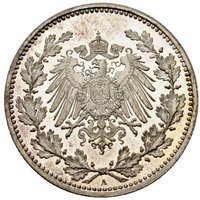
Imperial German Eagle with small shield (second type), mintmark below.
Inscription:
E E
Script: Latin
Designer and engraver: Otto Schultz
Reverse
Description:
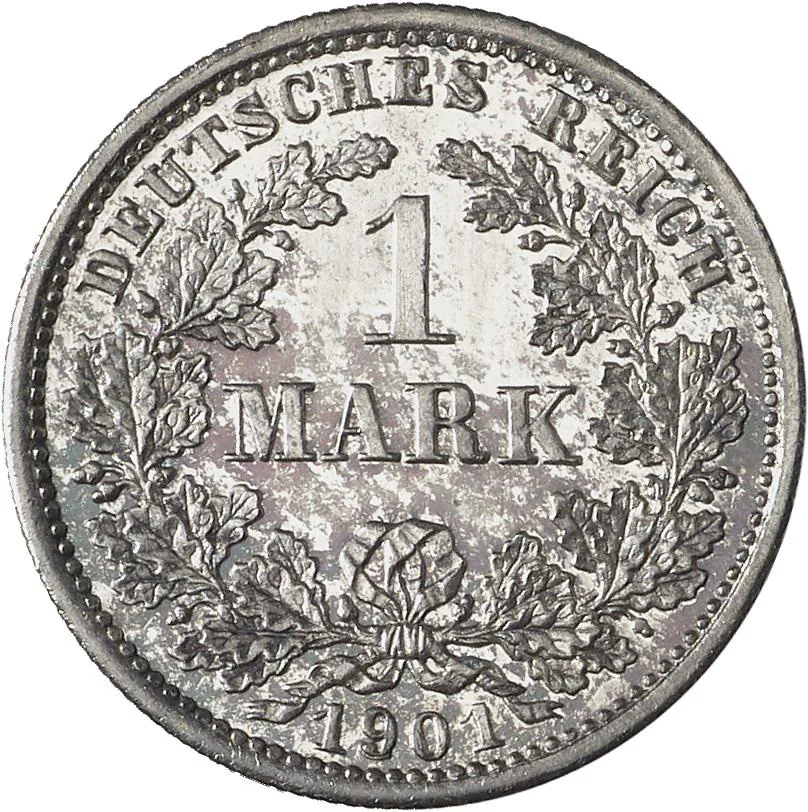
Denomination within wreath, date below, lettering around beaded rim.
Inscription:
DEUTSCHES REICH
1
MARK
1915
1
MARK
1915
Translation:
GERMAN EMPIRE
1
MARK
1915
1
MARK
1915
Script: Latin
Language: German
Designer and engraver: Johann Adam Ries
Edge
Reeded
Mints
| Name | Mark |
|---|---|
| Berlin | A |
| Munich | D |
| Muldenhütten | E |
| Staatliche Münze Baden-Württemberg | F |
| Staatliche Münze Baden-Württemberg | G |
| Hamburgische Münze | J |
Mintings
| Year | Mint Mark | Mintage | Quality | Collection |
|---|---|---|---|---|
| 1891 | A | 711,076 | ||
| 1891 | D | — | ||
| 1892 | A | 908,639 | ||
| 1892 | D | 418,223 | ||
| 1892 | E | 222,811 | ||
| 1892 | F | 301,914 | ||
| 1892 | G | 182,674 | ||
| 1892 | J | 236,889 | ||
| 1893 | A | 1,633,018 | ||
| 1893 | D | 425,420 | ||
| 1893 | E | 224,221 | ||
| 1893 | F | 299,895 | ||
| 1893 | J | 253,755 | ||
| 1894 | G | 183,685 | ||
| 1896 | J | 326,227 | ||
| 1896 | D | 562,336 | ||
| 1896 | E | 296,606 | ||
| 1896 | F | 400,787 | ||
| 1896 | G | 243,381 | ||
| 1896 | A | 2,159,782 | ||
| 1898 | A | 1,000,000 | ||
| 1899 | A | 1,438,550 | ||
| 1899 | D | 633,591 | ||
| 1899 | E | 335,250 | ||
| 1899 | F | 392,949 | ||
| 1899 | G | 273,721 | ||
| 1899 | J | 367,650 | ||
| 1900 | A | 1,625,032 | ||
| 1900 | D | 420,691 | ||
| 1900 | E | 223,228 | ||
| 1900 | F | 300,885 | ||
| 1900 | G | 183,070 | ||
| 1900 | J | 245,706 | ||
| 1901 | A | 3,821,438 | ||
| 1901 | D | 914,853 | ||
| 1901 | E | 484,037 | ||
| 1901 | F | 802,113 | ||
| 1901 | G | 579,282 | ||
| 1901 | J | 530,628 | ||
| 1902 | A | 5,222,533 | ||
| 1902 | D | 1,546,287 | ||
| 1902 | E | 818,798 | ||
| 1902 | G | 269,878 | ||
| 1902 | J | 898,439 | ||
| 1902 | F | 952,536 | ||
| 1903 | A | 3,965,262 | ||
| 1903 | D | 914,123 | ||
| 1903 | E | 485,099 | ||
| 1903 | F | 652,240 | ||
| 1903 | G | 613,985 | ||
| 1903 | J | 531,368 | ||
| 1904 | A | 3,242,906 | ||
| 1904 | D | 1,761,340 | ||
| 1904 | E | 931,204 | ||
| 1904 | F | 1,254,509 | ||
| 1904 | G | 663,986 | ||
| 1904 | J | 1,021,459 | ||
| 1905 | A | 10,303,492 | ||
| 1905 | D | 1,759,073 | ||
| 1905 | E | 931,380 | ||
| 1905 | G | 859,504 | ||
| 1905 | F | — | ||
| 1905 | J | 1,021,120 | ||
| 1906 | J | 372,000 | ||
| 1906 | A | 5,413,642 | ||
| 1906 | D | 1,412,003 | ||
| 1906 | E | 745,439 | ||
| 1906 | F | 2,257,203 | ||
| 1906 | G | 609,148 | ||
| 1906 | G | — | Proof | |
| 1907 | A | 9,201,246 | ||
| 1907 | D | 2,387,369 | ||
| 1907 | E | 1,265,162 | ||
| 1907 | F | 1,703,552 | ||
| 1907 | G | 1,035,303 | ||
| 1907 | J | 1,833,265 | ||
| 1908 | A | 4,337,674 | ||
| 1908 | F | — | Proof | |
| 1908 | D | 1,126,002 | ||
| 1908 | E | 596,000 | ||
| 1908 | F | 802,430 | ||
| 1908 | G | 488,000 | ||
| 1908 | J | 653,873 | ||
| 1909 | A | 4,150,849 | ||
| 1909 | D | 1,968,400 | ||
| 1909 | E | — | ||
| 1909 | G | 854,000 | ||
| 1909 | J | 53,000 | ||
| 1910 | F | 1,631,285 | ||
| 1910 | G | 610,000 | ||
| 1910 | J | 1,094,309 | ||
| 1910 | A | 5,869,535 | ||
| 1910 | D | 1,406,000 | ||
| 1910 | E | 1,050,240 | ||
| 1911 | A | 5,693,475 | ||
| 1911 | D | 126,000 | ||
| 1911 | E | 737,613 | ||
| 1911 | F | 773,000 | ||
| 1911 | G | 305,000 | ||
| 1911 | J | 812,332 | ||
| 1912 | J | 408,500 | ||
| 1912 | A | 2,438,550 | ||
| 1912 | D | 632,700 | ||
| 1912 | E | 707,750 | ||
| 1912 | F | 502,449 | ||
| 1913 | F | 450,905 | ||
| 1913 | G | 274,500 | ||
| 1913 | J | 367,623 | ||
| 1914 | A | 11,304,295 | ||
| 1914 | D | 3,515,000 | ||
| 1914 | E | 2,235,000 | ||
| 1914 | F | 2,300,000 | ||
| 1914 | G | 1,910,739 | ||
| 1914 | J | 2,977,603 | ||
| 1915 | A | 13,817,009 | ||
| 1915 | D | 4,218,000 | ||
| 1915 | E | 2,235,000 | ||
| 1915 | F | 2,911,500 | ||
| 1915 | G | 1,749,261 | ||
| 1915 | J | 1,634,000 | ||
| 1916 | F | 306,000 |
Historical background
In 1891, Germany's currency situation was defined by the complex legacy of unification two decades prior. The nation was still navigating the transition from a fragmented system of multiple regional currencies—like the Thaler, Gulden, and Mark Banco of Hamburg—to a single, unified national currency as mandated by the Coinage Act of 1871. This act established the Goldmark, placing Germany firmly on the gold standard, which aimed to ensure monetary stability and facilitate international trade. However, the practical transition was prolonged, with older silver-based coins remaining in circulation alongside the new gold currency well into the 1890s.
Economically, the period was marked by the onset of the "Great Deflation," a prolonged phase of falling prices that began in 1873 and created significant social and political strain. While the gold standard provided external stability, it was criticized for constricting the money supply domestically, a point of contention for agrarian and industrial interests needing easier credit. Furthermore, the scarcity of small-denomination gold coins led to a reliance on token silver coins and paper Reichskassenscheine (Treasury notes) for everyday transactions, creating a practical disconnect between the official gold standard and the circulating media used by most citizens.
Politically, the currency system was a settled issue in terms of its fundamental principles, but its management remained a key function of the Reichsbank, established in 1876. The central focus by 1891 was not on altering the gold standard itself, but on managing its consequences—mitigating deflationary pressures, financing Germany's rapid industrialization, and maintaining sufficient gold reserves. Thus, the currency situation in 1891 was one of consolidated but not yet fully homogenized stability, operating within a rigid metallic framework that would face its ultimate test in the financial demands of the coming world war.
Economically, the period was marked by the onset of the "Great Deflation," a prolonged phase of falling prices that began in 1873 and created significant social and political strain. While the gold standard provided external stability, it was criticized for constricting the money supply domestically, a point of contention for agrarian and industrial interests needing easier credit. Furthermore, the scarcity of small-denomination gold coins led to a reliance on token silver coins and paper Reichskassenscheine (Treasury notes) for everyday transactions, creating a practical disconnect between the official gold standard and the circulating media used by most citizens.
Politically, the currency system was a settled issue in terms of its fundamental principles, but its management remained a key function of the Reichsbank, established in 1876. The central focus by 1891 was not on altering the gold standard itself, but on managing its consequences—mitigating deflationary pressures, financing Germany's rapid industrialization, and maintaining sufficient gold reserves. Thus, the currency situation in 1891 was one of consolidated but not yet fully homogenized stability, operating within a rigid metallic framework that would face its ultimate test in the financial demands of the coming world war.

🌱 Very Common