

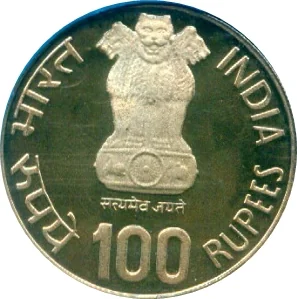
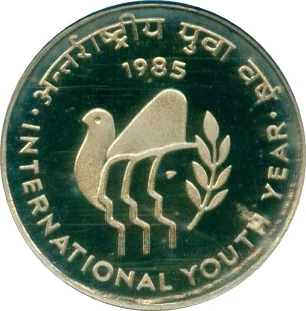
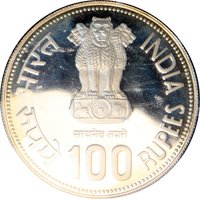
100 Rupees – India
Non-circulating coins
Commemoration: 1985 International Youth Year
India
Context

Material
References
KM: #Click to copy to clipboard282
Numista: #34094
Value
Exchange value: 100 INR = $1.10
Bullion value: $50.84
Inflation-adjusted value: 1653.15 INR
Obverse
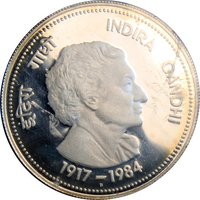
Reverse
Edge
Reeded
Mints
| Name | Mark |
|---|---|
| Kolkata / Calcutta / Murshidabad | — |
Mintings
| Year | Mint Mark | Mintage | Quality | Collection |
|---|---|---|---|---|
| 1985 | — | 16,000 | In sets | |
| 1985 | — | 6,267 | Proof |
Historical background
In 1985, India's currency situation was characterized by a complex blend of stability and underlying structural pressures. The Indian Rupee (₹) operated under a fixed exchange rate system, pegged to a basket of currencies of its major trading partners, though with a heavy implicit weight on the British Pound Sterling and the U.S. Dollar. This peg provided a facade of stability for international transactions and planning. Domestically, the economy and its currency were still heavily regulated under the License Raj, with strict capital controls and a highly managed financial sector. The Reserve Bank of India (RBI) maintained tight control over money supply and credit, but the physical currency in circulation—primarily notes and coins—was just one component of a largely cash-based yet constrained economy.
Beneath this surface, significant fiscal challenges were mounting, which would later precipitate currency crises. The government of Prime Minister Rajiv Gandhi, while ushering in early liberalization in industrial policy, was running high fiscal deficits, partly financed by deficit spending from the RBI. This practice, known as deficit financing, stoked inflationary pressures and eroded the rupee's internal value. Furthermore, India's current account deficit was widening due to rising imports of oil and capital goods, while exports remained sluggish, creating persistent balance of payments strains. These factors placed a steady, invisible devaluation pressure on the pegged rupee, as the official exchange rate increasingly diverged from economic fundamentals.
Consequently, 1985 represents a calm before the storm in India's monetary history. The currency regime was intact but increasingly anachronistic, propped up by controls rather than confidence. The pressures building in the mid-1980s—fiscal profligacy, low foreign exchange reserves, and a rigid trade regime—would culminate in a severe balance of payments crisis by 1991. That crisis forced a dramatic devaluation of the rupee and the eventual abandonment of the fixed exchange rate system, paving the way for the economic reforms that would transform India's currency into a more market-determined instrument in the following decade.
Beneath this surface, significant fiscal challenges were mounting, which would later precipitate currency crises. The government of Prime Minister Rajiv Gandhi, while ushering in early liberalization in industrial policy, was running high fiscal deficits, partly financed by deficit spending from the RBI. This practice, known as deficit financing, stoked inflationary pressures and eroded the rupee's internal value. Furthermore, India's current account deficit was widening due to rising imports of oil and capital goods, while exports remained sluggish, creating persistent balance of payments strains. These factors placed a steady, invisible devaluation pressure on the pegged rupee, as the official exchange rate increasingly diverged from economic fundamentals.
Consequently, 1985 represents a calm before the storm in India's monetary history. The currency regime was intact but increasingly anachronistic, propped up by controls rather than confidence. The pressures building in the mid-1980s—fiscal profligacy, low foreign exchange reserves, and a rigid trade regime—would culminate in a severe balance of payments crisis by 1991. That crisis forced a dramatic devaluation of the rupee and the eventual abandonment of the fixed exchange rate system, paving the way for the economic reforms that would transform India's currency into a more market-determined instrument in the following decade.
💎 Very Rare