

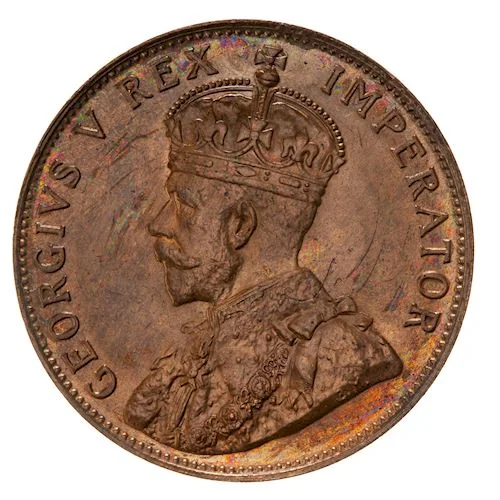
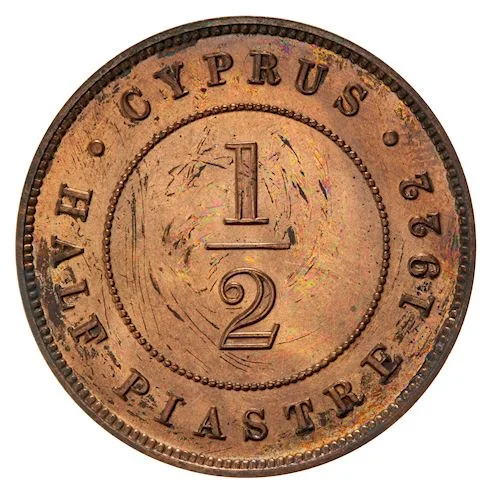
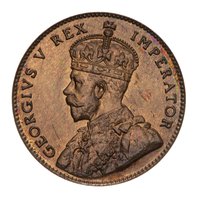
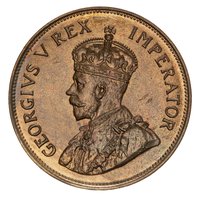
Obverse
Description:
Left-facing crowned bust. "B.M." (Bertram Mackennal) on the truncation, with a circular inscription.
Inscription:
GEORGIVS V REX IMPERATOR
Translation:
GEORGE V KING EMPEROR
Script: Latin
Language: Latin
Engraver: Edgar Bertram MacKennal
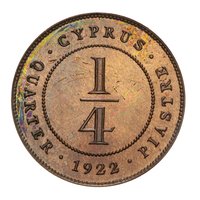
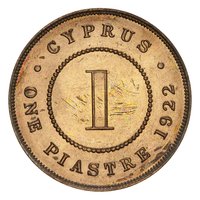
Reverse
Description:
Half within a beaded circle, encircled by text.
Inscription:
· CYPRUS ·
1
2
HALF PIASTRE 1931
1
2
HALF PIASTRE 1931
Script: Latin
Edge
Reeded
Mints
| Name | Mark |
|---|---|
| Royal Mint (Tower Hill) | — |
Mintings
| Year | Mint Mark | Mintage | Quality | Collection |
|---|---|---|---|---|
| 1922 | — | 36,000 | ||
| 1927 | — | 108,000 | ||
| 1927 | — | — | Proof | |
| 1930 | — | 180,000 | ||
| 1930 | — | — | Proof | |
| 1931 | — | 90,000 | ||
| 1931 | — | — | Proof |
Historical background
In 1922, Cyprus was under British administration, having been formally annexed from the Ottoman Empire in 1914. The island's currency situation was complex and transitional, reflecting its shifting political and economic ties. Officially, the Cypriot pound (£C) was established in 1879, pegged at par with the British pound sterling. However, in practice, a multitude of currencies circulated, including British gold sovereigns, Turkish Ottoman liras (piastres), and French francs, a legacy of the island's historic trade links and recent Ottoman past. This multiplicity created practical challenges for commerce and administration.
The year 1922 was significant as it marked a decisive step toward monetary standardization under British rule. In that year, the British authorities demonetized the Turkish currency, which had remained in widespread use. This move was part of a broader policy to integrate Cyprus more fully into the British economic sphere and to simplify the monetary system. The Turkish lira was officially withdrawn from circulation, and the Cypriot pound, divisible into 20 shillings or 180 piastres (retaining the Ottoman subdivision for local convenience), became the sole legal tender.
This consolidation occurred against a backdrop of regional turmoil, notably the Greco-Turkish War (1919-1922) and the subsequent population movements. The demonetization of the Turkish currency also had symbolic weight, distancing the island from the collapsing Ottoman monetary system. While the Cypriot pound was firmly pegged to sterling, the local economy remained relatively insulated and agrarian. The reforms of 1922 successfully established a unified currency system, providing stability but within a colonial framework that linked Cyprus's financial fate directly to decisions made in London.
The year 1922 was significant as it marked a decisive step toward monetary standardization under British rule. In that year, the British authorities demonetized the Turkish currency, which had remained in widespread use. This move was part of a broader policy to integrate Cyprus more fully into the British economic sphere and to simplify the monetary system. The Turkish lira was officially withdrawn from circulation, and the Cypriot pound, divisible into 20 shillings or 180 piastres (retaining the Ottoman subdivision for local convenience), became the sole legal tender.
This consolidation occurred against a backdrop of regional turmoil, notably the Greco-Turkish War (1919-1922) and the subsequent population movements. The demonetization of the Turkish currency also had symbolic weight, distancing the island from the collapsing Ottoman monetary system. While the Cypriot pound was firmly pegged to sterling, the local economy remained relatively insulated and agrarian. The reforms of 1922 successfully established a unified currency system, providing stability but within a colonial framework that linked Cyprus's financial fate directly to decisions made in London.
⭐ Somewhat Rare