

5 euro – Italy
Add to wishlist
Italy
Context
Material
Diameter: 26.95 mm
Weight: 10.3 g
Shape: Round
Composition: Copper-nickel
Alignment: Medal alignment
flip
References
KM: #
Numista: #340410
Value
Exchange value: 5 EUR
Inflation-adjusted value: 5.76 EUR
Obverse
Description:
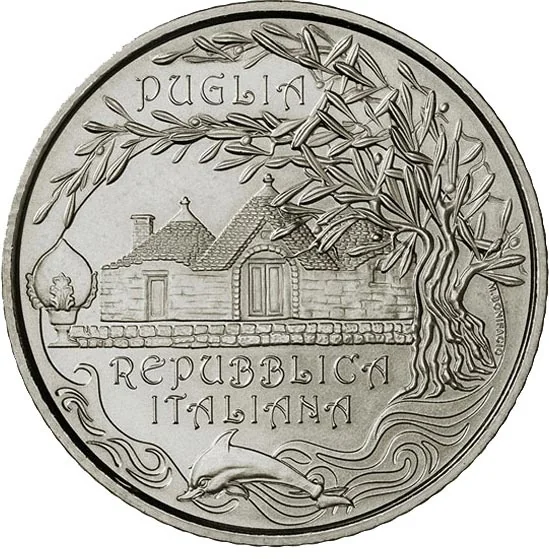
UNESCO World Heritage Sites—Alberobello's Trulli and an Apulian dry stone wall—flank an olive tree (right) and the Grottaglie Pumo (left). Below, stylized waves and a dolphin from ancient Taranto coins. Inscriptions: "PUGLIA" above, "REPUBBLICA ITALIANA" below, and the designer "M. BONIFACIO" on the right.
Inscription:
PUGLIA
REPUBBLICA ITALIANA
M. BONIFACIO
REPUBBLICA ITALIANA
M. BONIFACIO
Translation:
Apulia
Italian Republic
M. Bonifacio
Italian Republic
M. Bonifacio
Script: Latin
Language: Italian
Reverse
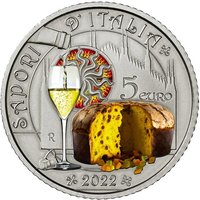
Description:
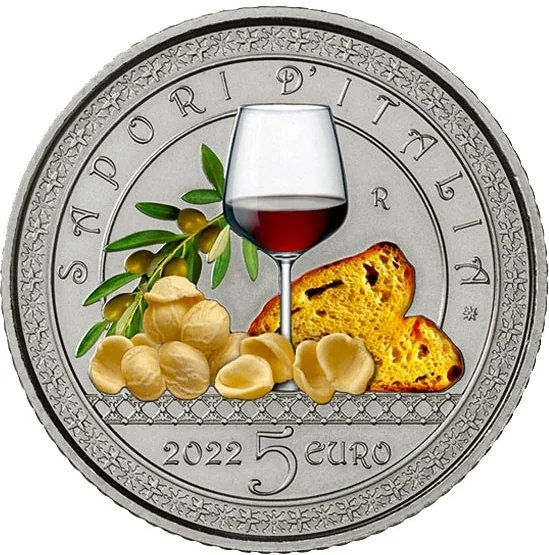
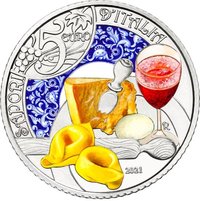
Apulian foods: Altamura bread, orecchiette, olives, and wine. Field decorations inspired by Romanesque fretwork from Sant'Elia's chair in Bari's Basilica of San Nicola. Above, the arched inscription "SAPORI D'ITALIA"; right, "R" (Rome Mint); below, "2022" and "5 EURO". Colour coin.
Inscription:
SAPORI D ITALIA
R
2022 5 EURO
R
2022 5 EURO
Script: Latin
Edge
Milled.
Categories
| Geography> Region |
| Object> Container or tableware |
| Plant> Tree |
| Animal> Marine mammal |
| Building |
Mints
| Name | Mark |
|---|---|
| Rome | R |
Mintings
| Year | Mint Mark | Mintage | Quality | Collection |
|---|---|---|---|---|
| 2022 | R | 15,000 |
Historical background
In 2022, Italy's currency situation was defined by its continued use of the euro as a member of the Eurozone, amidst significant economic pressures. The year was dominated by high inflation, which averaged 8.7% for the year and peaked near 12% in the autumn, largely driven by soaring energy prices following Russia's invasion of Ukraine. This inflation eroded household purchasing power and became a central political issue. While the euro provided stability by preventing a currency crisis and a speculative attack on a standalone lira, it also meant the Bank of Italy had no direct control over monetary policy, which was set by the European Central Bank (ECB) for the entire currency bloc.
The economic context placed Italy in a delicate position due to its high public debt, which exceeded 150% of GDP. Rising interest rates, as the ECB began a tightening cycle in July to combat inflation, increased the cost of servicing this massive debt stock, raising concerns about long-term fiscal sustainability. This tension highlighted the classic dilemma for Italy within the Eurozone: the inability to devalue its own currency to boost competitiveness or use independent monetary policy to address domestic recessions, while simultaneously being constrained in fiscal spending by EU rules.
Despite these underlying strains, there was no serious political movement to abandon the euro in 2022. The national debate focused instead on securing funds from the EU's post-pandemic Recovery and Resilience Facility (RRF), with Italy being the largest beneficiary. The technocratic government of Mario Draghi, and later the right-wing coalition led by Giorgia Meloni, remained firmly committed to the euro, viewing access to European funds and financial markets as contingent on Eurozone membership. Thus, the currency situation was one of stability underpinned by the euro, but with intense focus on managing the economic side-effects of a common monetary policy during a year of severe external shocks.
The economic context placed Italy in a delicate position due to its high public debt, which exceeded 150% of GDP. Rising interest rates, as the ECB began a tightening cycle in July to combat inflation, increased the cost of servicing this massive debt stock, raising concerns about long-term fiscal sustainability. This tension highlighted the classic dilemma for Italy within the Eurozone: the inability to devalue its own currency to boost competitiveness or use independent monetary policy to address domestic recessions, while simultaneously being constrained in fiscal spending by EU rules.
Despite these underlying strains, there was no serious political movement to abandon the euro in 2022. The national debate focused instead on securing funds from the EU's post-pandemic Recovery and Resilience Facility (RRF), with Italy being the largest beneficiary. The technocratic government of Mario Draghi, and later the right-wing coalition led by Giorgia Meloni, remained firmly committed to the euro, viewing access to European funds and financial markets as contingent on Eurozone membership. Thus, the currency situation was one of stability underpinned by the euro, but with intense focus on managing the economic side-effects of a common monetary policy during a year of severe external shocks.
Series: Cultura Enogastronomica Italiana

💎 Very Rare