

Obverse
Description:
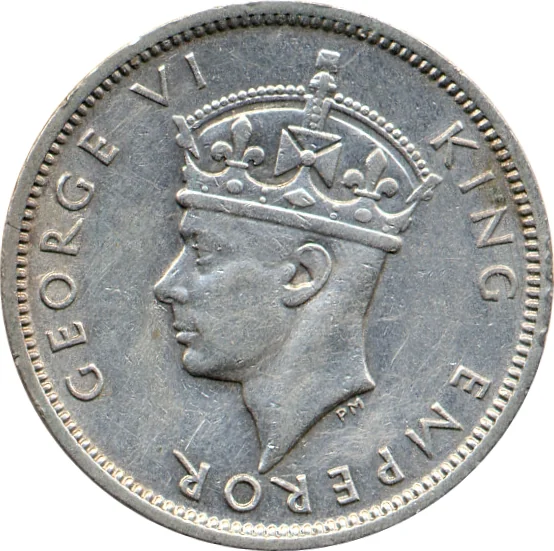
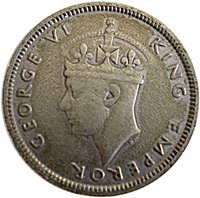
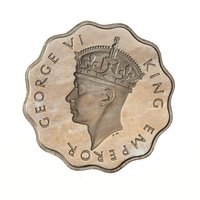
Crowned head left.
Inscription:
GEORGE VI KING EMPEROR
PM
PM
Translation:
GEORGE VI KING EMPEROR
INDIA EMPEROR
INDIA EMPEROR
Script: Latin
Language: English
Engraver: Percy Metcalfe
Reverse
Description:
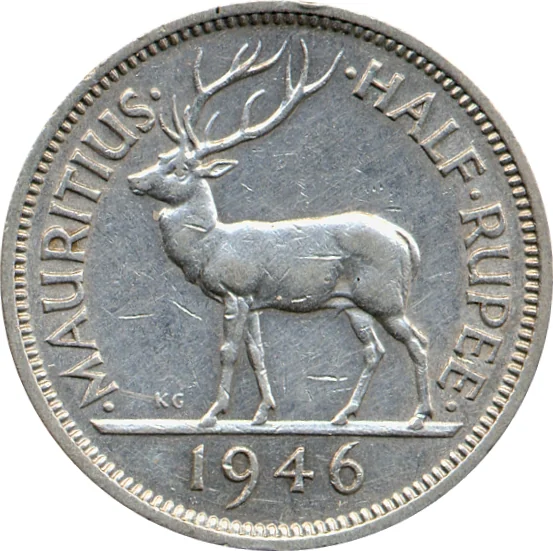
Stag left, date below.
Inscription:
.MAURITIUS. .HALF.RUPEE.
KG
1946
KG
1946
Script: Latin
Engraver: George Kruger Gray
Edge
Security edge
Mints
| Name | Mark |
|---|---|
| Royal Mint (Tower Hill) | — |
Mintings
| Year | Mint Mark | Mintage | Quality | Collection |
|---|---|---|---|---|
| 1946 | — | 100,000 | ||
| 1946 | — | — | Proof |
Historical background
In 1946, Mauritius was a British Crown Colony, and its currency situation was directly tied to the imperial sterling system. The Mauritian rupee, introduced in 1877, was not an independent currency but a local expression of sterling, with its value fixed by law. The colony operated under a Currency Board system, which held sterling reserves in London to fully back the local currency in circulation, ensuring strict convertibility at the fixed rate of one Mauritian rupee to 1 shilling and 6 pence (or 13⅓ rupees to £1 sterling).
This arrangement provided monetary stability and facilitated trade with the United Kingdom, which was the island's dominant economic partner. However, it also meant Mauritius had no autonomous monetary policy; its money supply and credit conditions were essentially determined by the colony's balance of payments with the sterling area. The economy was heavily dependent on sugar exports, and the currency's fixed link to sterling simplified transactions for the plantation economy but tied the island's financial fortunes directly to Britain's post-war economic management.
The year 1946 fell within a period of global monetary realignment following World War II. While the Bretton Woods system was being established internationally, Mauritius's system remained unchanged. The fixed sterling link would persist until the late 1960s. Importantly, 1946 saw the introduction of new banknotes by the Mauritius Currency Board, featuring the portrait of King George VI, symbolizing the enduring colonial monetary relationship that would define the currency situation for another two decades.
This arrangement provided monetary stability and facilitated trade with the United Kingdom, which was the island's dominant economic partner. However, it also meant Mauritius had no autonomous monetary policy; its money supply and credit conditions were essentially determined by the colony's balance of payments with the sterling area. The economy was heavily dependent on sugar exports, and the currency's fixed link to sterling simplified transactions for the plantation economy but tied the island's financial fortunes directly to Britain's post-war economic management.
The year 1946 fell within a period of global monetary realignment following World War II. While the Bretton Woods system was being established internationally, Mauritius's system remained unchanged. The fixed sterling link would persist until the late 1960s. Importantly, 1946 saw the introduction of new banknotes by the Mauritius Currency Board, featuring the portrait of King George VI, symbolizing the enduring colonial monetary relationship that would define the currency situation for another two decades.
💎 Very Rare