

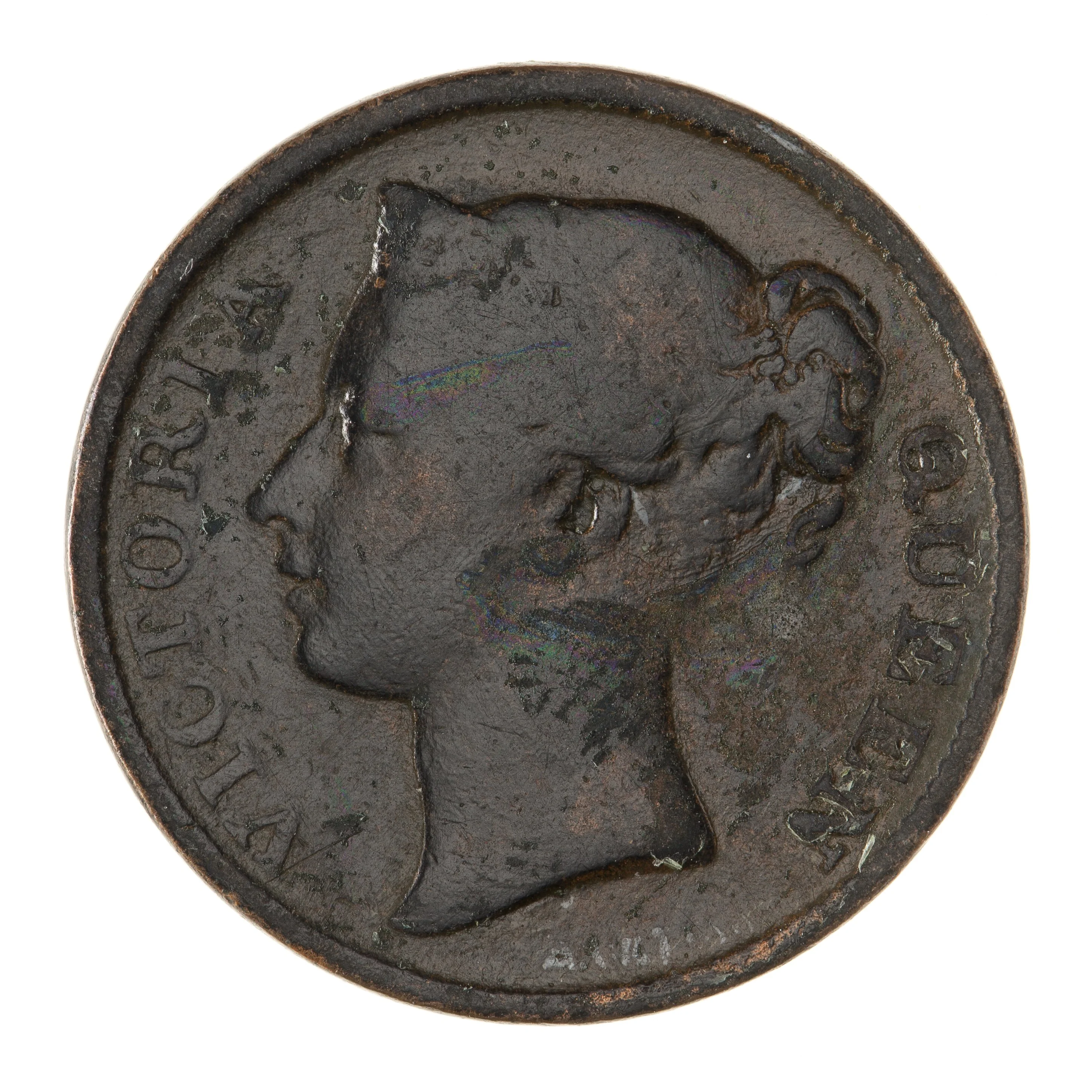
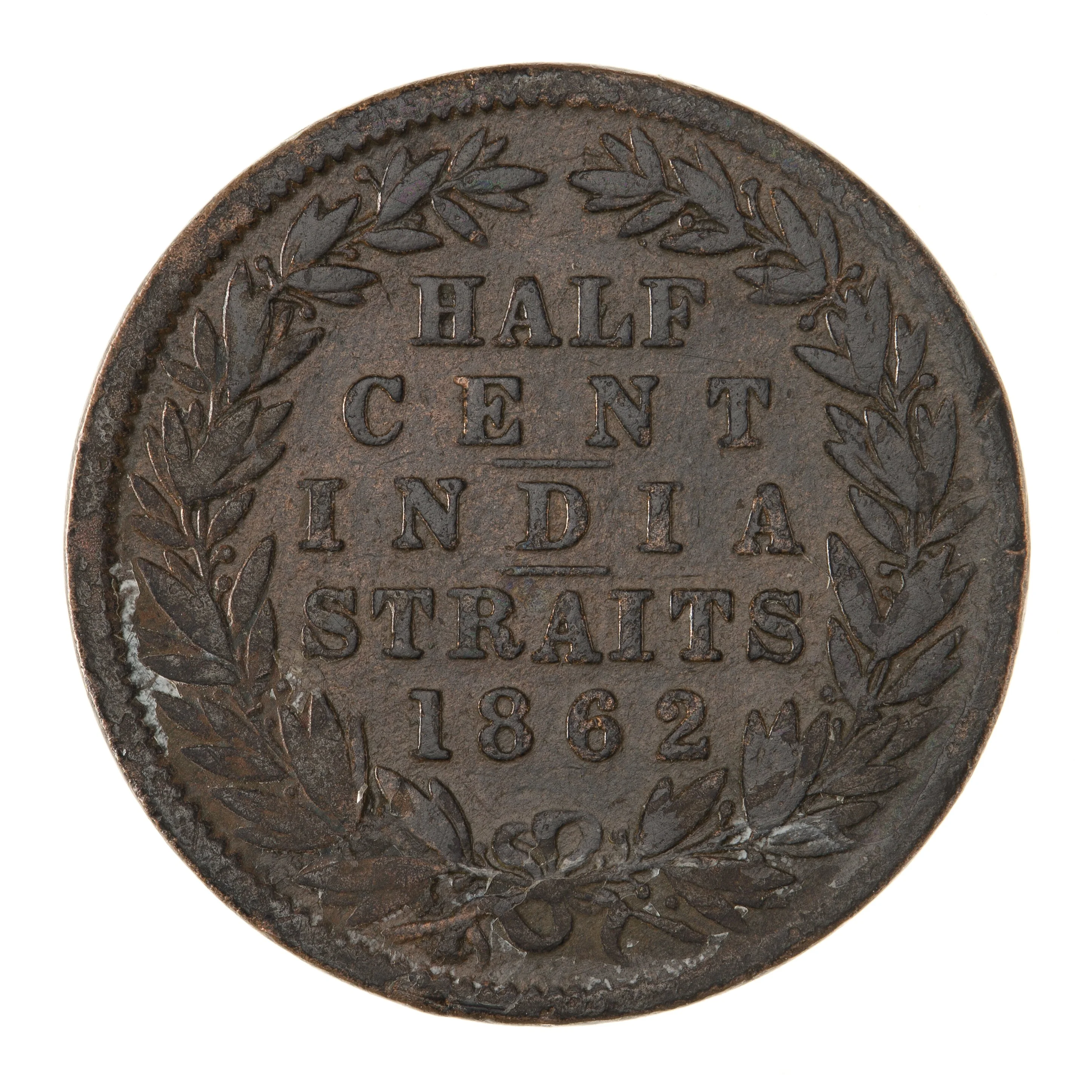
½ cent – Straits Settlements
Add to wishlist
Malaysia
Context
Year: 1862
Country: Malaysia
Issuer: Straits Settlements
Ruler: Victoria
Currency:
(1845—1939)
Demonetized: Yes
Total mintage: 4,590,499
Material
References
KM: #
Numista: #34024
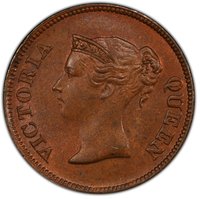
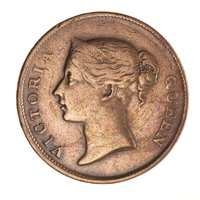
Obverse
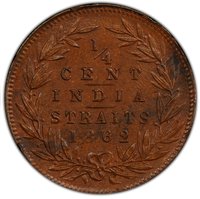
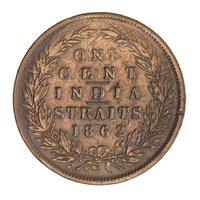
Reverse
Edge
Plain
Mints
| Name | Mark |
|---|---|
| Kolkata / Calcutta / Murshidabad | — |
Mintings
| Year | Mint Mark | Mintage | Quality | Collection |
|---|---|---|---|---|
| 1862 | — | 4,590,499 | ||
| 1862 | — | — | Proof |
Historical background
By 1862, the currency situation in the Straits Settlements (comprising Singapore, Penang, and Malacca) was one of significant complexity and transition. The colony operated within a diverse monetary ecosystem dominated by the Spanish-American silver dollar and its local equivalents, such as the Mexican dollar and the later "reproduced" dollars minted by the British in Bombay and Calcutta. These silver coins were the primary medium for substantial trade, coexisting with a plethora of smaller silver and copper coins from neighbouring regions, including Indian rupees, Dutch guilders, and Chinese cash coins. This multiplicity led to chronic confusion, with merchants and officials constantly grappling with fluctuating exchange rates and the problem of worn or debased foreign coins.
The year 1862 itself was pivotal, as it marked a decisive step toward monetary standardization. In that year, the British government in India, under whose administration the Straits Settlements fell, passed the Indian Coinage Act. This act made the Indian rupee the sole legal tender in all British Indian territories. Consequently, the Straits Settlements were ordered to adopt the rupee and its subsidiary coinage, aiming to replace the silver dollar standard and integrate the colony's finances more closely with the Indian imperial system. The transition, however, was not immediate and was met with practical and commercial resistance.
Despite the official mandate, the directive of 1862 proved deeply unpopular and ultimately unsuccessful in the marketplace. The mercantile community in Singapore, the thriving commercial heart of the colony, fiercely opposed the move. They were deeply accustomed to the silver dollar, which was the preferred currency for the vast China and regional trade, and found the rupee inconvenient. This resistance forced a prolonged period of dual circulation and set the stage for future monetary reforms. Thus, 1862 stands as the year a top-down imperial currency policy was imposed, only to be rejected by local economic realities, foreshadowing the eventual establishment of the Straits dollar in the decades that followed.
The year 1862 itself was pivotal, as it marked a decisive step toward monetary standardization. In that year, the British government in India, under whose administration the Straits Settlements fell, passed the Indian Coinage Act. This act made the Indian rupee the sole legal tender in all British Indian territories. Consequently, the Straits Settlements were ordered to adopt the rupee and its subsidiary coinage, aiming to replace the silver dollar standard and integrate the colony's finances more closely with the Indian imperial system. The transition, however, was not immediate and was met with practical and commercial resistance.
Despite the official mandate, the directive of 1862 proved deeply unpopular and ultimately unsuccessful in the marketplace. The mercantile community in Singapore, the thriving commercial heart of the colony, fiercely opposed the move. They were deeply accustomed to the silver dollar, which was the preferred currency for the vast China and regional trade, and found the rupee inconvenient. This resistance forced a prolonged period of dual circulation and set the stage for future monetary reforms. Thus, 1862 stands as the year a top-down imperial currency policy was imposed, only to be rejected by local economic realities, foreshadowing the eventual establishment of the Straits dollar in the decades that followed.
⭐ Somewhat Rare