

5 yuan – People's Republic of China
Add to wishlist
China
Context
Year: 1996
Country: China
Issuer: People's Republic of China
Period:
(since 1949)
Currency:
(since 1955)
Material
References
KM: #
Numista: #13876
Value
Exchange value: 5 CNY
Inflation-adjusted value: 8.89 CNY
Obverse
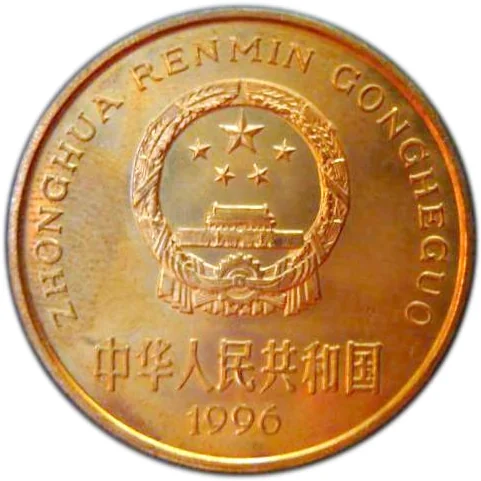
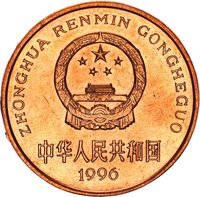
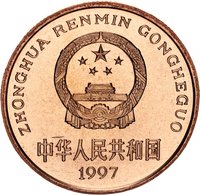
Description:
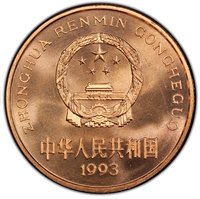
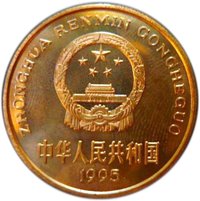
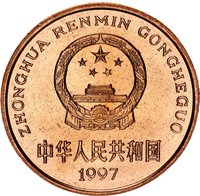
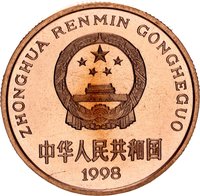
National symbol
Inscription:
ZHONGHUA RENMIN CONGHEGUO
中华人民共和国
中华人民共和国
Translation:
The People's Republic of China
Language: Chinese
Reverse
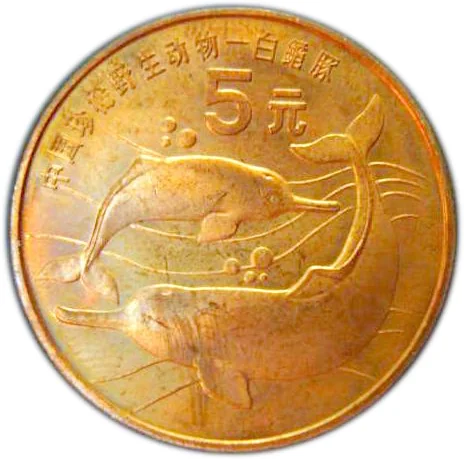
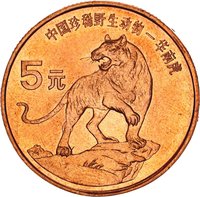
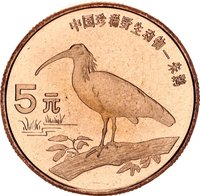
Description:
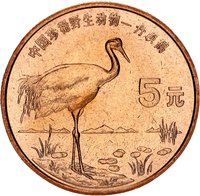
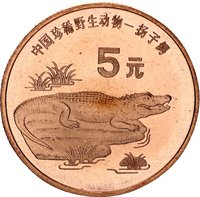
Yangtze river dolphins
Inscription:
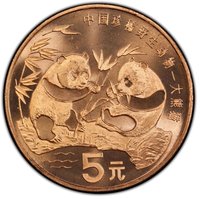
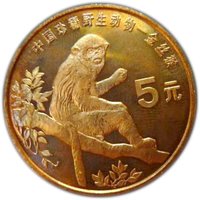
中国珍稀野生动物 — 白鳍豚
5元
5元
Translation:
Rare Wildlife of China — Baiji
5 Yuan
5 Yuan
Language: Chinese
Edge
Alternating reeded and smooth
Categories
| Animal> Marine mammal |
Mintings
| Year | Mint Mark | Mintage | Quality | Collection |
|---|---|---|---|---|
| 1996 | — | — |
Historical background
In 1996, the People's Republic of China was navigating a critical juncture in its economic transition, with its currency, the Renminbi (RMB), operating under a complex dual-track system. Officially, the RMB was pegged to the US dollar at a fixed, overvalued rate of approximately 8.3 RMB to 1 USD for current account transactions like trade. However, alongside this official rate existed a more market-driven "swap rate" available in foreign exchange adjustment centers, which traded at a slight discount. This system, a legacy of the gradualist reform approach, aimed to maintain stability for planning purposes while cautiously introducing market forces. The period was marked by stringent capital controls, strictly separating the current account (for trade) from the capital account (for investments), to prevent destabilizing hot money flows and shield the still-fragile banking system.
The macroeconomic context of the mid-1990s was pivotal. Following a bout of high inflation, the government had successfully implemented austerity measures, achieving a "soft landing" by 1996. This stability bolstered confidence and set the stage for a major policy milestone: the full convertibility of the RMB under the current account, which was formally achieved in December 1996. This move, a requirement for World Trade Organization (WTO) accession negotiations, was a significant step in China's integration into the global economy, allowing domestic enterprises to freely convert RMB for foreign trade and service payments. However, the capital account remained tightly closed, reflecting a deliberate strategy of sequenced liberalization.
Internationally, the RMB was not a significant global currency, and its value was a source of trade friction, particularly with the United States, which argued it was kept artificially weak to boost exports. Domestically, the banking sector grappled with a high burden of non-performing loans, largely to state-owned enterprises (SOEs), creating underlying financial vulnerabilities. Thus, the currency situation in 1996 was one of controlled transition—a carefully managed stability that facilitated crucial international integration while authorities prepared for the deeper reforms and pressures that would follow WTO entry, all while guarding against potential financial instability.
The macroeconomic context of the mid-1990s was pivotal. Following a bout of high inflation, the government had successfully implemented austerity measures, achieving a "soft landing" by 1996. This stability bolstered confidence and set the stage for a major policy milestone: the full convertibility of the RMB under the current account, which was formally achieved in December 1996. This move, a requirement for World Trade Organization (WTO) accession negotiations, was a significant step in China's integration into the global economy, allowing domestic enterprises to freely convert RMB for foreign trade and service payments. However, the capital account remained tightly closed, reflecting a deliberate strategy of sequenced liberalization.
Internationally, the RMB was not a significant global currency, and its value was a source of trade friction, particularly with the United States, which argued it was kept artificially weak to boost exports. Domestically, the banking sector grappled with a high burden of non-performing loans, largely to state-owned enterprises (SOEs), creating underlying financial vulnerabilities. Thus, the currency situation in 1996 was one of controlled transition—a carefully managed stability that facilitated crucial international integration while authorities prepared for the deeper reforms and pressures that would follow WTO entry, all while guarding against potential financial instability.
Series: Red Book Animals
🌟 Limited