

1 Mohar – Nepal
Nepal
Context
Years: 1881–1911
Issuer: Nepal 
Ruler: Prithvi Bir Bikram Shah
Currency:
(1546—1932)
Demonetized: Yes
Material
References
KM: #Click to copy to clipboard651
Numista: #33988
Value
Bullion value: $15.89
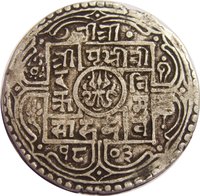
Obverse
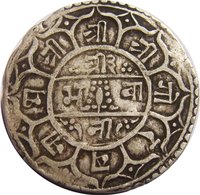
Reverse
Description:
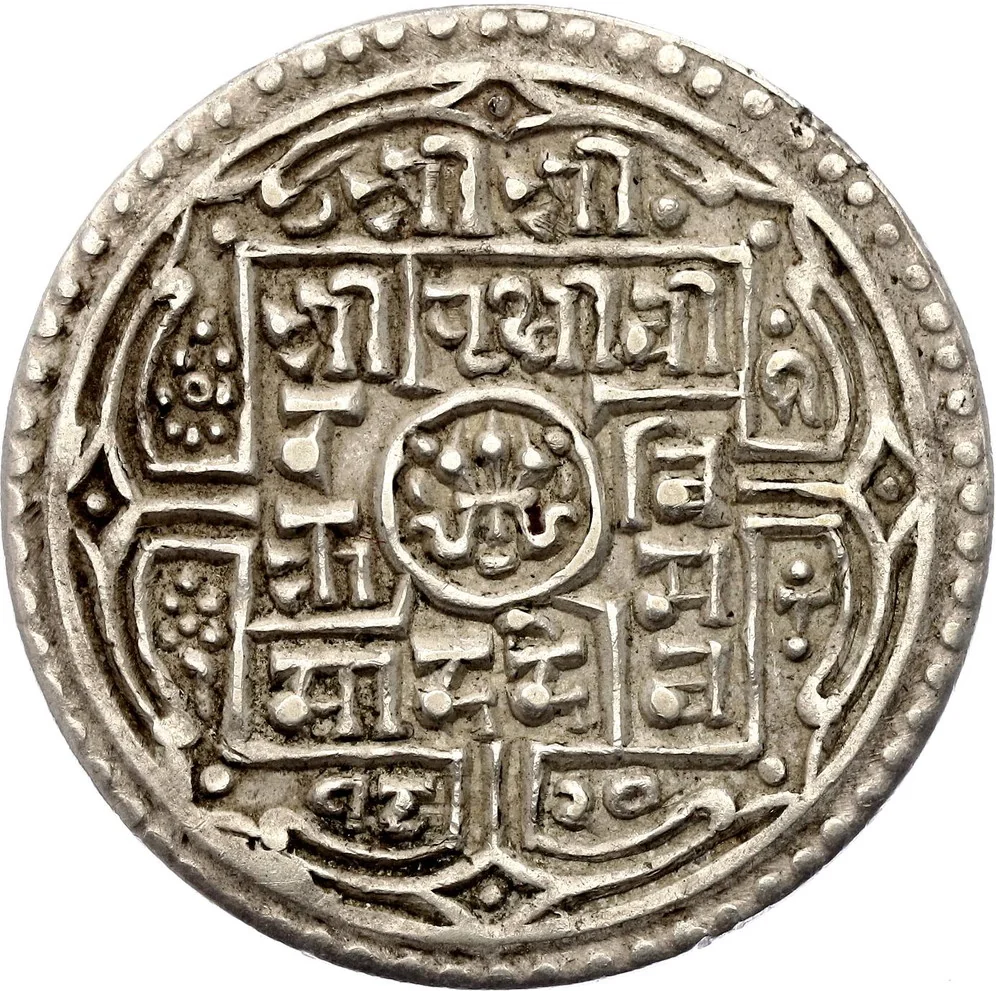
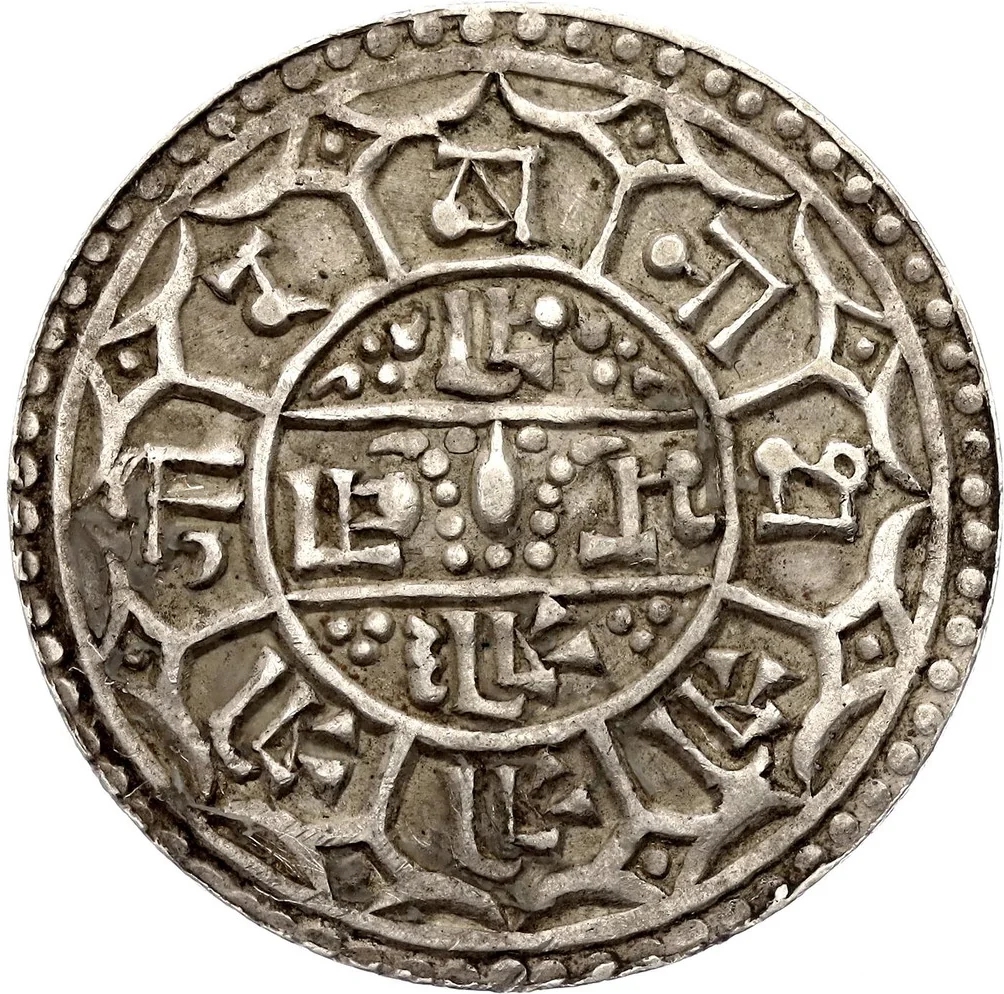
"Shree Shree Shree Gorkhanath" outside circle; "Shree 3 Bhavani" in Devanagari inside.
Inscription:
श्री श्री श्री गो र ख ना थ
श्री ३
भ वा
नी
श्री ३
भ वा
नी
Translation:
Shri Shri Shri Gorakhnath
Shri 3
Bhava
Ni
Shri 3
Bhava
Ni
Language: Sanskrit
Edge
Smooth or milled
Mintings
| Year | Mint Mark | Mintage | Quality | Collection |
|---|---|---|---|---|
| 1881 | — | — | ||
| 1882 | — | — | ||
| 1883 | — | — | ||
| 1884 | — | — | ||
| 1885 | — | — | ||
| 1886 | — | — | ||
| 1887 | — | — | ||
| 1888 | — | — | ||
| 1889 | — | — | ||
| 1894 | — | — | ||
| 1895 | — | — | ||
| 1896 | — | — | ||
| 1897 | — | — | ||
| 1898 | — | — | ||
| 1899 | — | — | ||
| 1900 | — | — | ||
| 1901 | — | — | ||
| 1902 | — | — | ||
| 1903 | — | — | ||
| 1904 | — | — | ||
| 1905 | — | — | ||
| 1906 | — | — | ||
| 1907 | — | — | ||
| 1908 | — | — | ||
| 1909 | — | — | ||
| 1910 | — | — | ||
| 1911 | — | — |
Historical background
In 1881, Nepal's currency situation was characterized by a complex and fragmented system, heavily influenced by its political and economic relationship with British India. The primary circulating medium was the Mohar, a silver coin minted by the Shah dynasty, but its value and purity were inconsistent. More significantly, vast quantities of Indian rupees, particularly the British India silver rupee, circulated freely, especially in the southern Terai region and for larger transactions. This created a de facto dual-currency system where the Indian rupee, seen as more stable and widely accepted in regional trade, often held greater practical authority than the domestic coinage.
This monetary duality was a direct reflection of Nepal's geopolitical position. Following the Anglo-Nepalese War (1814-1816) and the subsequent Treaty of Sugauli, Nepal was a functionally independent but tightly bound neighbor to the British Raj. The 1860s had seen formal agreements allowing the free flow of Indian rupees into Nepal, effectively tying its economy to the Indian monetary sphere. Consequently, the Nepalese state struggled with controlling its own money supply and suffered from the export of its limited silver to India, which exacerbated local shortages.
Recognizing the need for monetary sovereignty and stability, the Rana Prime Minister, Bir Shumsher Jang Bahadur Rana, initiated a major reform in 1881. This year marked the introduction of the Nepali rupee (NRs), a new decimalized currency intended to replace the Mohar and standardize the system. The reform established a fixed parity, pegging the new Nepali rupee at a value equal to the Indian rupee. While the transition took time, the 1881 reform laid the essential foundation for a unified national currency, seeking to reduce dependence on foreign coinage and assert greater administrative control over the kingdom's fiscal affairs.
This monetary duality was a direct reflection of Nepal's geopolitical position. Following the Anglo-Nepalese War (1814-1816) and the subsequent Treaty of Sugauli, Nepal was a functionally independent but tightly bound neighbor to the British Raj. The 1860s had seen formal agreements allowing the free flow of Indian rupees into Nepal, effectively tying its economy to the Indian monetary sphere. Consequently, the Nepalese state struggled with controlling its own money supply and suffered from the export of its limited silver to India, which exacerbated local shortages.
Recognizing the need for monetary sovereignty and stability, the Rana Prime Minister, Bir Shumsher Jang Bahadur Rana, initiated a major reform in 1881. This year marked the introduction of the Nepali rupee (NRs), a new decimalized currency intended to replace the Mohar and standardize the system. The reform established a fixed parity, pegging the new Nepali rupee at a value equal to the Indian rupee. While the transition took time, the 1881 reform laid the essential foundation for a unified national currency, seeking to reduce dependence on foreign coinage and assert greater administrative control over the kingdom's fiscal affairs.
🌟 Uncommon