

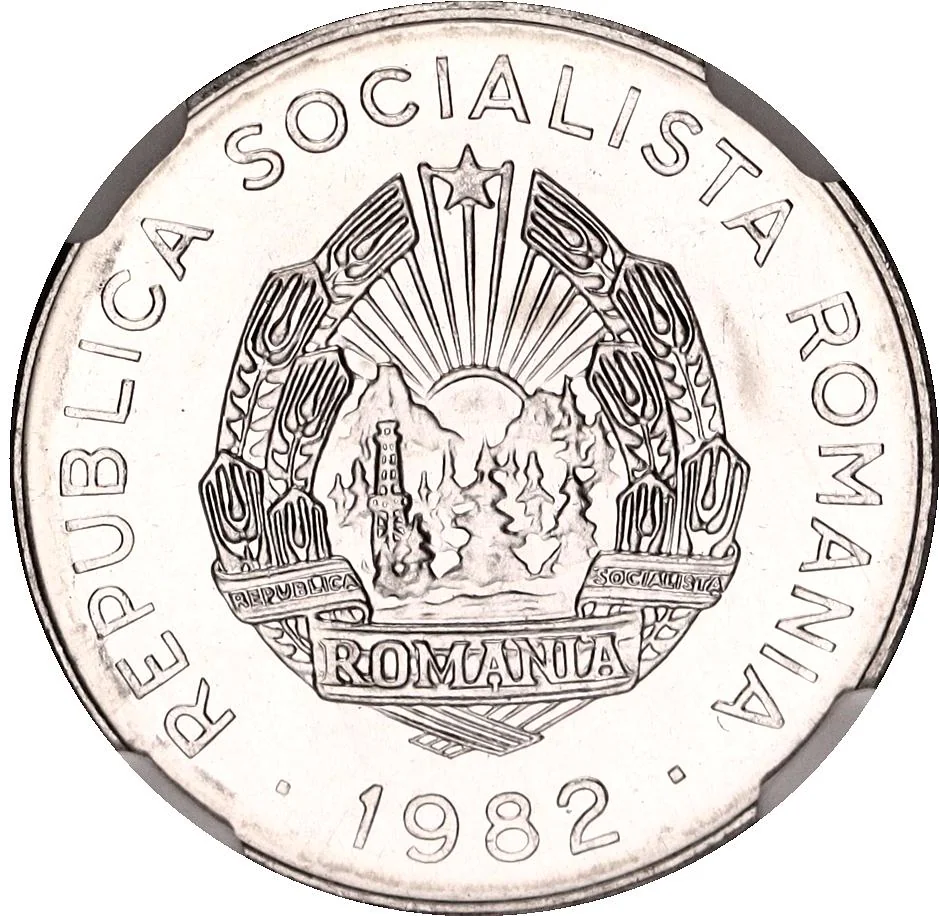
Obverse
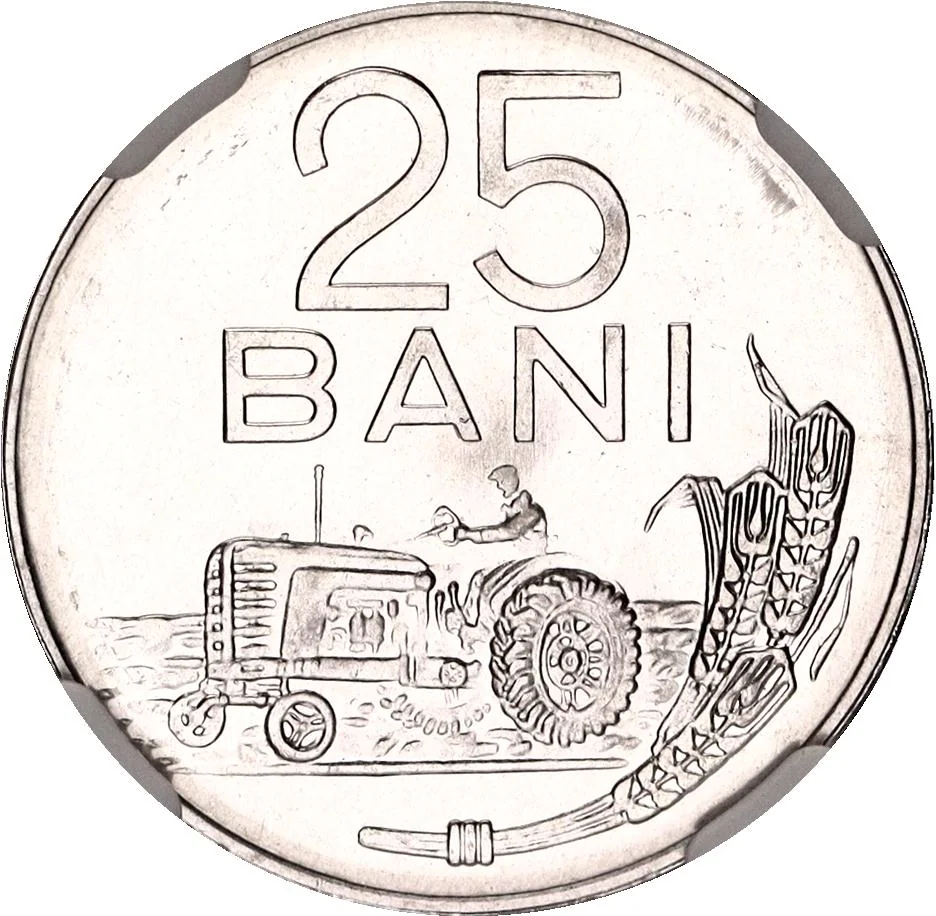
Reverse
Description:
Tractor driving left, wheat to right.
Inscription:
25
BANI
BANI
Script: Latin
Engraver: Haralambie Ionescu
Edge
Plain
Categories
| Agriculture |
| Symbols> Coat of Arms |
| Transportation> Truck or tractor |
Mints
| Name | Mark |
|---|---|
| State Mint | — |
Mintings
| Year | Mint Mark | Mintage | Quality | Collection |
|---|---|---|---|---|
| 1982 | — | — |
Historical background
In 1982, Romania's currency situation was a direct consequence of Nicolae Ceaușescu's extreme drive to eliminate the nation's foreign debt. Throughout the 1970s, the regime had borrowed heavily from Western creditors to finance an ambitious and inefficient industrialization program. By the early 1980s, as global interest rates soared and the economy stagnated under the rigidities of central planning, servicing this debt became crippling. Ceaușescu's response was not reform but austerity, launching a brutal campaign to export virtually all viable domestic production to earn hard currency for debt repayment.
This policy had a catastrophic impact on the domestic economy and the Romanian leu. While the official exchange rate was set by the state at an artificially strong level, it was largely meaningless for citizens and reflected none of the economic reality. The real value of the leu was evident on the thriving black market, where hard currencies like the US dollar commanded exponentially higher rates. Internally, the austerity program created severe shortages of food, energy, fuel, and consumer goods, rendering the leu increasingly powerless for purchasing basic necessities, even when people had savings.
Thus, the currency situation in 1982 was one of profound duality and dysfunction. Externally, the government was accumulating hard currency reserves through forced exports, aiming for a symbolic financial independence. Internally, the leu was being hollowed out by a collapsing supply system and rampant inflation in all but name. The population endured deepening poverty and deprivation, their salaries in lei buying less and less, while the state prioritized debt figures over human welfare, setting the stage for the severe economic and social crisis that would define the remainder of the Ceaușescu era.
This policy had a catastrophic impact on the domestic economy and the Romanian leu. While the official exchange rate was set by the state at an artificially strong level, it was largely meaningless for citizens and reflected none of the economic reality. The real value of the leu was evident on the thriving black market, where hard currencies like the US dollar commanded exponentially higher rates. Internally, the austerity program created severe shortages of food, energy, fuel, and consumer goods, rendering the leu increasingly powerless for purchasing basic necessities, even when people had savings.
Thus, the currency situation in 1982 was one of profound duality and dysfunction. Externally, the government was accumulating hard currency reserves through forced exports, aiming for a symbolic financial independence. Internally, the leu was being hollowed out by a collapsing supply system and rampant inflation in all but name. The population endured deepening poverty and deprivation, their salaries in lei buying less and less, while the state prioritized debt figures over human welfare, setting the stage for the severe economic and social crisis that would define the remainder of the Ceaușescu era.
🌱 Very Common