

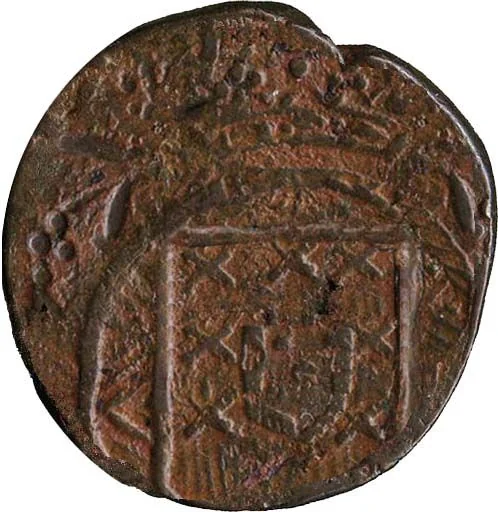
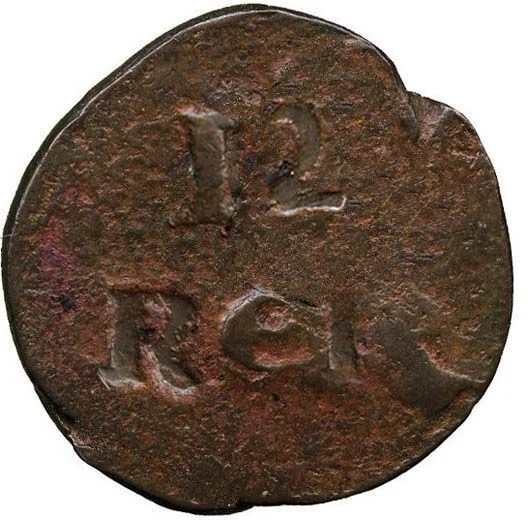
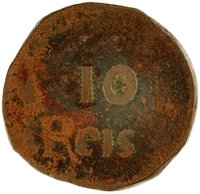
15 Bazarucos – Portuguese India
India
Context
Years: 1816–1826
Country: India 
Issuer: Portuguese India
Ruler: João VI
Currency:
(1706—1880)
Demonetized: Yes
Material
Diameter: 22 mm
Weight: 7.6 g
Shape: Irregular round
Composition: Copper
Magnetic: No
Technique: Hammered
References
KM: #Click to copy to clipboard231
Numista: #339299
Obverse
Description:
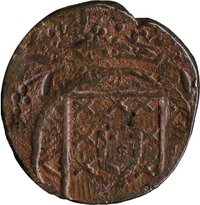
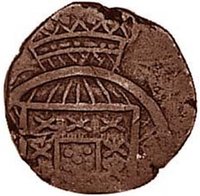
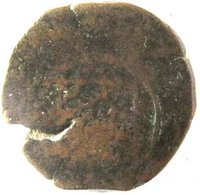
Gomes/2013: J6.08.0 (Large) and J6.25.0 (Small armillary spheres)
Reverse
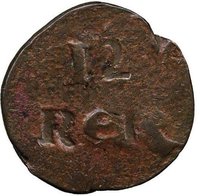
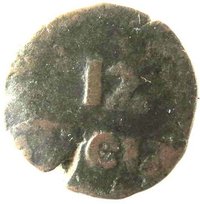
Inscription:
12
ReIS
ReIS
Script: Latin
Edge
Mints
| Name | Mark |
|---|---|
| Goa | — |
Mintings
| Year | Mint Mark | Mintage | Quality | Collection |
|---|---|---|---|---|
| — | — | — |
Historical background
In 1816, the currency situation in Portuguese India, centered on the territories of Goa, Daman, and Diu, was characterized by a complex and chaotic multiplicity of circulating coins. The official Portuguese currency, the real, was theoretically the standard, but in practice, it competed with a plethora of foreign coins that dominated everyday commerce. The most important of these was the British Indian silver rupee, which, due to the overwhelming economic influence of the neighboring British East India Company and the robust trade networks of the Indian Ocean, served as the de facto benchmark for larger transactions. Alongside it circulated other European coins like Spanish dollars (pieces of eight), older Portuguese cruzados, and a variety of local and regional coins, creating a confusing system without a fixed exchange rate.
This monetary disorder was a direct result of Portugal's weakened economic and political position. The Napoleonic Wars and the subsequent transfer of the Portuguese court to Brazil (1808-1821) had drained metropolitan attention and resources, leaving Goa administratively neglected and economically stagnant. The local government lacked the bullion reserves and minting capacity to impose a uniform currency. Consequently, exchange rates between the various coins fluctuated based on intrinsic metal content, wear, and local market demand, leading to frequent disputes, fraud, and significant hindrance to both internal revenue collection and external trade.
Attempts at reform were piecemeal and largely ineffective. Authorities periodically issued proclamations to fix the value of foreign coins against the Portuguese real, but these official rates often failed to match market realities and were widely ignored. The circulation of worn, clipped, and counterfeit coins further exacerbated the problem. Thus, in 1816, the monetary landscape of Portuguese India was not one of sovereign control but of pragmatic adaptation to a hybrid system, where economic life was mediated through an unstable alloy of imperial ambition, colonial decline, and the dominant commercial forces of the wider Indian Ocean world.
This monetary disorder was a direct result of Portugal's weakened economic and political position. The Napoleonic Wars and the subsequent transfer of the Portuguese court to Brazil (1808-1821) had drained metropolitan attention and resources, leaving Goa administratively neglected and economically stagnant. The local government lacked the bullion reserves and minting capacity to impose a uniform currency. Consequently, exchange rates between the various coins fluctuated based on intrinsic metal content, wear, and local market demand, leading to frequent disputes, fraud, and significant hindrance to both internal revenue collection and external trade.
Attempts at reform were piecemeal and largely ineffective. Authorities periodically issued proclamations to fix the value of foreign coins against the Portuguese real, but these official rates often failed to match market realities and were widely ignored. The circulation of worn, clipped, and counterfeit coins further exacerbated the problem. Thus, in 1816, the monetary landscape of Portuguese India was not one of sovereign control but of pragmatic adaptation to a hybrid system, where economic life was mediated through an unstable alloy of imperial ambition, colonial decline, and the dominant commercial forces of the wider Indian Ocean world.
✨ Legendary