

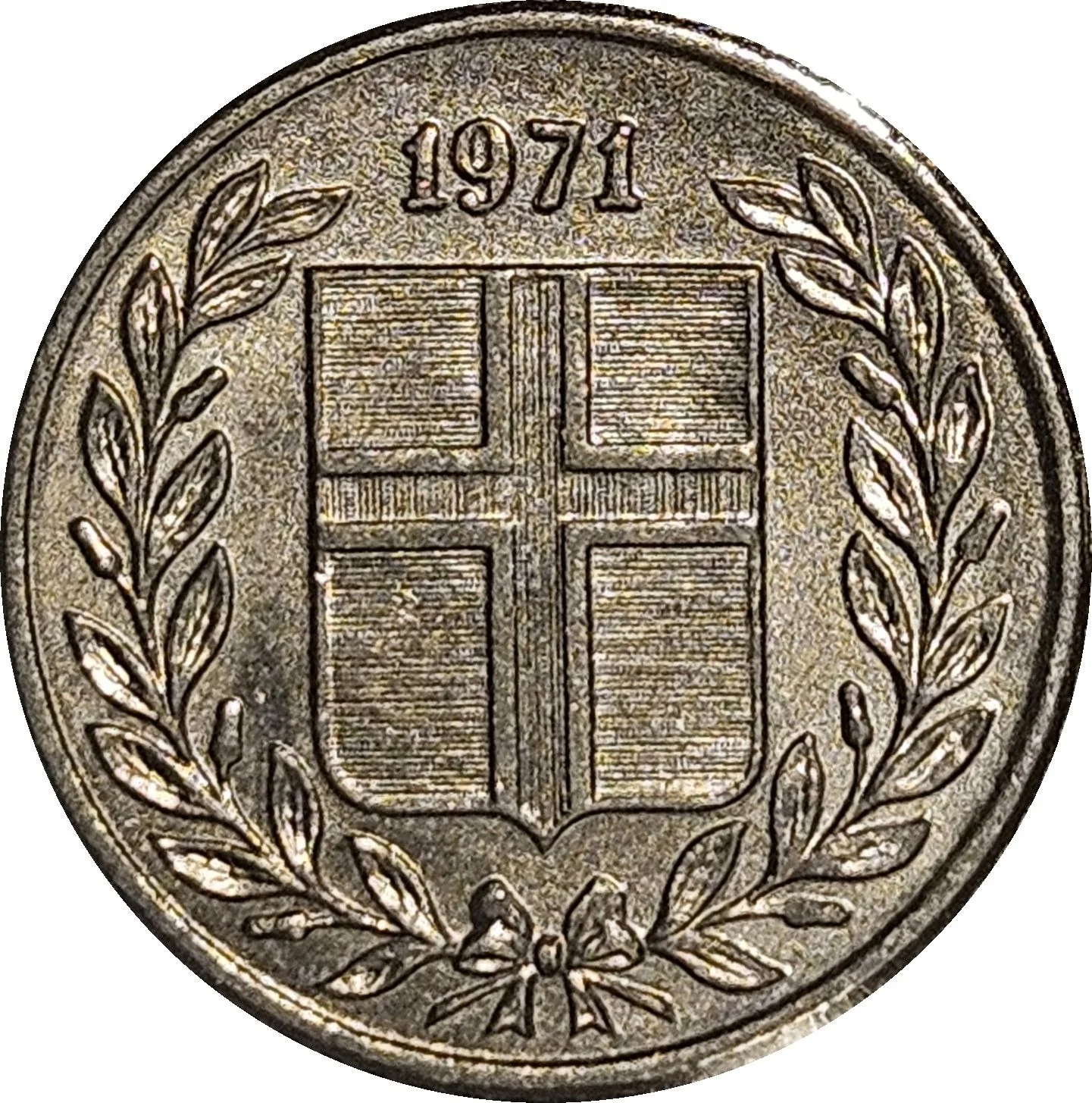
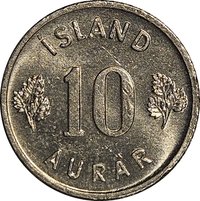
Obverse
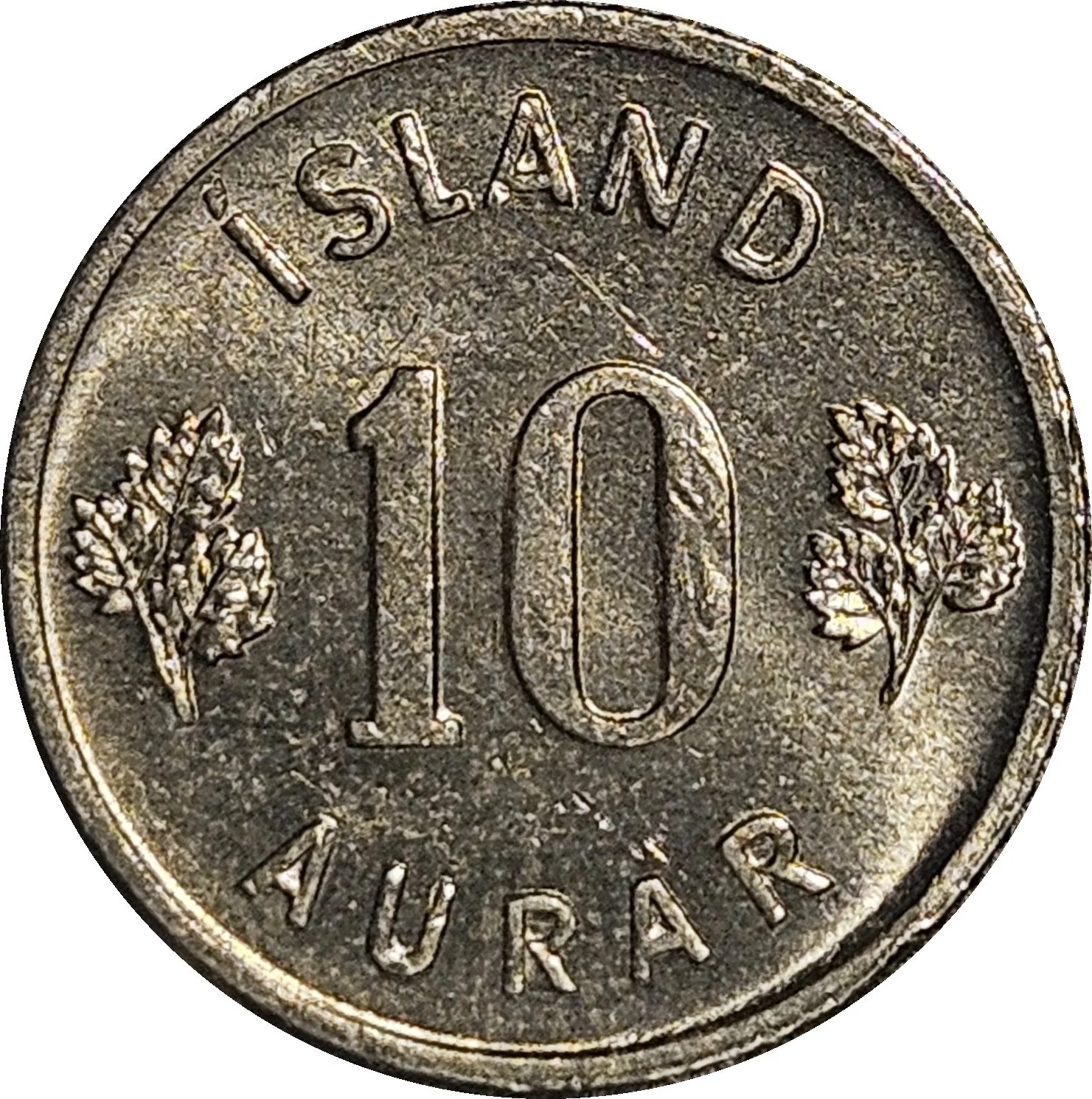
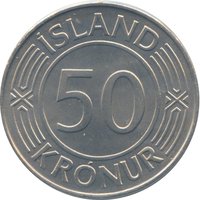
Reverse
Edge
Milled
Categories
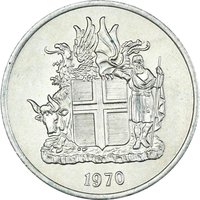
| Symbols> Coat of Arms |
| Symbol> Wreath |
Mints
| Name | Mark |
|---|---|
| Royal Mint | — |
Mintings
| Year | Mint Mark | Mintage | Quality | Collection |
|---|---|---|---|---|
| 1970 | — | 4,800,000 | ||
| 1971 | — | 11,200,000 | ||
| 1973 | — | 4,800,000 | ||
| 1974 | — | 4,800,000 | ||
| 1974 | — | 15,000 | Proof |
Historical background
In 1970, Iceland’s currency system was defined by its long-standing membership in the Scandinavian Currency Union (SCU), a fixed exchange rate regime it had joined in 1875. The Icelandic króna was pegged to the Danish krone and, by extension, to gold. However, this formal membership was largely symbolic by this time, as the original union had effectively dissolved decades earlier. Iceland maintained the peg unilaterally as a cornerstone of monetary stability, but its economy was vastly different from its Scandinavian partners, being heavily dependent on the volatile fishing sector.
Domestically, the currency faced significant pressures. The post-war period had seen rapid modernization and economic growth fueled by fisheries, but this was accompanied by persistent and high inflation. By 1970, inflationary trends were worsening, driven by strong domestic demand, indexation of wages to prices, and expansive fiscal policies. This created a growing strain on the fixed exchange rate peg, as Iceland's price level rose faster than those of its trading partners, hurting export competitiveness and encouraging imports.
Consequently, 1970 stood on the precipice of major change. The inherent conflict between a fixed exchange rate and an overheating, inflation-prone economy was becoming unsustainable. The pressures culminated just a few years later, leading to Iceland's exit from the fixed peg in 1972 and the beginning of a long era of frequent devaluations of the króna. Thus, the currency situation in 1970 was one of apparent but fragile stability, masking the severe imbalances that would soon force a fundamental shift in Iceland's monetary policy framework.
Domestically, the currency faced significant pressures. The post-war period had seen rapid modernization and economic growth fueled by fisheries, but this was accompanied by persistent and high inflation. By 1970, inflationary trends were worsening, driven by strong domestic demand, indexation of wages to prices, and expansive fiscal policies. This created a growing strain on the fixed exchange rate peg, as Iceland's price level rose faster than those of its trading partners, hurting export competitiveness and encouraging imports.
Consequently, 1970 stood on the precipice of major change. The inherent conflict between a fixed exchange rate and an overheating, inflation-prone economy was becoming unsustainable. The pressures culminated just a few years later, leading to Iceland's exit from the fixed peg in 1972 and the beginning of a long era of frequent devaluations of the króna. Thus, the currency situation in 1970 was one of apparent but fragile stability, masking the severe imbalances that would soon force a fundamental shift in Iceland's monetary policy framework.
🌱 Very Common