

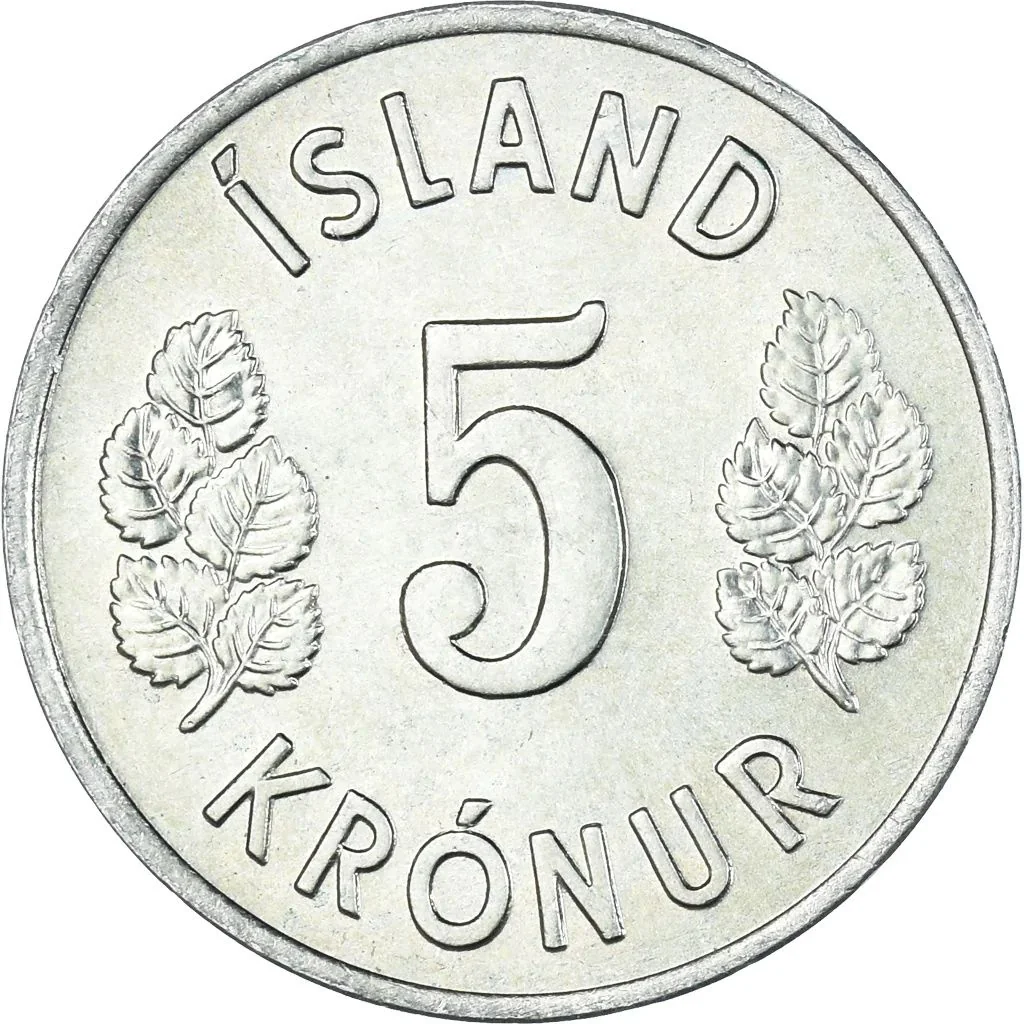
5 Krónur – Iceland
Iceland

Obverse
Description:
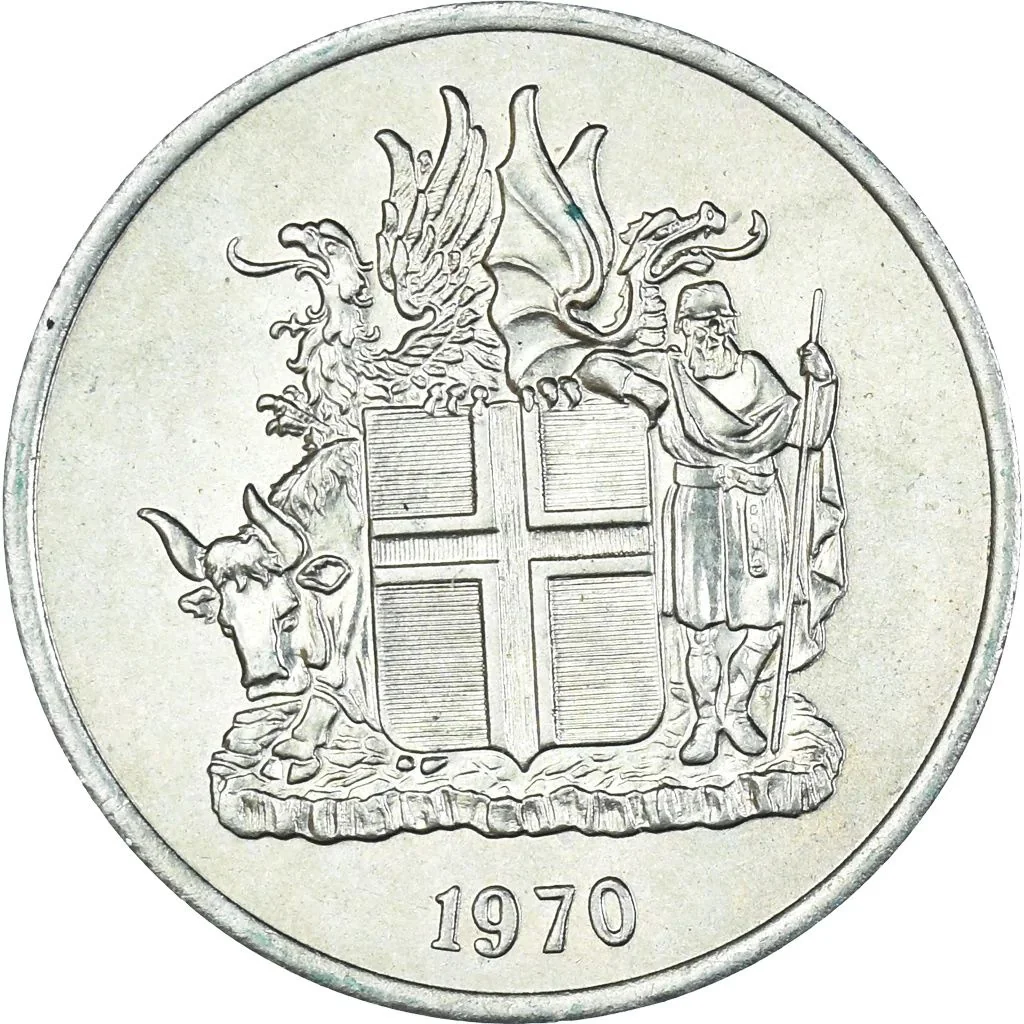
Iceland's coat of arms encircled by its four guardian spirits (Landvættir): the bull, eagle, dragon, and giant.
Inscription:
1970
Script: Latin
Reverse
Edge
Plain
Categories
| Animal> Bird |
| Animal> Cow |
| Mythology> Fantastic animal |
| Symbols> Coat of Arms |
Mints
| Name | Mark |
|---|---|
| Royal Mint | — |
Mintings
| Year | Mint Mark | Mintage | Quality | Collection |
|---|---|---|---|---|
| 1969 | — | 2,000,000 | ||
| 1970 | — | 1,000,000 | ||
| 1971 | — | 500,000 | ||
| 1973 | — | 1,100,000 | ||
| 1974 | — | 1,200,000 | ||
| 1975 | — | 1,500,000 | ||
| 1976 | — | 500,000 | ||
| 1977 | — | 1,000,000 | ||
| 1978 | — | 4,672,000 | ||
| 1980 | — | 2,400,000 | ||
| 1980 | — | 15,000 | Proof |
Historical background
In 1969, Iceland's currency situation was characterized by a period of relative stability under the fixed exchange rate regime of the króna, but this stability was underpinned by persistent and structural economic vulnerabilities. The country was a decade into a major economic transformation, shifting from a reliance on fishing and agriculture toward industrialization, particularly through the expansion of energy-intensive aluminum smelting. This development drive, coupled with a high standard of living and strong labor unions, fueled chronic inflation and recurrent trade deficits. The króna, which had been devalued significantly in 1960 and again in 1967, was pegged to the US dollar, but maintaining this peg required strict capital controls and frequent central bank intervention to manage the balance of payments.
The core tension lay in the "stop-go" cycle of the economy, where periods of rapid growth and overheating were followed by forced stabilization. Inflation, often in the double digits, steadily eroded the króna's domestic purchasing power, creating pressure on the fixed exchange rate. To defend the peg, authorities relied heavily on import restrictions and foreign borrowing, as Iceland's export base (still dominated by volatile fish products) was insufficient to cover the import bill for machinery, consumer goods, and raw materials needed for development. This environment created a complex system of currency regulations and multiple exchange rates for different types of transactions, distorting the economy.
Thus, while 1969 itself was not a year of dramatic currency crisis, it existed within an unsustainable trajectory. The fixed exchange rate was increasingly seen as a straitjacket, conflicting with the domestic goal of full employment and growth. The pressures building in the late 1960s would culminate in the early 1970s, leading to the breakdown of the Bretton Woods system and, for Iceland, the eventual abandonment of the fixed peg in favor of a managed float and further devaluations to restore competitiveness, setting the stage for the high-inflation turmoil of the subsequent decades.
The core tension lay in the "stop-go" cycle of the economy, where periods of rapid growth and overheating were followed by forced stabilization. Inflation, often in the double digits, steadily eroded the króna's domestic purchasing power, creating pressure on the fixed exchange rate. To defend the peg, authorities relied heavily on import restrictions and foreign borrowing, as Iceland's export base (still dominated by volatile fish products) was insufficient to cover the import bill for machinery, consumer goods, and raw materials needed for development. This environment created a complex system of currency regulations and multiple exchange rates for different types of transactions, distorting the economy.
Thus, while 1969 itself was not a year of dramatic currency crisis, it existed within an unsustainable trajectory. The fixed exchange rate was increasingly seen as a straitjacket, conflicting with the domestic goal of full employment and growth. The pressures building in the late 1960s would culminate in the early 1970s, leading to the breakdown of the Bretton Woods system and, for Iceland, the eventual abandonment of the fixed peg in favor of a managed float and further devaluations to restore competitiveness, setting the stage for the high-inflation turmoil of the subsequent decades.
🌱 Very Common