

10 francs – Hungary
Add to wishlist
Hungary
Context
Years: 1880–1890
Issuer: Hungary
Ruler: Francis Joseph I
Currency:
(1857—1892)
Subdivision: 10 francs = 4 Florins
Demonetized: Yes
Total mintage: 313,102
Material
References
KM: #
Numista: #33831
Value
Bullion value: $452.58
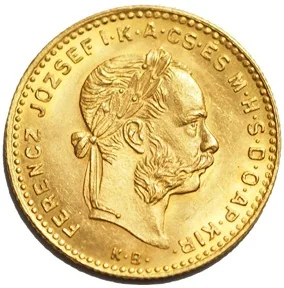
Obverse
Description:
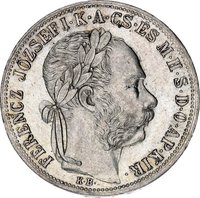
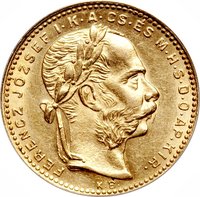
Aged bust in profile.
Inscription:
FERENCZ JÓZSEF I ·K · A · CS · ÉS · M · H · S · D · O · AP · KIR ·
K B
K B
Translation:
Francis Joseph I, by the Grace of God, Emperor of Austria, Apostolic King of Hungary, Croatia, Bohemia, and Dalmatia, etc. King.
Script: Latin
Engraver: Josef Tautenhayn
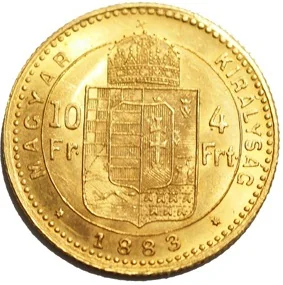
Reverse
Edge
Reeded
Mints
| Name | Mark |
|---|---|
| Kremnica | K B |
Mintings
| Year | Mint Mark | Mintage | Quality | Collection |
|---|---|---|---|---|
| 1880 | K | 12,546 | ||
| 1881 | K | 11,737 | ||
| 1882 | K | 13,350 | ||
| 1883 | K | 11,865 | ||
| 1884 | K | 53,533 | ||
| 1885 | K | 64,277 | ||
| 1886 | K | 39,066 | ||
| 1887 | K | 38,842 | ||
| 1888 | K | 48,682 | ||
| 1889 | K | 19,204 | ||
| 1890 | K | — |
Historical background
In 1880, Hungary operated within the complex monetary framework of the Austro-Hungarian Empire, established by the Compromise of 1867. The official currency was the Austro-Hungarian gulden (or forint in Hungarian), which was part of a bimetallic system theoretically based on both silver and gold. However, the system was under strain. The empire had suspended the free coinage of silver in 1879, effectively moving towards a de facto gold standard following the trends of other major European powers and in response to the global influx of silver that was depressing its value.
Economically, this period was one of consolidation and rapid growth for Hungary, often called the "Golden Age" of the Hungarian economy. The currency stability provided by the empire's monetary union was crucial for this development, facilitating trade, investment, and large-scale infrastructure projects like railway expansion. The shared currency eliminated exchange rate risks within the empire, integrating the Hungarian agricultural and budding industrial sectors with Austrian financial and industrial centers.
Nevertheless, monetary policy was a point of contention within the Dual Monarchy. Control over financial matters was centralized in Vienna under the Austro-Hungarian Bank, a shared institution. Hungarian political and economic leaders increasingly agitated for greater autonomy, seeking the establishment of a separate Hungarian central bank and the right to issue currency marked with Hungarian symbols. Thus, while the currency situation in 1880 was functionally stable and supportive of growth, it was also a backdrop for ongoing national-political struggles over economic sovereignty within the empire.
Economically, this period was one of consolidation and rapid growth for Hungary, often called the "Golden Age" of the Hungarian economy. The currency stability provided by the empire's monetary union was crucial for this development, facilitating trade, investment, and large-scale infrastructure projects like railway expansion. The shared currency eliminated exchange rate risks within the empire, integrating the Hungarian agricultural and budding industrial sectors with Austrian financial and industrial centers.
Nevertheless, monetary policy was a point of contention within the Dual Monarchy. Control over financial matters was centralized in Vienna under the Austro-Hungarian Bank, a shared institution. Hungarian political and economic leaders increasingly agitated for greater autonomy, seeking the establishment of a separate Hungarian central bank and the right to issue currency marked with Hungarian symbols. Thus, while the currency situation in 1880 was functionally stable and supportive of growth, it was also a backdrop for ongoing national-political struggles over economic sovereignty within the empire.
💎 Very Rare