

5 cents – South Africa
Add to wishlist
South Africa
Context
Years: 1996–2000
Issuer: South Africa
Period:
(since 1961)
Currency:
(since 1961)
Total mintage: 606,055,921
Material
References
KM: #
Numista: #3376
Value
Exchange value: 0.05 ZAR
Inflation-adjusted value: 0.24 ZAR
Obverse
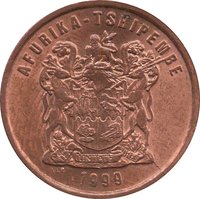
Description:
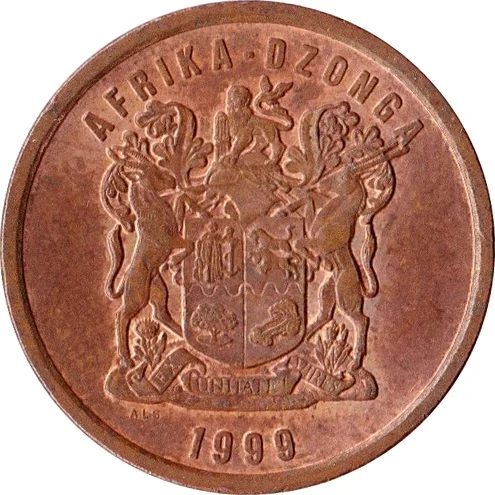
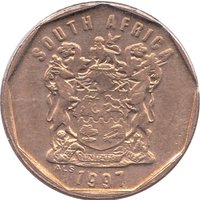
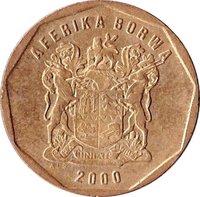
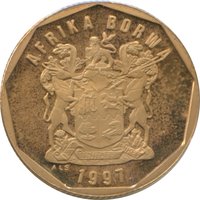
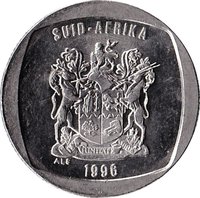
South Africa's coat of arms with the Tsonga name and motto "Ex Unitate Vires."
Inscription:
AFRIKA-DZONGA
EX UNITATE VIRES
ALS
1999
EX UNITATE VIRES
ALS
1999
Translation:
Out of Unity, Strength
South Africa
1999
South Africa
1999
Script: Latin
Engraver: Arthur Sutherland
Reverse
Edge
Plain
Categories
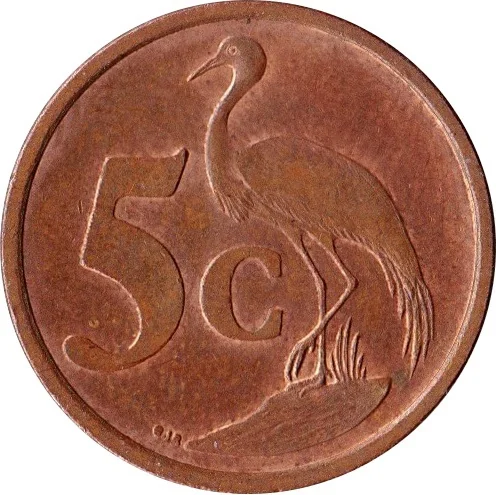
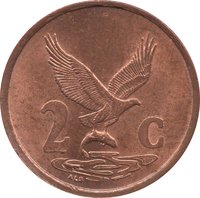
| Animal> Bird |
| Symbols> Coat of Arms |
Mints
| Name | Mark |
|---|---|
| South African Mint | — |
Mintings
| Year | Mint Mark | Mintage | Quality | Collection |
|---|---|---|---|---|
| 1996 | — | 101,000,000 | ||
| 1996 | — | 11,676 | BU | |
| 1996 | — | 4,827 | Proof | |
| 1997 | — | 3,596 | Proof | |
| 1997 | — | 228,000,000 | ||
| 1997 | — | 7,515 | BU | |
| 1998 | — | 88,000,000 | ||
| 1998 | — | 4,487 | BU | |
| 1998 | — | 3,051 | Proof | |
| 1999 | — | 57,000,000 | ||
| 1999 | — | 5,525 | BU | |
| 1999 | — | 3,774 | Proof | |
| 2000 | — | 132,000,000 | ||
| 2000 | — | 3,703 | Proof | |
| 2000 | — | 7,767 | BU |
Historical background
In 1996, South Africa's currency, the rand, was navigating a complex and volatile period marked by the dual pressures of political transition and economic liberalization. The new democratic government, led by President Nelson Mandela, was just two years into its tenure and faced the immense challenge of integrating the country into the global economy while addressing deep-seated domestic inequalities. This year was pivotal as it saw the introduction of the Growth, Employment and Redistribution (GEAR) strategy, a market-oriented policy that replaced the more interventionist Reconstruction and Development Programme (RDP). GEAR's focus on fiscal discipline, privatization, and trade liberalization had direct implications for the rand, as it aimed to attract foreign investment but also exposed the currency to the sentiments of international capital markets.
The rand experienced significant turbulence in 1996, most notably with a sudden and sharp depreciation in early March. The currency lost nearly 10% of its value against the US dollar in a matter of weeks, a crisis triggered by a combination of factors. These included a large current account deficit, concerns over the pace of socio-economic delivery, and a broader "emerging market sell-off" that affected currencies globally. The crisis underscored the rand's vulnerability to sudden shifts in investor confidence and led to a swift response from the South African Reserve Bank (SARB), which raised interest rates aggressively to stabilize the currency and curb inflation.
By the end of 1996, the rand had recovered some ground but remained under a regime of heightened volatility and scrutiny. The year cemented a shift towards a floating exchange rate system, with the SARB intervening only to curb disorderly market conditions rather than to defend a specific peg. This framework placed a new emphasis on domestic monetary policy, particularly inflation targeting, which would be formally adopted in 2000. Thus, 1996 set the stage for the modern era of South Africa's currency management, where the rand's value became a key barometer of both global risk appetite and confidence in the country's ongoing political and economic reforms.
The rand experienced significant turbulence in 1996, most notably with a sudden and sharp depreciation in early March. The currency lost nearly 10% of its value against the US dollar in a matter of weeks, a crisis triggered by a combination of factors. These included a large current account deficit, concerns over the pace of socio-economic delivery, and a broader "emerging market sell-off" that affected currencies globally. The crisis underscored the rand's vulnerability to sudden shifts in investor confidence and led to a swift response from the South African Reserve Bank (SARB), which raised interest rates aggressively to stabilize the currency and curb inflation.
By the end of 1996, the rand had recovered some ground but remained under a regime of heightened volatility and scrutiny. The year cemented a shift towards a floating exchange rate system, with the SARB intervening only to curb disorderly market conditions rather than to defend a specific peg. This framework placed a new emphasis on domestic monetary policy, particularly inflation targeting, which would be formally adopted in 2000. Thus, 1996 set the stage for the modern era of South Africa's currency management, where the rand's value became a key barometer of both global risk appetite and confidence in the country's ongoing political and economic reforms.
🌱 Very Common