

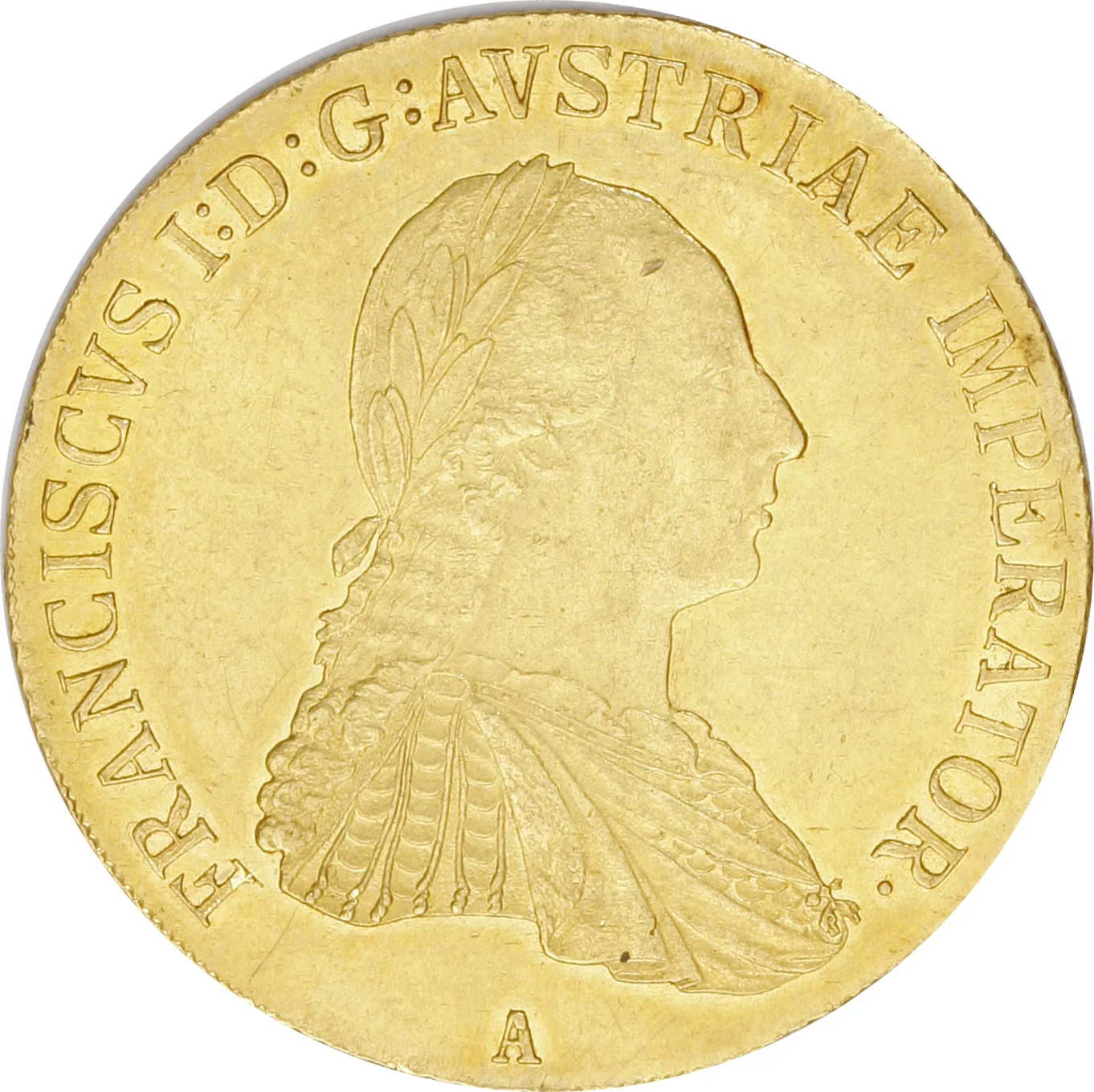
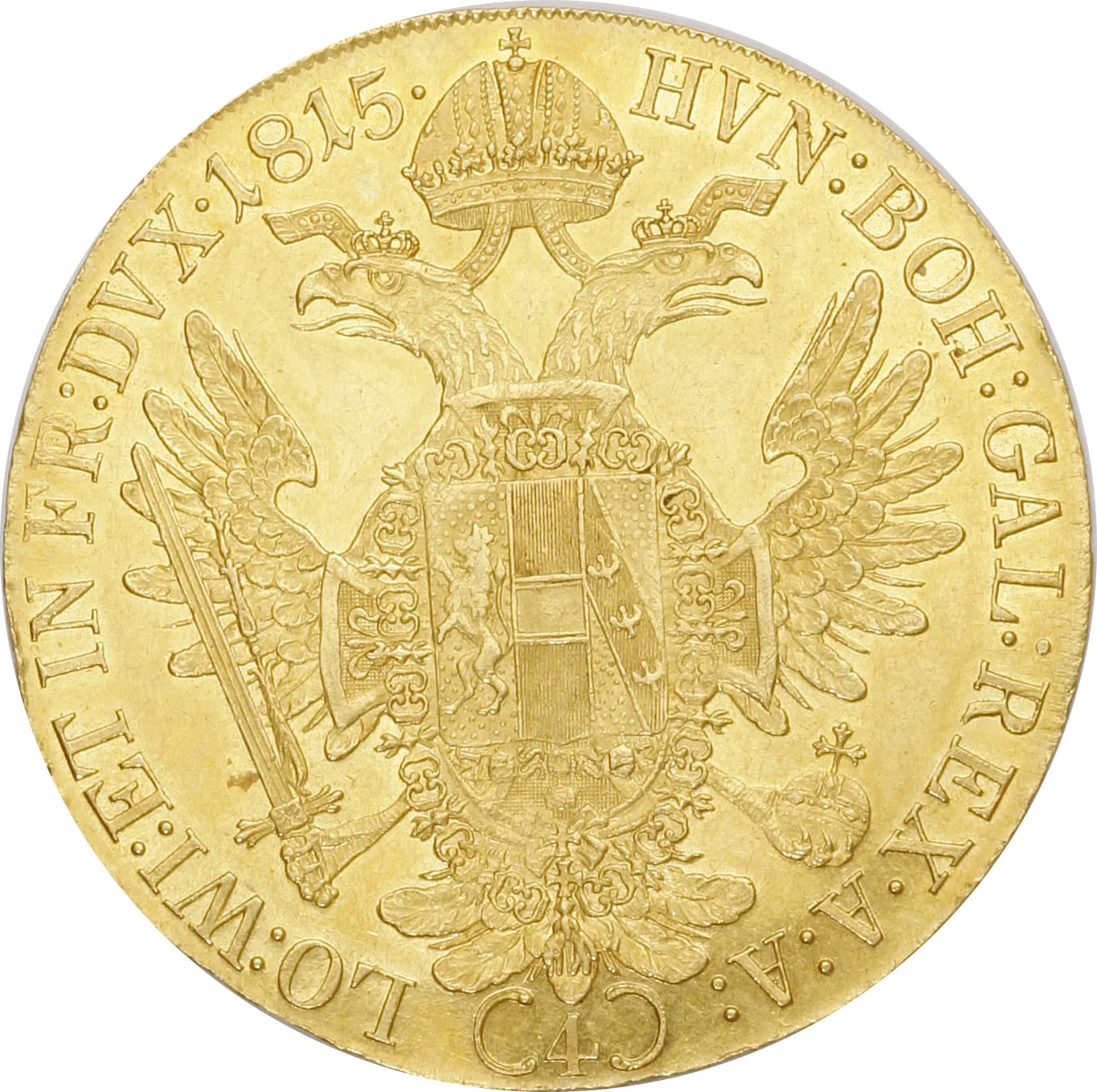
4 Ducats – Austrian Empire
Austria
Context
Years: 1811–1815
Country: Austria 
Issuer: Austrian Empire
Ruler: Francis I of Austria
Currency:
(1754—1857)
Demonetized: Yes
Material
References
KM: #Click to copy to clipboard2177
Numista: #33731
Value
Bullion value: $2305.45
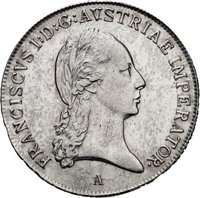
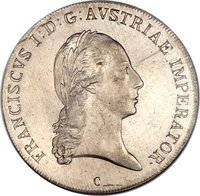
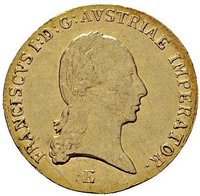
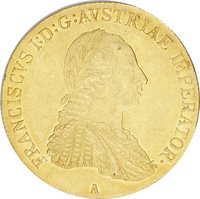
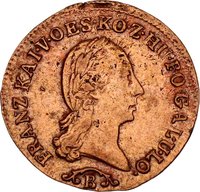
Obverse
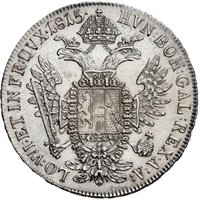
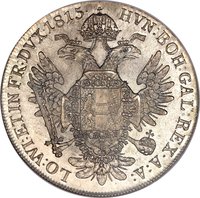
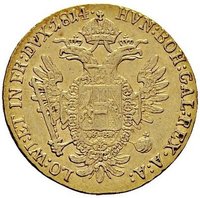
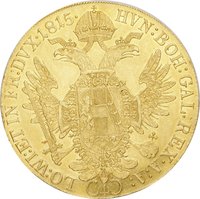
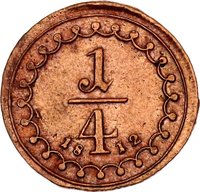
Reverse
Inscription:
HVN : BOH : GAL : REX . A:A. –LO : WI : ET IN. FR : DVX.
(4)
(4)
Script: Latin
Edge
Mints
| Name | Mark |
|---|---|
| Münze Österreich | A |
Historical background
The currency situation in the Austrian Empire in 1811 was one of catastrophic financial collapse, culminating in the State Bankruptcy of 1811. For decades, the Habsburg monarchy had financed its near-constant warfare, particularly against Revolutionary and Napoleonic France, not through taxes but by printing vast quantities of paper money known as Bankozettel. This unbacked currency, originally introduced in 1762, flooded the economy, leading to severe inflation and a dramatic loss of public confidence. By 1810, the paper gulden had lost over 80% of its nominal value against silver, causing economic distress, price instability, and a crippling disparity between the official and market exchange rates.
Faced with this crisis, Emperor Francis I's finance minister, Johann Philipp von Stadion, enacted a radical and coercive reform on February 20, 1811—the Finanz-Patent. This decree declared a state bankruptcy, mandating that all Bankozettel notes be exchanged for a new paper currency, the Einlösungsschein, at a brutal rate of 5:1. Furthermore, the state unilaterally reduced the interest and principal on its entire public debt by half. The aim was to drastically reduce the money supply, restore fiscal credibility, and stabilize state finances, but it came at a devastating cost to ordinary citizens, merchants, and state creditors, who saw their savings and assets evaporate overnight.
The short-term result was a temporary stabilization, but the underlying fiscal discipline was not maintained. The pressures of the ongoing Napoleonic Wars soon forced the government to once again resort to printing the new currency, setting the stage for a second bankruptcy in 1816. Thus, the 1811 episode stands as a stark example of the Habsburg monarchy's fiscal vulnerabilities in the early 19th century, where military exigencies repeatedly overwhelmed financial management, leading to policies that sacrificed economic stability and public trust for immediate state survival.
Faced with this crisis, Emperor Francis I's finance minister, Johann Philipp von Stadion, enacted a radical and coercive reform on February 20, 1811—the Finanz-Patent. This decree declared a state bankruptcy, mandating that all Bankozettel notes be exchanged for a new paper currency, the Einlösungsschein, at a brutal rate of 5:1. Furthermore, the state unilaterally reduced the interest and principal on its entire public debt by half. The aim was to drastically reduce the money supply, restore fiscal credibility, and stabilize state finances, but it came at a devastating cost to ordinary citizens, merchants, and state creditors, who saw their savings and assets evaporate overnight.
The short-term result was a temporary stabilization, but the underlying fiscal discipline was not maintained. The pressures of the ongoing Napoleonic Wars soon forced the government to once again resort to printing the new currency, setting the stage for a second bankruptcy in 1816. Thus, the 1811 episode stands as a stark example of the Habsburg monarchy's fiscal vulnerabilities in the early 19th century, where military exigencies repeatedly overwhelmed financial management, leading to policies that sacrificed economic stability and public trust for immediate state survival.
✨ Legendary