

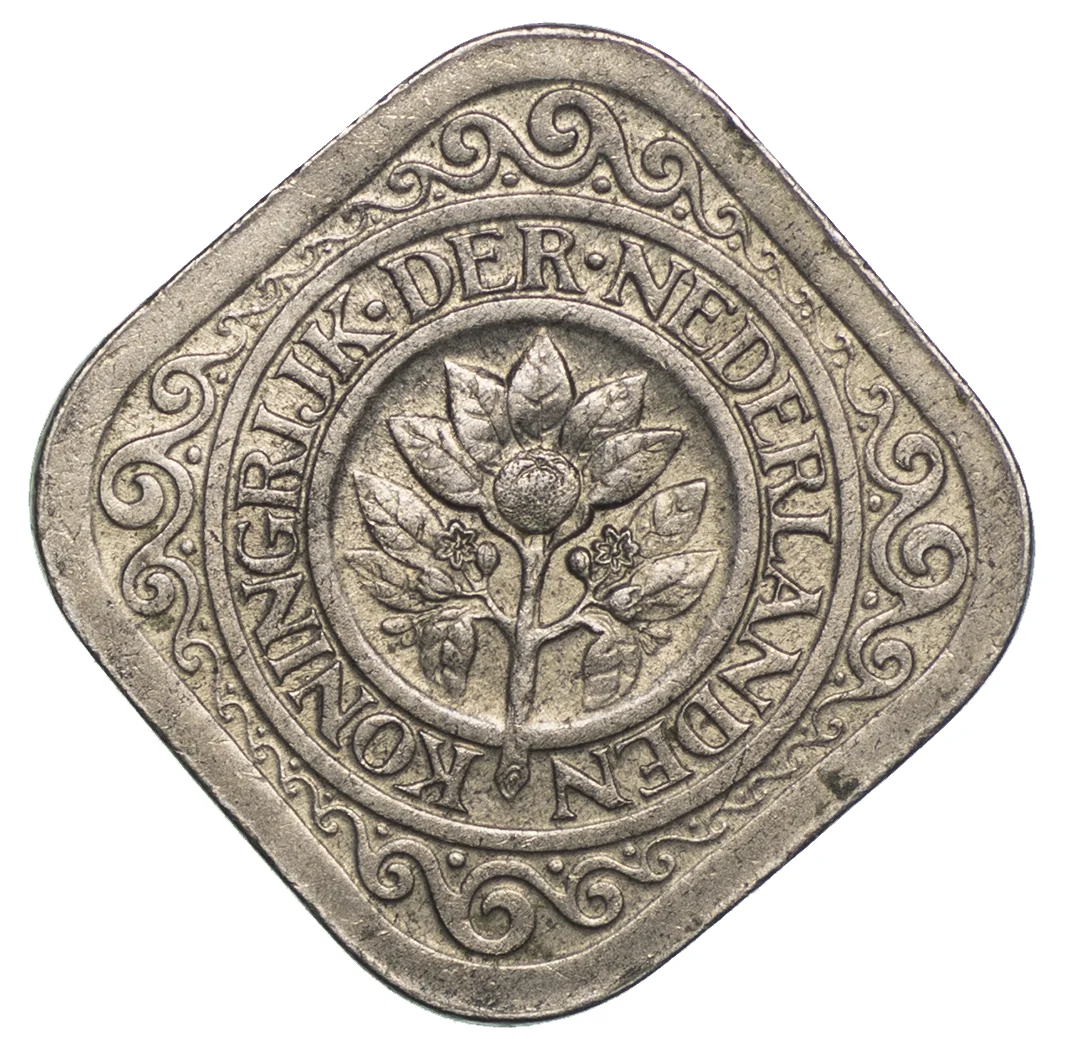
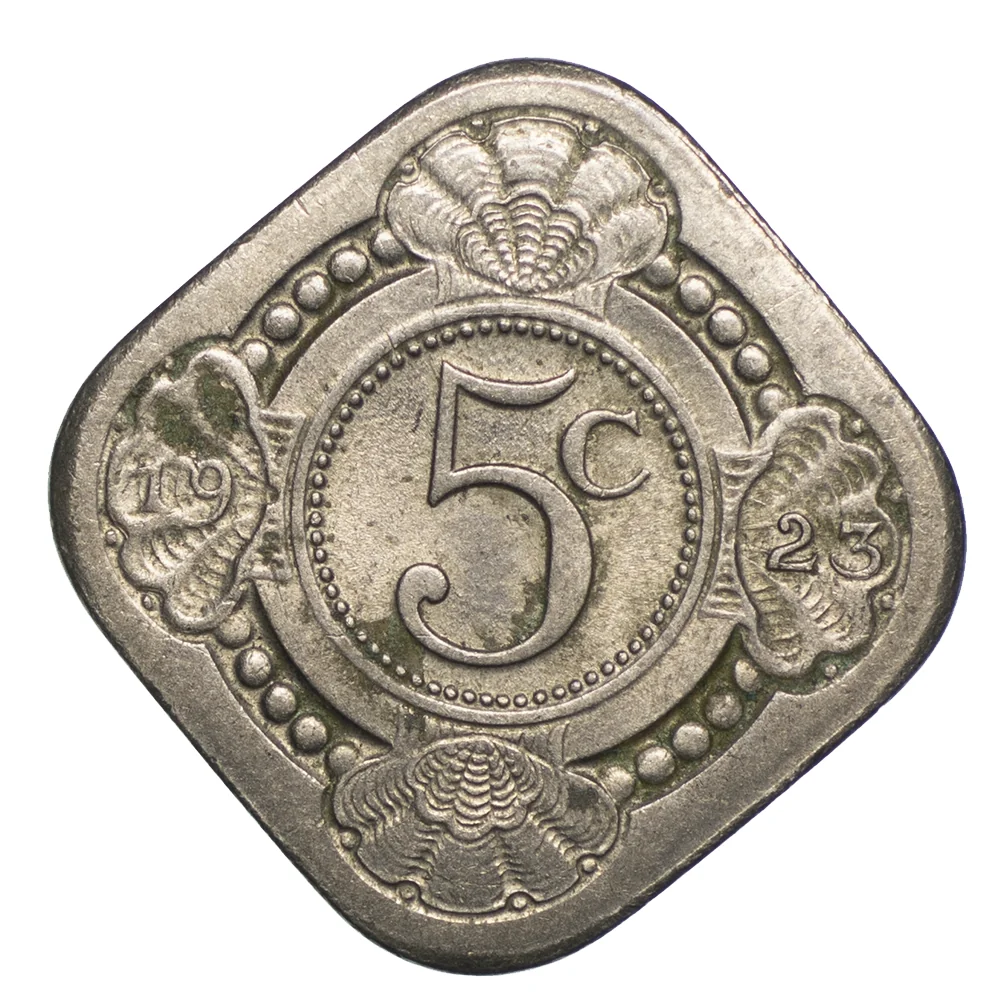
5 cents – Netherlands
Add to wishlist
Netherlands
Context
Years: 1913–1940
Issuer: Netherlands
Ruler: Wilhelmina
Currency:
(1817—2001)
Demonetization: 15 August 1950
Total mintage: 56,000,000
Material
Weight: 4.5 g
Thickness: 1.6 mm
Shape: Square with rounded corners
Technique: Milled
Alignment: Coin alignment
flip
References
KM: #
Numista: #3370
Value
Exchange value: 0.05 NLG
Obverse
Reverse
Edge
Plain
Mints
| Name | Mark |
|---|---|
| Royal Dutch Mint | — |
Mintings
| Year | Mint Mark | Mintage | Quality | Collection |
|---|---|---|---|---|
| 1913 | — | 6,000,000 | ||
| 1914 | — | 7,400,000 | ||
| 1923 | — | 10,000,000 | ||
| 1929 | — | 8,000,000 | ||
| 1932 | — | 2,000,000 | ||
| 1933 | — | 1,400,000 | ||
| 1934 | — | 2,600,000 | ||
| 1936 | — | 2,600,000 | ||
| 1938 | — | 4,200,000 | ||
| 1939 | — | 4,600,000 | ||
| 1940 | — | 7,200,000 |
Historical background
In 1913, the Netherlands operated under the classical gold standard, a system it had adhered to since 1875. This meant the Dutch guilder (gulden) had a fixed value defined in terms of gold, and the central bank, De Nederlandsche Bank, was obligated to exchange banknotes for gold on demand. This system ensured monetary stability, low inflation, and free convertibility with other major gold-backed currencies like the British pound sterling, the US dollar, and the German mark. As a highly trade-dependent nation, this international credibility was crucial for commerce and finance, anchoring the Dutch economy within the global financial order.
However, the stability of this system was under growing, though not yet critical, strain. The years leading up to World War I saw increasing geopolitical tensions in Europe, which caused occasional international financial crises and flows of "hot money" as capital sought safe havens. Domestically, there was a political debate about the role of gold. While the system was widely supported by business and banking elites, socialist and some liberal critics argued that the strict gold standard limited the government's ability to address social issues and constrained credit availability, prioritizing international stability over domestic economic development.
Consequently, on the eve of the Great War, the Dutch guilder was considered one of the world's soundest currencies, a testament to the country's fiscal prudence and prosperous colonial trade. Yet, the system's absolute rigidity was beginning to be questioned. The underlying pressures would soon become catastrophic: within a year, the outbreak of World War I would force the Netherlands—along with nearly all other nations—to suspend gold convertibility, abruptly ending the era of automatic monetary stability that had defined the guilder in 1913.
However, the stability of this system was under growing, though not yet critical, strain. The years leading up to World War I saw increasing geopolitical tensions in Europe, which caused occasional international financial crises and flows of "hot money" as capital sought safe havens. Domestically, there was a political debate about the role of gold. While the system was widely supported by business and banking elites, socialist and some liberal critics argued that the strict gold standard limited the government's ability to address social issues and constrained credit availability, prioritizing international stability over domestic economic development.
Consequently, on the eve of the Great War, the Dutch guilder was considered one of the world's soundest currencies, a testament to the country's fiscal prudence and prosperous colonial trade. Yet, the system's absolute rigidity was beginning to be questioned. The underlying pressures would soon become catastrophic: within a year, the outbreak of World War I would force the Netherlands—along with nearly all other nations—to suspend gold convertibility, abruptly ending the era of automatic monetary stability that had defined the guilder in 1913.
🌱 Very Common