

25 cents – Canada
Add to wishlist
Circulating commemorative coins
Commemoration: The entry into the third millennium series - Achievement
Canada
Context
Material
References
KM: #
Numista: #337
Value
Exchange value: 0.25 CAD
Inflation-adjusted value: 0.44 CAD
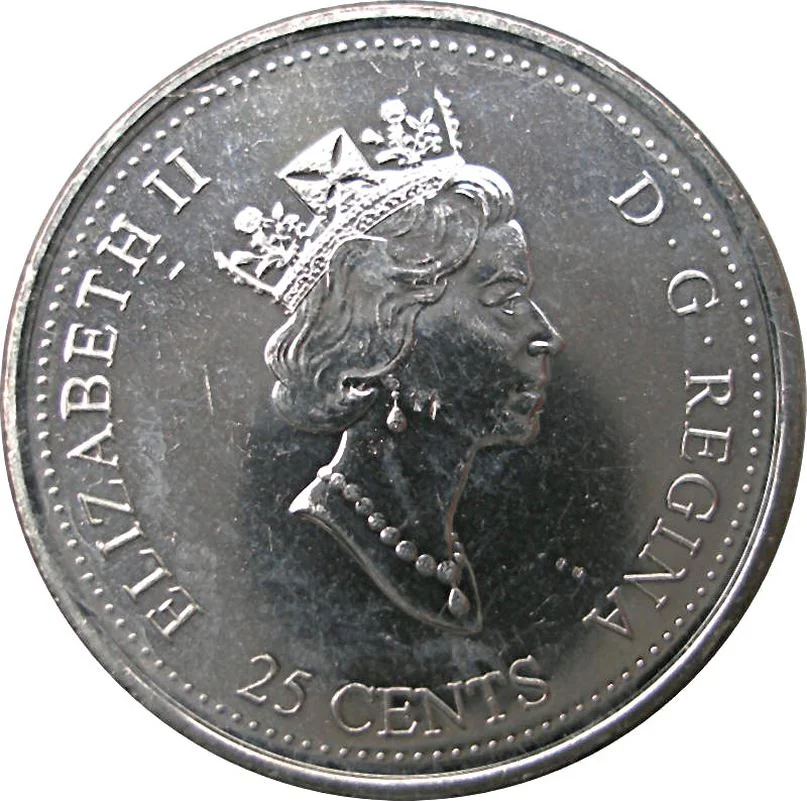
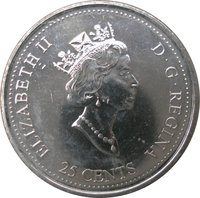
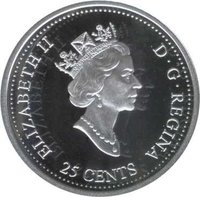
Obverse
Description:
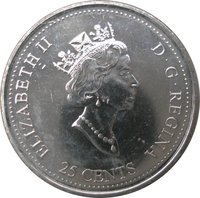
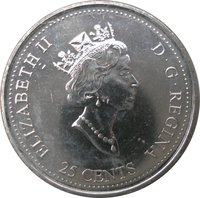
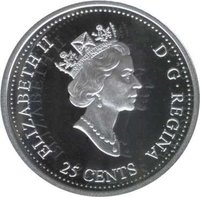
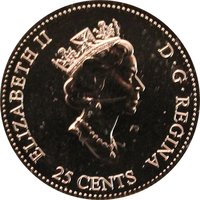
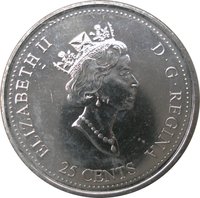
Queen Elizabeth II at 64, wearing the royal diadem and jewels, facing right.
Inscription:
25 CENTS ELIZABETH II D•G•REGINA
Translation:
Twenty-Five Cents Elizabeth II By the Grace of God, Queen
Script: Latin
Engraver: Ago Aarand
Designer: Dora de Pédery-Hunt
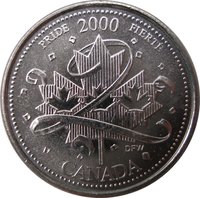
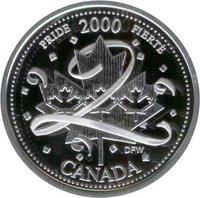
Reverse
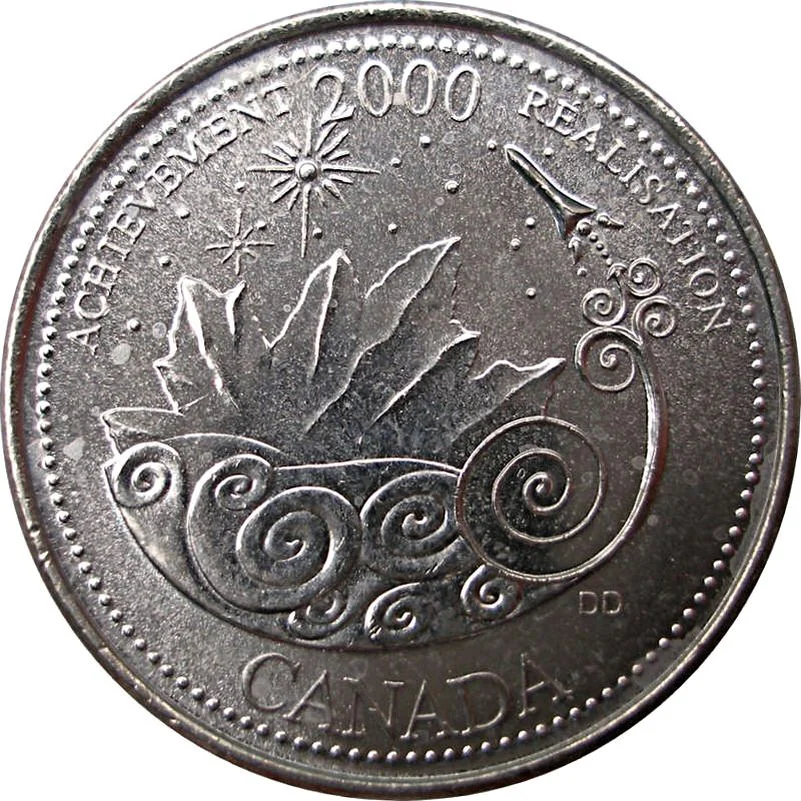
Description:
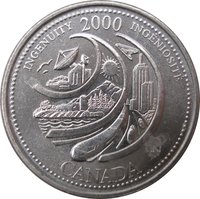
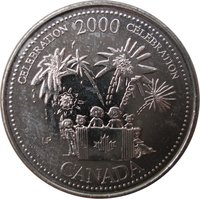
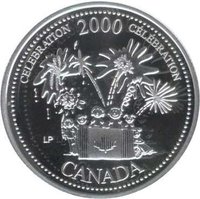
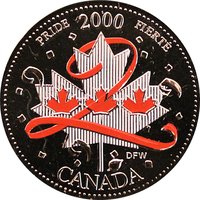
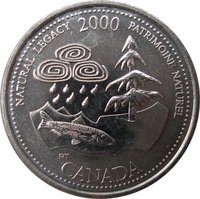
This millennium coin for March 2000 features a space conquest design, surrounded by the bilingual inscriptions "CANADA" and "ACHIEVEMENT 2000 RÉALISATION."
Inscription:
ACHIEVEMENT 2000 RÉALISATION
CANADA
DD
CANADA
DD
Translation:
ACHIEVEMENT 2000 ACHIEVEMENT
CANADA
DD
CANADA
DD
Script: Latin
Designer: Daryl Ann Dorosz
Edge
Reeded
Categories
| Event> Millennium |
Mints
| Name | Mark |
|---|---|
| Royal Canadian Mint of Winnipeg | — |
Mintings
| Year | Mint Mark | Mintage | Quality | Collection |
|---|---|---|---|---|
| 2000 | — | 35,312,750 |
Historical background
In the year 2000, Canada's currency situation was characterized by a period of significant weakness for the Canadian dollar, often colloquially referred to as the "loonie." The currency spent much of the year trading near its all-time historical low against the United States dollar, a trend that had begun in late 1998. By January 2000, the loonie fell to approximately 68.50 US cents, and it remained under intense pressure throughout the year, averaging in the low 67-cent range. This persistent weakness was a major economic and psychological concern, dominating financial headlines and public discourse.
The primary drivers of this weakness were multifaceted. A key factor was the substantial interest rate differential with the United States; the U.S. Federal Reserve had been raising rates to cool an overheating economy, while the Bank of Canada was more cautious, making U.S. dollar-denominated assets more attractive to global investors. Furthermore, Canada's economy was still heavily reliant on commodity exports, particularly oil, which was trading at relatively low prices at the time (around $30 USD per barrel), reducing foreign exchange inflows. A general sentiment of "Canada discount"—concerns about productivity, political uncertainty, and a perception of economic underperformance relative to the booming U.S.—also contributed to the selling pressure on the currency.
Despite the gloom, the latter part of 2000 saw the beginnings of a pivotal shift. The Bank of Canada, under Governor Gordon Thiessen, began a series of aggressive interest rate hikes to combat rising inflation and support the currency, ultimately narrowing the gap with U.S. rates. Concurrently, global commodity prices, especially for energy, started to firm up, foreshadowing the resource-driven boom that would define the subsequent decade. Thus, while 2000 marked a low point for the loonie's value, it also laid the groundwork for its eventual recovery, setting the stage for a dramatic reversal in fortune in the years to follow.
The primary drivers of this weakness were multifaceted. A key factor was the substantial interest rate differential with the United States; the U.S. Federal Reserve had been raising rates to cool an overheating economy, while the Bank of Canada was more cautious, making U.S. dollar-denominated assets more attractive to global investors. Furthermore, Canada's economy was still heavily reliant on commodity exports, particularly oil, which was trading at relatively low prices at the time (around $30 USD per barrel), reducing foreign exchange inflows. A general sentiment of "Canada discount"—concerns about productivity, political uncertainty, and a perception of economic underperformance relative to the booming U.S.—also contributed to the selling pressure on the currency.
Despite the gloom, the latter part of 2000 saw the beginnings of a pivotal shift. The Bank of Canada, under Governor Gordon Thiessen, began a series of aggressive interest rate hikes to combat rising inflation and support the currency, ultimately narrowing the gap with U.S. rates. Concurrently, global commodity prices, especially for energy, started to firm up, foreshadowing the resource-driven boom that would define the subsequent decade. Thus, while 2000 marked a low point for the loonie's value, it also laid the groundwork for its eventual recovery, setting the stage for a dramatic reversal in fortune in the years to follow.
🌱 Very Common