

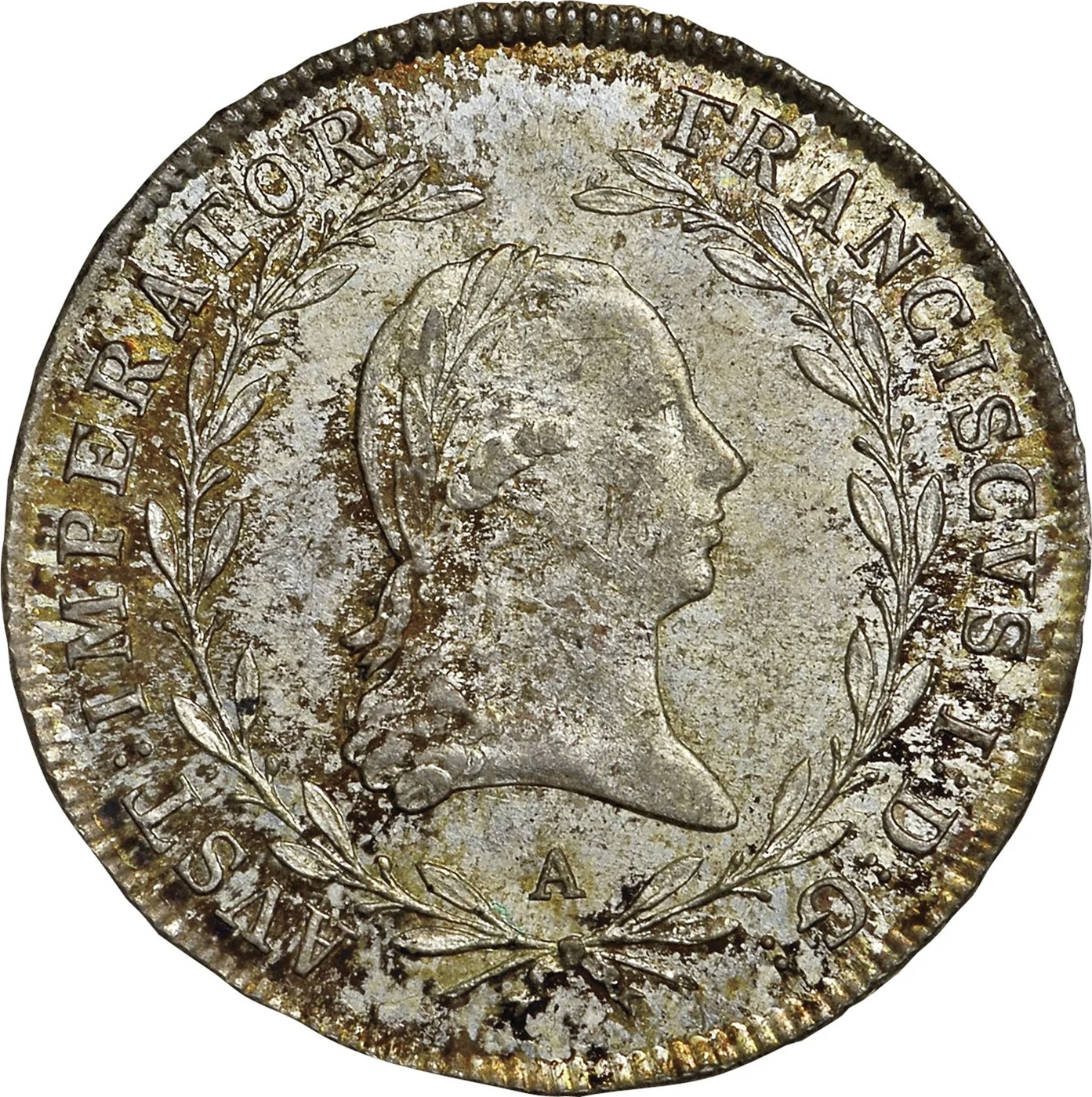
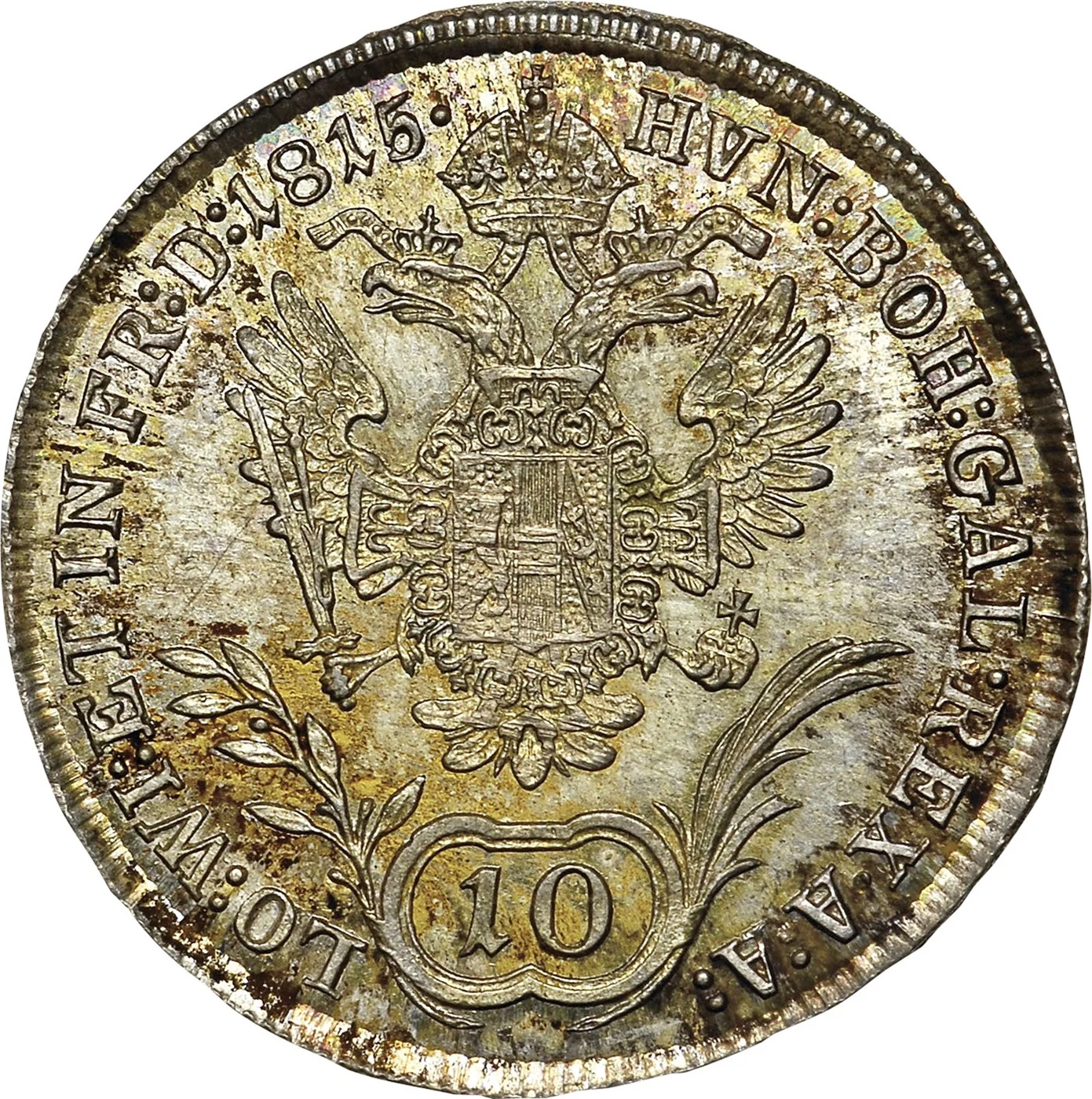
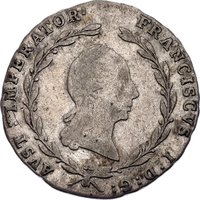
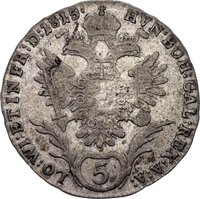
10 kreuzers – Austrian Empire
Add to wishlist
Austria
Context
Years: 1814–1815
Country: Austria
Issuer: Austrian Empire
Ruler: Francis I of Austria
Currency:
(1754—1857)
Demonetized: Yes
Total mintage: 1,800,000
Material
References
KM: #
Numista: #33682
Value
Bullion value: $4.97
Mints
| Name | Mark |
|---|---|
| Münze Österreich | A |
| Kremnica | B |
| Prague | C |
Historical background
In 1814, the Austrian Empire's currency system was a complex and fragile patchwork, a direct legacy of the prolonged Napoleonic Wars. The state treasury was effectively bankrupt, burdened by enormous war debts and the costs of maintaining a large army. To finance these expenditures, the Habsburg monarchy had for years relied heavily on the excessive printing of paper money, known as Bancozettel. This led to severe inflation, a deep loss of public confidence in the paper currency, and a wide gap between its face value and its actual worth in silver.
The monetary landscape was characterized by a chaotic duality. Alongside the depreciated paper Bancozettel, older silver coins (Conventionsthaler and Gulden) remained in circulation but were often hoarded, leading to a shortage of sound coinage. This created a two-tier economy where essential goods and state obligations were often priced in the more stable silver standard, while daily transactions for the populace were conducted in ever-depreciating paper. The result was economic instability, hardship for those on fixed incomes, and a significant obstacle to post-war recovery and trade.
Recognizing the crisis, the government under Emperor Francis I and his minister Count Stadion was already moving toward reform. The urgent task for 1814 was stabilization, setting the stage for the major currency reform that would be enacted in 1816 with the establishment of the Privilegierte Österreichische Nationalbank. The primary goal was to restore confidence by backing the currency with silver reserves and to eventually retire the massive overhang of Bancozettel, a painful but necessary process known as the Staatsbankrott (state bankruptcy) of 1811 that continued to cast a long shadow over the empire's finances.
The monetary landscape was characterized by a chaotic duality. Alongside the depreciated paper Bancozettel, older silver coins (Conventionsthaler and Gulden) remained in circulation but were often hoarded, leading to a shortage of sound coinage. This created a two-tier economy where essential goods and state obligations were often priced in the more stable silver standard, while daily transactions for the populace were conducted in ever-depreciating paper. The result was economic instability, hardship for those on fixed incomes, and a significant obstacle to post-war recovery and trade.
Recognizing the crisis, the government under Emperor Francis I and his minister Count Stadion was already moving toward reform. The urgent task for 1814 was stabilization, setting the stage for the major currency reform that would be enacted in 1816 with the establishment of the Privilegierte Österreichische Nationalbank. The primary goal was to restore confidence by backing the currency with silver reserves and to eventually retire the massive overhang of Bancozettel, a painful but necessary process known as the Staatsbankrott (state bankruptcy) of 1811 that continued to cast a long shadow over the empire's finances.
💎 Very Rare